Southern California
Regional Freight Study
Executive Summary
As part of a process to enrich the national dialogue about freight
transportation issues, needs, and potential program options, the Federal
Highway Administration’s (FHWA) Office of Freight Management and
Operations has undertaken a series of case studies. This report presents
the results of a case study undertaken in Southern California (the Los
Angeles metropolitan area). Southern California is home to the nation’s
largest container port complex, a major air cargo center, a West Coast
rail hub, and numerous regional distribution centers. As the second
largest metropolitan area in the U.S., Southern California also represents
one of the largest local markets for freight services in the country.
The volume and complexity of freight movements in the region are enormous.
The institutional environment for freight planning in Southern California
is also extremely complex. Within this complex region much is being
done to address freight issues. Yet many of the participants in this
case study agree that the challenges the region faces in the future
will require substantial resources and innovative approaches that are
still being developed.
Freight movement in Southern California consists of three major markets:
1) regional and local distribution, 2) domestic trade and national distribution,
and 3) international trade. Southern California provides a huge internal
market for goods and services. Based on the Freight Analysis Framework,
FHWA estimated that over 223 million tons of freight were shipped internally
within the Southern California region – approximately 30 percent
of the total freight shipped in the region. Southern California is
also one of the leading manufacturing centers in the nation, generating
shipments for domestic trade with the rest of the U.S. The six-county
region ranks fourth in the nation, behind only California, Ohio, and
Texas, in total manufacturing jobs. Shipments between Southern California
and the rest of the country account for 447 million tons, or over 60
percent of freight shipped in the region. Southern California is also
a large gateway for international trade. Over 11 percent of the
nation’s trade (by value) passes through the region and it collects
over 37 percent of the nation’s import duties.
In order to meet its freight transportation needs, the Southern California
transportation network has developed and invested in international gateway
facilities (such as the Ports of Los Angeles and Long Beach and the
international airports of Los Angeles and Ontario), interstate multi-modal
corridors (including several major interstate highways and the transcontinental
rail lines operated by the Union Pacific and Burlington Northern Santa
Fe railroads), and a vast metropolitan roadway system.
As Southern California grapples with its freight transportation needs,
it plans within the context of a number of major regional issues. These
include:
- Growth – Southern California continues to be
a major population and employment growth region, fueling demand for
freight transportation services. According to the Southern California
Association of Governments, freight transportation demand is expected
to grow by 80 percent between 1995 and 2020.
- Congestion – Southern California has some of the
most congested highway, rail, and airport facilities in the country.
This creates substantial delays for all users of the transportation
system and imposes costs on goods shipped through the regional freight
transportation system.
- Air Quality – Much of Southern California is within
severe non-attainment areas for national air quality standards. Any
new system capacity must justify that it will not negatively change
air quality, which may serve as major constraint to growth in the
freight transportation system.
- Security – In the aftermath of the events of September
11th, increasing attention is being paid to freight transportation
security, especially at international ports of entry.
- Safety – Provision of a safe transportation system
is a major goal of regional planning. However, the interaction of
passenger and freight transportation creates significant safety concerns,
especially on high truck volume freeways and at rail-highway crossings.
- Land Use – High land costs in the developed areas
surrounding ports, airports, intermodal terminals, and truck terminals
have forced the freight transportation industry to look to outlying
areas for facility growth. This coupled with the region’s sprawling
development patterns has caused regional freight distribution patterns
that emphasize peak period congestion and high levels of freight vehicle-miles
traveled.
- Regional Governance and Institutional Complexity –
Southern California includes four district offices of the state
department of transportation, 14 subregional councils of government,
six county transportation commissions that program transportation
funds, and 184 cities. Needless to say, this is an extremely difficult
environment within which to plan for freight transportation systems
that transcend multiple jurisdictional boundaries within the region.
Despite these challenges, the region has enjoyed numerous successes
in addressing freight transportation needs. Successes have included
both major capital projects as well as planning process/institutional
relationships. Perhaps the best known of these successes is the Alameda
Corridor, which brought together cities, ports, and railroads in a unique
public-private partnership of epic proportions. Lesser known, but equally
important, successes are present throughout the region.
The experiences of Southern California illustrate a number of themes
that should be the focus of freight policy discussions throughout the
nation. These fall into two broad categories: funding/financing and
institutional/planning process.
Funding/Financing
- Adequacy of Resources – Southern California has
enormous transportation funding needs, but freight transportation
projects will need to compete with all other projects for local funding
resources. Freight projects, particularly international gateway projects,
tend to be expensive and their local benefits are considered to be
relatively low when compared to development costs. With a transportation
programming process that largely focuses locally, broad freight projects
will continue to face an uphill battle for funding. This suggests
that major gateway and mutli-modal interstate corridor projects will
need to include partnerships with state and federal agencies, find
new revenue sources that are increasingly user-fee oriented, and look
for greater flexibility in use of federal surface transportation funds
in the next reauthorization.
- Burden Sharing and Fairness: The Distribution of Costs and Benefits –
Southern California maintains freight transportation facilities
that have regional, statewide, and national significance. The benefits
of these facilities are felt throughout the U.S., but the transportation
effects of these facilities are greatest at the local level. The
question of who pays and who benefits from improvements in these facilities
requires national attention and may imply a need for new federal and
state funding programs, i.e., local users bear the cost for dispersed
national benefits.
- Innovative Financing and User Fees – Given the
enormous transportation funding needs in Southern California and the
benefits of freight transportation projects to the private sector,
it is not surprising that planners will look to user fees as a source
of financing for freight transportation improvements. The Alameda
Corridor is one of the most often cited examples of how user fees
can play a critical role in financing major freight projects. But
not all freight projects in Southern California will be able to rely
on user fee financing. Initial evaluations of tolling options for
truck lanes in Southern California show that they may not produce
sufficient revenues to support project financing. Beneficiaries of
freight improvements, particularly on highways, include non-freight
interests and they need to pay their share of costs. In addition,
user fees may reduce the competitive position of regional freight
facilities as compared to ports and intermodal facilities elsewhere
in the U.S.
- Public Investment in Private Freight System – While
a substantial volume of freight is moved on public highway systems,
there is increasing interest in expanding the role of private systems,
such as using railroads or barge activities to alleviate highway congestion.
The Metrolink project in Southern California is a good example of
how public passenger rail projects can be used to benefit rail freight
capacity needs. But the limited flexibility of existing funding sources
and the difficulties associated with justifying public investment
in private systems are obstacles that will need to be addressed in
the future.
Institutional/Planning Process
- Regional Coordination and Decision-Making – Freight
projects do not respect jurisdictional boundaries. Thus, freight
projects tend to require the coordination of numerous local and regional
agencies. In an area as complex as Southern California this creates
an extremely complex planning process for freight projects. In addition,
achieving multi-jurisdictional consensus on regional freight priorities
is very difficult. New institutions are needed to address these multi-jurisdictional
issues. The joint powers agency created for the Alameda Corridor
is an example of one type of institution used to create cooperative
working arrangements. Other forums like the regional Goods Movement
Advisory Committee, that brings different governmental agencies together
to develop a consensus regarding planning objectives, are also important.
- Public-Private Collaboration – Freight planning
requires the coordination of public and private sector interests.
Yet public agencies plan on a long-term (20-25 years) basis, while
private agencies plan on a much more immediate basis. For private
businesses that must devote as much of their resources as possible
to revenue generating activities, the public sector planning process
is complex and cumbersome. There is also a longstanding mistrust
between public and private sectors in the freight industry due to
concerns regarding regulatory relationships. The region needs standing
institutions to bring public and private sector freight organizations
together to tackle the short term and long term needs of the freight
transportation system.
- Private-Private Collaboration – In Southern California,
there is tremendous potential for resolving freight transportation
issues through operational strategies. These include making better
use of existing capacity through more coordinated time of day operations.
But to affect this change, private companies who are fiercely competitive
must work together, and recognize that the public sector clearly has
a role to play in facilitating this cooperation. Removing regulatory
obstacles (such as night-time operating restrictions) and providing
economic inducements (such as congestion fees charged at terminal
gates for peak period operations) are potential alternatives that
could be explored.
- Public Awareness – Citizen groups often line up
against freight interests in the local planning process. This has
been an issue for air cargo and port access projects in Southern California.
Yet freight transportation demands are derivative of the public’s
demand for goods and service. Much needs to be done to educate the
public as to the benefits of efficient goods movement.
- Data Modeling and Tools – Critical decisions about
freight transportation face local agencies in Southern California
and these agencies have taken major steps to develop the tools necessary
to evaluate alternative transportation investments and policies.
Yet many of these tools rest on flimsy methodologies and insufficient
data. Information about freight movement in a metropolitan area is
difficult to obtain due to the proprietary nature of much of these
data. The Federal government can play a role in developing techniques
and data for local freight planning that would assist in local decision-making.
- Coordination of ITS – ITS presents tremendous
potential for improving the efficiency of goods movement. However,
for this potential to be realized it will require a greater level
of cooperation and interface between public and private information
systems. ITS intermodal demonstrations at the Port of Long Beach
are beginning to tackle the problem of how to bring these public and
private information systems together to produce good traveler and
traffic management information. Building on this program and other
ITS projects in other parts of the region would be beneficial.
1. Case Study Introduction
The Federal Highway Administration’s (FHWA) Office of Freight
Management and Operations invited stakeholders from five areas across
the country to examine how different regions are addressing freight
transportation needs. These case studies were selected to illustrate
different types of freight activity, institutional complexity, and approaches
to problem solving. Together, these case studies help tell the national
“freight story.”
Southern California (the Greater Los Angeles Metropolitan region) presents
a particularly informative example. The region is home to the nation’s
largest container port complex, a major air cargo center, a West Coast
rail hub, and numerous regional distribution centers. As the second
largest metropolitan area in the U.S., Southern California also represents
one of the largest local markets for freight services in the country.
The volume and complexity of freight movements in the region are enormous.
The institutional environment for freight planning in Southern California
is also extremely complex. Within the region much is being done to
address freight issues. Yet most agree that the challenges the region
faces in the future will require substantial resources and innovative
approaches that are still being developed.
This report summarizes the results of a case study conducted by major
freight transportation stakeholders in Southern California.[1]
The report begins with a brief description of the characteristics of
freight movement and the freight transportation network in Southern
California. Freight transportation in the region serves three distinct
markets: international trade, domestic trade, and regional/local distribution.
To serve these markets, the regional freight transportation network
consists of three types of facilities playing the roles of international
gateways, elements of a statewide/multi-state transport network, and
a system of local roads and connector facilities that aid in local and
regional distribution systems.
After describing Southern California freight transportation, the report
describes some of the critical factors and issues that influence freight
transportation planning and management in the region. These issues
include regional economic/population growth, congestion on transportation
facilities, air quality concerns, land use issues/conflicts, and regional
governance and institutional complexity.
Southern California has often succeeded in addressing freight transportation
needs within this context of regional issues and concerns. The report
provides some examples of how the region has dealt with its diverse
freight transportation needs. Examples of capital project successes,
institutional/planning successes, and funding/resource successes are
also examined.
The remainder of the report describes lessons learned from the region’s
experience and describes challenges for the future. These can be broadly
categorized as institutional/planning process-related or funding/resource-related.
The analysis suggests areas where various freight transportation partners
in private sector, regional and local government agencies, state government
agencies, and the federal government will need to work together to shape
the region’s future freight transportation system. An analysis
of the challenges related to many topics, including funding/financing,
regional coordination and decision-making, institutional partnerships,
public awareness of freight issues, development of data and analytical
tools, and implementation and coordination of information technology
and intelligent transportation systems (ITS), is also discussed.
While the region has undertaken a number of freight movement studies
(including an interregional goods movement study, a number of subregional
goods movement reports, and numerous analyses of corridors and specific
freight-related projects), this case study provided a unique opportunity
to take a big picture look at regional freight issues. By examining
not only how regional freight issues manifest themselves within the
broader regional transportation picture, but also where past efforts
have resulted in successful programs and projects, and finally where
challenges remain, local stakeholders have been able to discuss the
region’s freight future from a new perspective.
2. An Overview of Existing Freight Movement Patterns in Southern
California
Southern California – the counties of Los Angeles, Orange,
Riverside, San Bernardino, Imperial, and Ventura that comprise the metropolitan
planning organization (MPO) region of the Southern California Association
of Governments (SCAG) – is the second largest metropolitan
region in the United States. The population in the region is over 16.5 million
people, up two million from 1990, according to census reports. In addition,
the Southern California economy generates over seven million jobs, mostly
in the trade and transportation, manufacturing, and tourism industries.
Freight Movement in Southern California
Freight movement in Southern California consists of three major and
distinct freight markets:
- regional and local distribution,
- domestic trade and national distribution, and
- international trade.
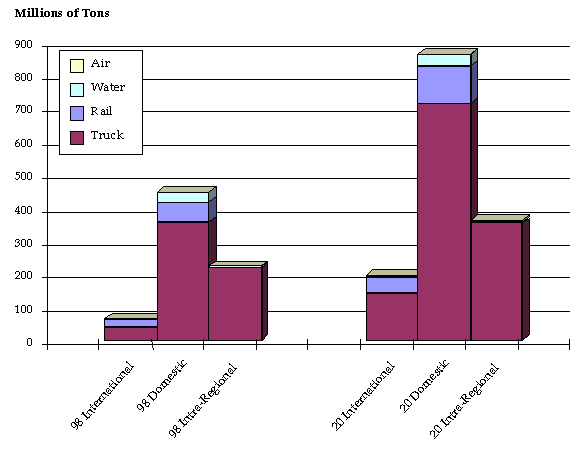
Figure 2.1 provides some perspective on the magnitude of each
of these components of the regional freight movement picture and how
this is projected to change in the future. This figure shows the amount
of tonnage carried by each freight mode in each of the three market
segments in 1998 and forecasted for 2020. The data for international
trade shows the mode used to move these cargoes to/from their domestic
markets through Southern California gateways, not necessarily the mode
used to carry the product into or out of the United States. In 1998,
over 735 million tons of freight moved into, out of, and within Southern
California (FHWA Freight Analysis Framework Database, 2002). Key features
of Southern California freight markets are summarized below.
Regional and Local Distribution
- The enormous population and economic base creates a massive internal
market for local/regional distribution and creates a critical mass
of freight transportation facilities.
- Over 30 percent of the freight tonnage moved in Southern California
remained within the six county region (see Figure 2.1)
- The region is home to 32,538 wholesale trade establishments and
7,345 trucking firms.
- The region ranks second among U.S. metropolitan areas for wholesale
trade employment and sixth in wholesale trade share of total employment.
Figure 2.1 Freight in the SCAG Region (Millions
of Tons)
Source: Federal Highway Administration, Office of Freight Management
and Operations, Freight Analysis Framework.
Domestic Trade and National Distribution
- The Los Angeles MSA is one of the leading manufacturing centers
in the country, shipping $20 billion in manufactured goods and providing
roughly one million manufacturing jobs in 1997 (more than the entire
state of Michigan).
- The six county region ranks fourth in total manufacturing jobs behind
the entire state of California, Ohio, and Texas.
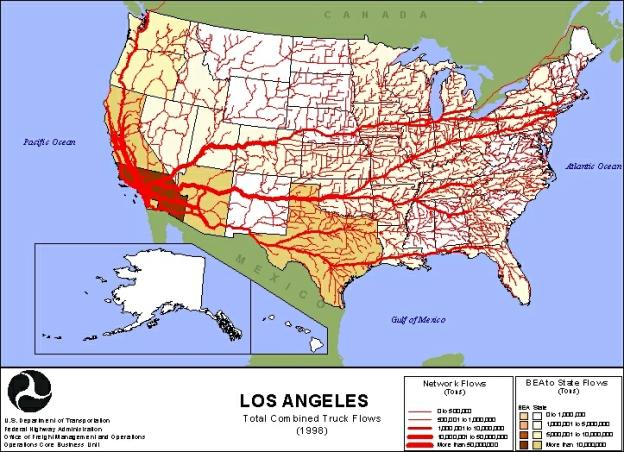
- Figure 2.2 illustrates commodity flows between Southern California
and its local, regional and national markets. The map was developed
in the Freight Analysis Framework, and shows the movement of freight
that has either an origin or destination within the Southern California
area. (Freight shipments that travel the area but do not actually
have an origin or destination within the region are not represented.)
This illustrates the importance of both domestic and international
trade shipments between Southern California and the rest of the U.S.
and the need for effective transportation networks to link the region's
economy to the rest of the United States.
Figure 2.2 Los Angeles Total Truck Flows (1998)
International Trade
- According to the Los Angeles County Economic Development Corporation,
$230 billion of international trade cargoes moved through the region’s
ports of entry in 2000. This accounted for over 11 percent of
the nation’s international trade and generated 37 percent of
all import duties.
- International trade accounted for approximately 9 percent of the
total tonnage moved into and out of Southern California in 1998 (see
Figure 2.1).
- International trade is the fastest growing segment of the Southern
California freight picture, with expected growth to 14 percent of
total tonnage moved in the region by 2020 (see Figure 2.1).
The Freight Transportation Network in Southern California
In order to support its freight transportation markets, Southern California
has developed an extensive infrastructure of international gateway facilities,
interstate multimodal corridors, and a metropolitan roadway and distribution
network.
International Gateways
Southern California has made substantial investments in infrastructure
to service international trade through its airports and maritime ports.
The region is a major air cargo center, home to two international and
six commercial airports. Most of the region’s air cargo moves
through Los Angeles International Airport (LAX), making it the third
busiest air cargo facility in the world. Air cargo is critical for
many manufacturing operations both in the U.S. and abroad, and the high-value
cargo typically shipped by air explains why LAX handles more exports
by dollar value ($36.5 billion in 1997) than the nearby Ports of
Long Beach and Los Angeles ($35.2 billion).
Southern California is home to three international deepwater port facilities
that comprise the Los Angeles Customs Region. The Ports of Los Angeles
and Long Beach, respectively the first and second largest container
port facilities in the United States, together form the third largest
container port complex in the world. Their share of West Coast container
cargo is an astounding 50 percent and growing, and they handle
35 percent of all waterborne cargo in the U.S. The Port of Hueneme,
the only deepwater harbor between Los Angeles and the San Francisco
Bay Area, has developed to serve a core niche. It is the top seaport
in the United States for citrus exports and ranks among the top 10 ports
in the country for imports of automobiles and bananas.
Interstate Multimodal Corridors
An extensive network of multimodal facilities has developed in order
to link the large cargo volumes of both domestic and international trade
moving between Southern California and the rest of the country. The
regional air cargo system also serves the domestic trade system. Southern
California is a major rail hub with both Western Class I railroads
operating on mainlines that connect the region to the national rail
network. The region includes six rail-truck intermodal facilities,
including Burlington Northern Santa Fe’s (BNSF) Hobart Intermodal
Facility, the busiest in the U.S. (handling over 90,000 lifts per month).
There are three major interstate highway corridors in the region: I-5
(providing linkages to the rest of the West Coast of the U.S., Canada,
and Mexico); I-15/I-40 (providing links to the interior U.S.); and I-10
(the “Southwest Passage” to the rest of the Sun Belt).
Each of these interstates ranks among the highest truck volume corridors
in the Western U.S.
Metropolitan Roadway System
Southern California is famous for its freeway system, which functions
as the backbone for the extensive local distribution network that serves
the regional economy. As of 1997, Southern California was home to 8,906
miles of freeways; 14,998 miles of principal arterials; 17,605 miles
of minor arterials; and 8,262 miles of major collectors. This system
includes critical access routes to the ports, airports, and rail intermodal
facilities.
3. Regional Concerns that Influence Freight Planning and Management
in Southern California
Freight transportation has helped facilitate the enormous economic
success Southern California has enjoyed throughout its history. Looking
to the future, this metropolitan area must determine how it will balance
the needs of a growing economy and population with an increasingly constrained
transportation system. Decision-makers at the state and local level
are beginning to craft innovative strategies for addressing freight
transportation needs, with an initial focus on trade gateways and corridors
of statewide and regional significance. An example of these innovative
approaches is the Global Gateways Development Program (SCR 96, Karnette),
a state program that calls on the state’s Department of Transportation
(Caltrans) to develop strategies and funding programs to improve those
key transportation facilities that provide access to trade gateways.
In its report to the legislature as mandated by SCR 96, Caltrans identified
a number of issues that will influence freight transportation priorities
in California in the future. Most of these issues will also drive freight
transportation planning in Southern California.
Growth heads the list of regional issues that will face freight transportation
planners in the future. The question for Southern California is how
to accommodate economic and transportation growth in the context of
heavily congested transportation facilities, regulatory constraints
posed by the region’s air quality non-attainment status, increasing
concerns about transportation safety and security, growing land use
conflicts and constraints, and the complexity of regional governance
and institutional relationships.
Growth
Fueled by the continuing economic growth of the region and the increasing
importance of international trade in the national economy, goods movement
traffic in Southern California by all modes is projected to increase
by over 80 percent between 1995 and 2020, according to studies
conducted for SCAG. More recent freight forecasts by the FHWA project
that domestic freight flows in Southern California will grow at a higher
rate than the national growth rate (83 percent growth in Southern
California between 1998 and 2020 as compared to 71 percent growth nationally).
International freight traffic in Southern California is projected to
grow at a substantially higher rate than international freight will
grow for the nation as a whole (170 percent growth in Southern
California between 1998 and 2020 as compared to 98.7 percent growth
in the rest of the nation).
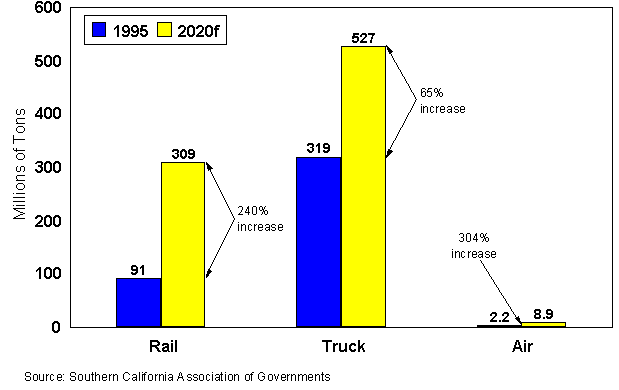
Figure 3.1 illustrates the growth in freight tonnage by mode projected
by SCAG. The Regional Transportation Plan (RTP) forecasts over 65 percent
increase in regional heavy-duty truck traffic by 2020. SCAG studies
project rail tonnage in Southern California to increase by more than
240 percent between 1995 and 2020, due in large part to international
trade growth and connections to the Ports of Los Angeles and Long Beach.
Air cargo is expected to be the fastest growing component of the regional
goods movement picture, with growth of over 300 percent in tonnage projected
by SCAG between 1995 and 2020. Other studies forecast the strong growth
in marine cargoes will continue into the future. Port projections show
increases to between 25 million and 36.1 million 20-foot equivalent
units (TEUs) by 2025 from current levels of 9.5 million TEUs.
Figure 3.1 Freight Forecasts by Mode: 1995-2020
Population growth will exacerbate trends in congestion and land use
competition, while creating an even larger internal market. The six-county
Southern California region will add more than five million people –
twice the population of Chicago – over the next 20 years.
Ultimately, additional freight growth will also be driven by demand
from this growing population.
Congestion - Highway and Facility Based
Congestion is a critical problem in Southern California. According
to the American Society of Civil Engineers’ 2001 Report Card for
America’s Infrastructure, Los Angeles highways create 82 person-hours
of delay per capita annually, the highest in the country. This report
also shows that Los Angeles has four of the 10 most congested highway
locations in the U.S. The I-405 at the I-10 interchange, U.S. 101
at the I-405 interchange, State Route 55 at the State Route 22
Interchange, and the I-10 at the I-5 interchange each average 10 minutes
of delay per vehicle per trip during peak hours. The contribution of
trucks to regional congestion is forecast to increase as truck vehicle
miles of travel (VMT) increase from 38 million miles in 2000 to 50 million
miles in 2010, according to estimates by the California Air Resources
Board (ARB), a higher rate of growth than is being experienced by automobile
traffic.
There remains a perception that trucks are significant contributors
to congestion due to their disproportionate use of roadway capacity,
but trucks are also influenced by congestion, and the resultant costs
eventually affect all consumers. Congestion leads to longer travel
times per trip, which in turn means that truck drivers will make fewer
pickups and deliveries during a day. Therefore, either the cost of
goods will increase or drivers’ income will decrease. Spreading
of the peak period exacerbates the congestion problem by making it more
difficult for truckers to squeeze their activities into narrowing windows
of low traffic volumes during off-peak hours.
Incident-based congestion creates unreliability in the transportation
system. Unreliable transportation systems cause travel times to become
unstable, preventing shippers, carriers, and logistics providers from
being able to precisely schedule shipments. This can cause a ripple
effect throughout the supply chain as inefficient inventory levels and
labor utilization increase the cost to deliver goods to the final customer.
Highway congestion also affects the operations of other transportation
facilities. Air cargo facilities rely on trucks to feed shipments to
the airport and to deliver goods to their final destination. Intermodal
rail facilities primarily utilize trucks to connect the rail system
to its customers and with other modes such as the ports. The largest
intermodal facility, the BNSF Hobart Yard in downtown Los Angeles, is
within 20 miles of four of the worst interchanges in the country (I-405
at I-10 interchange, U.S. 101 at I-405 interchange, State Route 55 at
State Route 22 interchange, and I-10 at I-5 interchange) [2].
I-710, the major access route to the Ports of Los Angeles/Long Beach,
experiences an average of five accidents, and the resultant delays,
everyday.
In addition to congestion on the highways, air, rail, and port facilities
in Southern California also face significant internal capacity constraints.
For example, airport and air traffic congestion is influencing the reliability
of airfreight operations. In 1999, the Federal Aviation Administration
reported that about 28 percent of departures (including freight and
passenger flights) at LAX were delayed because of air traffic volumes.
To accommodate future demand, the region must balance between expanding
the 6.1 million square feet of dedicated cargo space in the LAX
local area (over two million of which are on LAX property) and expanding
air cargo facilities at other local airports. The traffic volumes at
intermodal facilities serving both the ports and railyards in Southern
California are also projected to exceed capacity over the next 20 years.
Increased delays at terminals gates and within the terminals themselves,
coupled with increased passenger traffic demands to move freight into
and from these facilities, has led to additional concerns over the region's
ability to handle future freight movements.
Air Quality
Air quality management is another significant issue facing transportation
planners in Southern California. The region includes all or part of
seven different air quality non-attainment or maintenance areas in five
air basins. The South Coast Air Basin is a severe non-attainment area
and the need to demonstrate transportation plan conformity can constrain
capacity expansion.
Marine, rail, and truck modes predominantly use diesel fuels, which
are major sources of oxides of nitrogen (NOx – an ozone precursor)
and the primary mobile source of particulate matter. With the successes
of the past 30 years in the control of emissions from light-duty
on-road vehicles, emissions from freight modes are coming under increasing
scrutiny. However, the share of total mobile source NOx emissions in
the South Coast Air Basin attributable to trucks is expected to increase
from 44 percent to 53 percent between 2000 and 2010, even
with the adoption of new truck emission standards.
In California, trucks will face increasingly stringent emission standards
and requirements for cleaner burning diesel fuels. These requirements
will add costs to freight transportation. Historically, California
established its own emission and fuel standards, a difficult posture
given that many trucks operate in interstate commerce. Competitive
effects on the California trucking industry have long been an issue
of contention between the California Trucking Association and the California
Air Resources Board, which, with the U.S. Environmental Protection Agency
(EPA), regulates truck emissions and diesel fuel specifications. Regulation
of off-road mobile sources of pollution, including locomotive and steamship
emissions, have also periodically involved contentious relationships
among the carrier community, the California Air Resources Board, and
regional air quality management agencies.
Security
In the aftermath of the terrorist attacks on September 11, 2001,
transportation security has become a priority. The Coast Guard has
dramatically stepped up its harbor patrols and monitoring efforts. The
California Highway Patrol completed a re-certification of the 1,000 companies
licensed to carry hazardous materials in the Southern California region,
although current inspection processes are costly and time consuming.
Containers must be selected (often at random), stopped, opened, sifted,
and approved to continue moving towards their final destination. Increasing
the amount of inspection introduces significant additional costs to
goods movement.
Air cargo facilities have a unique security issue, because passengers
and freight are often mixed aboard the same aircraft with cargo being
carried in the belly of commercial airlines. Screening of cargo is
likely to undergo increased scrutiny in line with the procedures that
have been enacted for air passengers and their baggage. Potential future
actions range from increasing the percentage of cargo security checks,
to improving the cargo screening equipment, to mandating that cargo
use dedicated air freighters only. The latter solution would dramatically
increase the cost for both air cargo and air passengers. In Southern
California, implementation of increased inspection processes will be
particularly difficult due to the high percentage of international freight
moving through airport facilities.
Safety
Provision of a safe transportation system is one of the key goals of
regional transportation planning in Southern California. However, the
interaction of passenger transportation and freight transportation on
the regional roadway system and at road-railroad crossings creates significant
safety concerns. Many accidents result from outdated highway designs
that do not reflect current vehicle size, vehicle performance, or driving
habits. The lack of proper median or narrow shoulders of highways has
also increased accident risk. Overloading or improper loading of vehicles
also creates safety concerns. Truck-involved accidents have a higher
incidence of fatality, property damage, and economic loss compared to
other types of accidents. Truck-involved accidents also generate traffic
congestion, because truck related incidents generally involve a larger
number of lanes blocked or closed. Records show that, in Southern California
during the five-year period from 1992 to 1997, there were over 27,000
truck-related accidents with 10,200 accidents involving injuries, 232
accidents involving fatalities, and over 20,000 accidents involving
property damage. Safety issues are more critical on the corridors with
heavy volumes of truck traffic. For example, in 2000, on a 27-mile
stretch of the I-710 Freeway, trucks were involved in over 31 percent
of its 2,250 reported accidents. The trucks were found to be at
fault in roughly half of the accidents.
Rail accidents are also a major concern in the region, especially at
rail-roadway crossings. Fatalities related to railroad traffic have
declined by two-thirds since 1960 as the result of improvements in rail
crossing technology, better education, and improvements to rail infrastructure.
Nevertheless, between 1997 and 2000, the California Highway Patrol counted
over 40 deaths and 345 injuries due to rail crossing accidents. Hundreds
of millions of dollars are spent in the region to separate the rail
and road infrastructure in an effort to reduce the safety risk of accidents
at highway-rail crossings.
Land Use
While the older metropolitan areas of the East and industrial Midwest
are grappling with freight access problems in mature, built-out, high-density
urban cores, Southern California faces its own unique land use-related
problems. The metropolitan area is famous for its sprawling development
and high-priced real estate. This development pattern has had significant
consequences for freight facilities in the region. Ports, airports,
intermodal terminals, and truck terminals frequently abut built-out
industrial, residential, and commercial areas, creating land-use conflicts
and limiting the ability to expand existing facilities. Attempts to
expand the LAX airport are fiercely opposed by residents in neighboring
communities, while residents of communities along the I-710 access routes
to the San Pedro Bay ports complain of environmental justice violations
associated with heavy truck traffic. Truck operators face increasing
parking and traffic route restrictions in cities throughout Southern
California.
Distribution centers utilize cheap suburban land to relocate and expand
their facilities. Housing developers are building in the same areas
to provide homes to the region’s growing population. Over time,
the pattern experienced in today’s developed sections of the metropolitan
area will be repeated. Community pressure will mount for the distribution
centers to relocate and expand further out of the region. One long-term
outcome may be more dispersed distribution centers and longer truck
trips, leading to an increase in local and regional congestion and emissions.
Regional Governance and Institutional Complexity
Transportation planning and programming in Southern California are
conducted in one of the most institutionally complex settings of any
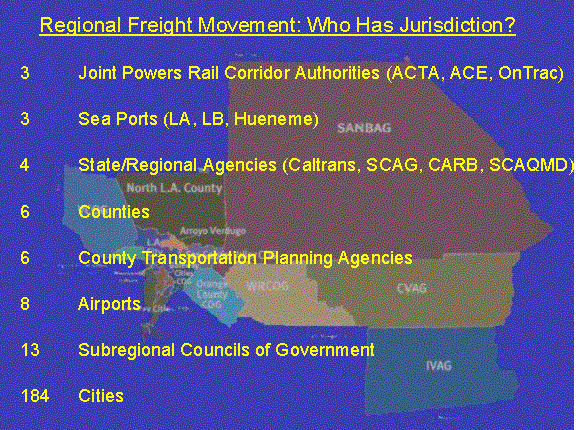
region in the country. Figure 3.2 lists some of the many organizations
that are involved in regional transportation planning. Four different
district offices of the California Department of Transportation (Caltrans)
are responsible for planning, design, construction, maintenance, and
operation of the region’s state highways. SCAG, the regional
MPO, develops the Regional Transportation Plan (RTP) and provides funding
for numerous regional transportation studies. There are six county
transportation commissions/authorities (CTCs) that are responsible for
programming and funding the transportation projects in Southern California.
There are 14 subregions, represented by councils of government and subregional
planning agencies that work with SCAG and the CTCs to conduct transportation
planning throughout the region. At the base of this pyramid of regional
transportation agencies are 184 cities that have critical roles
in permitting roadway construction projects and operating and maintaining
much of the regional roadway network.
Figure 3.2 Organizations Involved in the Regional Transportation
Planning
There are a host of other governmental agencies involved in regional
transportation issues. These include the seaport and airport operators
(city agencies or joint powers authorities), the California ARB, and
the regional air quality management and water quality agencies. The
competing priorities, fragmented funding resources and authority, and
overlapping geographic jurisdiction of these different agencies make
cooperative planning a necessity and a frequent challenge. In general,
the various transportation agencies in Southern California have developed
processes for planning and implementing transportation programs and
projects that provide clear authority and jurisdiction to each participating
agency. However, most of these planning and implementation models encounter
problems when applied to freight projects. The reach of freight markets
and freight projects extends across traditional jurisdictional boundaries
and the cooperative relationships that are needed to deal with freight
projects (often involving both public and private agencies) have often
not been developed.
In an attempt to coordinate freight activities at the regional level,
SCAG has established a Goods Movement Advisory Committee (GMAC). While
the GMAC provides a useful forum for discussing freight issues that
have regional implications, it has yet to tackle some of the thornier
problems associated with institutional relationships. Some stakeholders
feel new institutional structures/models are needed to bring together
various agencies that have responsibilities for planning freight projects
that overlap existing jurisdictional boundaries. In the most widely
heralded freight success story in the region, the Alameda Corridor,
a new joint powers agency was created to handle implementation of the
project. Creating new joint powers agencies for every multi-jurisdictional
freight project in the region may prove cumbersome in the future. Which
agencies will be included in these agreements and which will not, could
be a source of much controversy. Clearly, Southern California is still
searching for the appropriate institutional mechanisms with which to
plan and coordinate major freight projects of regional significance.
4. Regional Successes in Freight
Despite the many challenges facing freight planners and managers in
Southern California, the region has achieved some notable successes.
Several projects have addressed freight transportation for both international
and domestic shipping needs through improvements at the international
gateways, the statewide and multi-state corridors, and within the metropolitan
roadway network and by dealing with many of the freight planning and
management issues mentioned in the previous section. Successes have
included capital projects, several of which are under construction and
many of which have been programmed. In addition, the region has developed
successful planning processes and institutional strategies, along with
innovative funding/resource management strategies. The lessons learned
from these successes and the remaining planning process, institutional,
and funding challenges should help inform discussion about future regional,
statewide, and national freight policy.
Successes at the International Gateways
Capital Project Successes
- The Alameda Corridor – Perhaps the nation’s
largest freight-oriented public works project, the Alameda Corridor,
consolidates harbor-related rail traffic from four separate branch
lines into a 20-mile, fully grade-separated route. The corridor connects
the Ports of Los Angeles and Long Beach to the transcontinental rail
line near downtown Los Angeles, eliminating 200 at-grade crossings
and doubling rail speeds. The Alameda Corridor has helped the port
area cope with growth in international trade and roadway/railroad
congestion by facilitating more efficient on-dock rail movements to
and from the ports and reducing delays at rail grade crossings. Increased
on-dock rail will also have positive air quality implications as rail
movements emit fewer pollutants per ton-mile than do truck. The elimination
of 200 at-grade rail-roadway crossings will reduce accidents and improve
the safety of the freight transportation system.
- Port Infrastructure Improvements – All three
of the region’s deepwater ports are constructing major infrastructure
improvements on port property and at adjacent access roadways. These
include dredging and landfill projects, terminal expansion, and the
development of on-dock rail facilities, grade separations, interchange
construction, and bridge replacements. A major impetus for these
infrastructure improvements is to accommodate the projected tripling
of container traffic at the ports. Improvements to on-dock rail facilities
and roadway access improvements should also partially relieve congestion
near the ports. The on-dock rail improvements, coupled with the opening
of the Alameda Corridor, are projected to increase the on-dock rail
share of port inland container traffic from 15 to 35 percent.
- LAX/Ontario Air Cargo Improvements – These projects
include cargo terminal expansion and reconstruction, the development
of ITS for trucks at LAX, and roadway improvements related to the
opening of Ontario International Airport’s two new passenger
terminals in 1998. Like the terminal expansion and roadway access
projects at the ports, these improvements will help reduce congestion
in the vicinity of the airports and accommodate future growth in air
traffic.
Organizational and Planning Successes
- Port Truck Travel Demand Model – The Ports of
Long Beach and Los Angeles have developed a state-of-the-art truck
travel demand model that was used for the Port of Long Beach/Port
of Los Angeles Transportation Master Plan, and will be used as a major
component of the analysis tools for the I-710 Major Corridor Study.
This unique modeling tool is helping port and regional planners evaluate
alternatives that will address congestion and growth issues on access
routes to the port.
- West Coast Waterfront Coalition – The West Coast
Waterfront Coalition was formed to bring together shippers and other
interested parties on the waterfront to discuss ways of working together
to solve problems related to trade logistics operations in the ocean
shipping industries. By working together to change logistics practices
(such as changes in hours of operation), the group hopes to induce
more substantial changes in the operations of the port than if each
acted individually. Ultimately, increased efficiency in the supply
chain should translate into operational capacity improvements to deal
with growth and congestion problems.
- National Center for Metropolitan Research (METRANS)/Center for
International Trade and Transportation (CITT) – A major
program that has brought public and private interests together in
the region is METRANS, a University Transportation Center funded by
the U.S. DOT and operated by the University of Southern California
and the California State University at Long Beach. CITT, also at
the California State University at Long Beach, is another organization
that has focused on research and education efforts related to the
unique needs at the gateway facilities. CITT has been instrumental
in bringing together public and private stakeholders on issues related
to trade and transportation, including hosting the Southern California
Goods Movement Summit, and offers degree and certificate programs
in global logistics. METRANS/CITT have also facilitated dialogue
among industry and labor stakeholders in international trade through
their “town hall” meetings. These stakeholder meetings
cover a wide range of topics that are helping address operational
improvements that involve all of the stakeholder groups.
Funding/Resources Successes
- Financing for the Alameda Corridor – The approach
used to generate the required funding to construct the Alameda Corridor
is an outstanding example of how a combination of local grant money,
federal loan money, and user fee backed revenue bond financing can
be used to raise the significant capital required to make gateway
improvement projects work. The largest portion of funding ($1.16
billion) was obtained from revenue bonds. Another $400 million was
provided through federal loans under the TIFIA program. This debt
financing will be repaid with revenues obtained from user fees. The
Alameda Corridor Transportation Authority (ACTA) came up with a plan
to charge a $30 fee on all containers using the corridor. The remainder
of the project’s funding came from port contributions ($394
million), local contributions (conventional funding sources from the
Los Angeles County Metropolitan Transportation Authority (LACMTA)),
and other local sources ($130 million).
- ITS Intermodal Demonstration Funds – The ports
have also been successful in obtaining a grant from the Federal ITS
Intermodal Program, which was created to demonstrate how ITS solutions
could be applied to major intermodal hubs. The ports are using this
funding to implement a comprehensive ITS program that will link real-time
traffic information at the terminal gates with public ITS in the vicinity
of the port and private information management systems in order to
allow for more efficient scheduling, dispatching, and traffic management.
Successes on State and Multi-State corridors
Capital Project Successes
- The Alameda Corridor East (ACE) – The goal of
the ACE project seeks to mitigate the effects of increased rail traffic
along a freight mainline corridor from Los Angeles through San Bernardino
County. The project will include safety upgrades, traffic signal
control measures, constructing grade separations at rail crossings,
and the elimination of at-grade rail crossings. In addition to the
safety improvements, these projects will allow for more efficient
rail operations to deal with growth in domestic and international
trade by rail.
- The Orange County Gateway (Orangethorpe Corridor) –
This project will provide grade-separation for the BNSF mainline
through northern Orange County. The Orange County Gateway is part
of the larger ACE program and addresses rail-highway safety issues
and the need for more efficient, higher speed rail operations through
this congested rail corridor.
- San Bernardino County Infrastructure Projects – Using
traditional state and federal transportation funds in combination
with $600 million from a half-cent, voter-approved sales tax, this
subregion made numerous improvements integral to movement of freight
in and through San Bernardino County. Some of the key projects to
improve interregional goods movement facilities have included additional
capacity on SR-60 (a critical truck route through the county), upgrades
to I-215 that improve access to San Bernardino International Airport
and the BNSF Intermodal Facility, and ground access improvements at
Ontario International Airport.
- Railroad Investment Programs – After the mid-1990s
mergers left the Western U.S. with two Class I railroads, both rail
companies made major investments in Southern California. For example,
the BNSF has invested in new track and parking at its East Los Angeles
intermodal facility and upgrades and major expansion of the San Bernardino
intermodal facility. These improvements will expand capacity and
reduce rail congestion throughout the region.
Organizational and Planning Successes
- Development of Regional Freight Planning Capacity –
The Caltrans Office of Goods Movement has funded full and partial
positions in many of the Caltrans district offices for goods movement
planners. Through this process, local Caltrans officials are being
trained to understand the unique requirements of freight projects;
and this increases the likelihood that freight concerns will be addressed
in projects that involve the state highway system. This should also
help address some of the institutional obstacles to getting freight
projects programmed.
- Development of Statewide and Interregional Commodity Flow Data –
Recognizing the need for improved data and analytical tools, public
agencies in Southern California have worked together to develop several
innovative programs. California was one of the pilot states to develop
an intermodal management system (ITMS) as required by the Intermodal
Surface Transportation Efficiency Act of 1991 (ISTEA). The state
continues to support the ITMS even though the requirement for this
system has been eliminated from the federal regulations. The freight
component of ITMS includes county-level commodity flow data for the
entire state. Building from this early program, SCAG conducted an
interregional goods movement study in the mid-1990s that further developed
regional commodity flow data. These data are used in a variety of
planning studies to help understand the transportation requirements
to facilitate freight growth in the region.
- I-10 Pooled Funds Study – Caltrans has been a
leader in bringing together a group of state Department of Transportations
(DOTs) along the I-10 corridor from California to Florida to look
at how coordinated multi-state and multimodal freight planning can
be conducted for a nationally significant freight corridor. A pooled
funds study is being conducted to characterize current and projected
freight flows and to develop alternatives for improved freight efficiency
and safety in the corridor.
Successes on the Metropolitan Transportation Network
Capital Project Successes
- Los Angeles City Goods Movement Improvement Program –
This program was one of the first local goods movement investment
programs developed with funding assistance from SCAG. In Phase I
of the program, the City obtained $1.8 million in discretionary
funding from the LACMTA Transportation Improvement Program (TIP) to
address problems with truck movement and access to intermodal facilities,
distribution centers, industrial uses, and freeways in the City, as
well as truck conflicts with sensitive land uses.
- Riverside County Infrastructure Projects – Riverside
County also has a half-cent sales tax that has been used to fund major
transportation projects that have benefited goods movement. Currently,
the Riverside CTC has several major goods movement-related projects
underway, including construction of truck climbing lanes and truck
bypasses and interchanges on key freight routes. One interesting
example of public-private partnership in the county was the establishment
of the Metrolink commuter rail service, which invested millions of
dollars in track improvements on main lines of the Class I freight
railroads.
Organizational and Planning Successes
- Freight Element in SCAG Long-Range Transportation Plan –
When the ISTEA mandated that states and Metropolitan Planning Organizations
(MPOs) plan for efficient intermodal systems for passenger and freight
transportation, very few regions had instituted the necessary processes
to examine goods movement needs. However, in the Southern California
region, a number of steps have been taken to develop the necessary
planning processes. Almost immediately after the passage of ISTEA,
SCAG began implementing a goods movement planning program, including
the designation of goods movement planners on the staff and development
of a freight element in the RTP.
A major freight focus in the most recent RTP has been the identification
of a system of corridors that could benefit from dedicated truck lanes.
SCAG, in partnership with Caltrans District Offices and the relevant
CTCs, is undertaking a process to examine the feasibility of the truck
lane concept in these corridors. To assist in this process, SCAG
has developed a Truck Lane Task Force. SCAG is also conducting studies
of rail capacity constraints in order to develop regional public-private
investment strategies. All of these planning efforts have addressed
regional governance and multi-jurisdictional cooperation in the region.
- Subregional Freight Studies – Another successful
program initiated by SCAG is the funding of subregional freight studies.
These studies, which often focus on arterial needs and involve city
public works directors in the process, have helped participating cities
identify projects for programming in the TIP. These projects have
been very successful in developing multi-jurisdictional collaboration
within the region and, in a number of cases, have helped facilitate
public-private cooperation by focusing on specific projects of concern
to the goods movement industry.
- Regional GMAC – Several efforts have been undertaken
in Southern California to facilitate public-private collaboration
on freight projects. SCAG convened a regional GMAC that brings elected
officials and public agency staff together with representatives of
private sector freight interests to address problems of regional significance.
- Regional Heavy-Duty Truck Model –In the late-1990s,
SCAG undertook development of a regional heavy-duty truck model.
Funding for this project was obtained from discretionary funds of
the South Coast Air Quality Management District, which was interested
in obtaining more reliable forecasts of truck activity for emissions
modeling.
- Subregional Truck Models – A number of subregions
have also developed truck models or truck elements of subregional
travel demand models, including the San Bernardino Associated Governments
(SANBAG) and Imperial County. The LACMTA has recently begun a major
effort to build a county truck model and freight database that will
be used in the evaluation and planning of future freight projects.
- Truck Data Collection Programs – There have been
a number of efforts undertaken in the region to collect data on truck
activity. These include the regular Caltrans truck count program
on state highways, the recent Caltrans Statewide Truck Travel Survey,
numerous truck counts and shipper surveys conducted during the subregional
goods movement studies, a major truck count and truck origin-destination
study currently underway at SCAG, and planned truck travel diary surveys
to be conducted by the LACMTA.
- Freight Partnership Working Group – Recently,
the LACMTA kicked off a major effort to enhance its freight planning
capabilities and convened a Freight Partnership Working Group to assist
in this effort. The Working Group, which includes public and private
sector freight interests, is assisting the LACMTA in establishing
policy and programming priorities and will help with data collection
needed to further develop models and analytical tools.
Funding/Resources Successes
- Programming Funds in Traditional TIP Process –
All of the CTCs in the region have begun to program local roadway
and arterial projects through their traditional TIP process. By focusing
planning resources on identification of fixable problems and educating
decision-makers about congestion relief, safety, and air quality benefits
of projects, the programming of freight projects is beginning to occur.
As a number of the region’s planners have noted, it helps when
freight projects also benefit non-freight modes.
- Local Sales Tax Measures – Several CTCs have been
able to program projects with funds from local sales tax measures.
In these cases, projects with clear local benefits have been the leading
candidates. For example, projects in San Bernardino County and Riverside
County that used local sales tax revenues to fund improvements on
freeways and freeway interchanges that are also major commute routes
or to provide better access to Ontario Airport, which serves a growing
volume of passenger travel, were sold to the public without any significant
discussion of freight benefits.
5. Lessons Learned and Continuing Challenges
Much can be learned from the Southern California experience that is
relevant to the national freight policy discussion. The region’s
project successes provide examples of the full range of types of freight
projects that states and MPOs may need to undertake at international
gateways, state and multi-state corridors, and in the metropolitan road
network. There are many more project ideas that have been identified
and will be pursued in the future.
What is most relevant to national freight policy are the lessons learned
and challenges in the areas of funding/financing and planning processes/institutional
relations. Within each of these broad areas, there are a number of
specific issues that have emerged in Southern California that are discussed
in the remainder of this section
Funding/Financing
Adequacy of Funding Resources
With the enormous growth in goods movement traffic predicted for Southern
California across all modes, it is not difficult to see why there is
a need for substantial investment in infrastructure and operational
improvements. However, the cost of maintaining and improving the existing
transportation network within the region for all users exceeds the available
resources. The 2001 SCAG RTP estimates costs of all regional transportation
projects over the next 20 years at $44 billion, compared with available
resources estimated at only $24 billion. In addition to the enormous
construction costs associated with these projects, transportation projects
in Southern California, as elsewhere in the country, face growing costs
of right-of-way acquisition, environmental compliance, complex public
involvement processes, and other planning costs that will strain local
transportation budgets. Competition for transportation funds will continue
to be hard fought and will challenge the political ability of the region’s
decision-makers.
Several freight projects have been identified that have the potential
to improve the flow of goods in the metropolitan area. However, freight
projects tend to be expensive, due to their scale and institutional
complexity, and funding of the projects remains a challenge in a fiscally
constrained environment.
A major program that may suffer from funding limitations is the development
of dedicated truck lanes. [3] The SCAG RTP has identified five freeway
segments that would benefit from the use of truck lanes. However, a
recent feasibility study of truck lanes on the SR-60 freeway indicated
that, even if tolls were optimally applied to the truck lanes, less
than 30 percent of the project costs could be recovered from project
revenues. Therefore, billions of dollars of the truck lane projects
would have to be funded from other (likely public) sources.
Table 5.1 SCAG RTP Freight Projects
| Truck Lane Projects |
Truck Climbing Lane Projects |
Truck Lane Study Projects |
| SR-60 (I-710 to San Bernardino County) |
SR-57 (Lambert to Tonner) |
I-5 (I-605 to SR-14) |
| SR-60 (San Bernardino County to I-15) |
I0-15 (Devore to Summit) |
I-5 (SR-14 to SR-126) |
| SR-60 (Los Angeles County to Riverside
County) |
- |
I-710 (SR-60 to Port of Long Beach) |
| I-15 (SR-60 to San Bernardino County) |
- |
- |
| I-15 (Riverside County to U.S. 395) |
- |
- |
Other projects, such as the Orangethorpe Corridor project and the San
Bernardino and Riverside County portions of the ACE project, have substantial
funding needs that have not been fully met.
As long as freight projects must compete in such a highly constrained
fiscal environment, they will advance slowly. This may be especially
true for projects at international gateways and on multi-state networks.
These freight projects tend to be especially costly and are often perceived
locally as having state or national benefits that should be paid for
by the state and federal governments. In addition, lack of flexibility
in many of the available funding sources that are targeted for highway
and transit improvements further limits the funding available for these
types of projects.
Burden Sharing and Fairness: The Distribution of Costs and Benefits
of Freight Projects
Projects conveying national benefits but having local repercussions
create unique challenges for local funding. For example, over $3 billion
worth of road improvements have been proposed for I-710, the major access
route to the San Pedro Bay ports. These improvements would have national
transportation implications, since a great deal of the truck traffic
is to support international trade that does not directly benefit Southern
California. Generating local sources of funding for these projects
is often difficult due to the perception that the projects benefit national
interests and have a mixed effect on local traffic. Other projects,
such as the Alameda Corridor, are completed only at substantial additional
cost in terms of the mitigation needed to overcome local opposition.
The issue of equitable distribution of costs and benefits for goods
movement projects is a question that is hotly debated in Southern California.
Many of the most expensive freight projects in the region involve access
improvements to international trade hubs and dealing with increasing
volumes of through traffic on facilities that serve these hubs. Projects
such as ACE, the Orangethorpe Corridor, and the San Bernardino and Riverside
County grade separation projects are all dealing with increased delay
and safety problems at railroad grade crossings due in part to increased
international trade traffic. The amount of local funding that has been
obtained for these projects to-date falls far short of need and many
local decision-makers contend that with national benefits should come
national funding.
In the past, there has been limited political support at the federal
level for separate categories of funds for nationally significant freight
projects, so funding from Washington has often come through earmarking
(as it did in the case of the Alameda Corridor). This often pits the
freight interests of this region against each other across jurisdictional
lines. At the state level, the source of funding for improvements
suggested for the Global Gateways Development Program has yet to be
identified and could involve contentious debate over user fees and state/local
allocation of transportation discretionary funds.
The Importance of Local Benefits in Justifying Local Funding
The evidence in Southern California suggests that, while economic development
benefits are often associated with successful freight projects, this
seems to be more important to attract federal funding than local funding.
Former Alameda Corridor Transportation Authority (ACTA) staff indicate
that it was the congestion relief and air quality benefits of the Corridor
that attracted local funding. This local funding, even in the case
of a nationally significant project like the Alameda Corridor, was extremely
important. The LACMTA provided $347 million in direct grants,
or 14 percent of the total project funding, based on the local congestion
and air quality benefits that could be demonstrated. In Los Angeles
City, while economic development benefits were an initial rationale
for the Goods Movement Improvement Program (when the project was started,
California was at the height of the recession of the early 1990s), ultimately
the project was sold on the merits of its safety benefits.
Innovative Financing and User Fees
Many goods movement planners in the region acknowledge that it will
be necessary in the future to come up with alternative revenue sources.
Thus, there is increasing interest in user fees. One of the successful
features of the Alameda Corridor was the provision for a $30 container
fee on all cargo moving in the Corridor. This provided a revenue stream,
which when combined with attractive loan terms from the federal government,
allowed for almost two-thirds of the financing of the project to come
from debt instruments. But not all freight projects can be structured
with user fees. Projects on Southern California’s freeways will
clearly address congestion, air quality, and safety issues that affect
all motorists and many non-motoring residents. Again, the issue of
equitable distribution of costs and benefits and linking revenue sources
with use of the facility is important in evaluating user fee alternatives.
There is also local concern about the negative effects that user fees
could have on the competitive position of the region in both international
and domestic trade. Local state legislators have recently proposed
to collect some form of fees on all cargoes moving through the ports
and to use this to finance landside access improvements. There are
strong and mixed feelings about this proposal among the private and
public sector freight interests.
Some local decision-makers think that the answer to the funding problem
may lie, at least in part, with an alternative mechanism for distributing
revenues from fees already collected by the federal government in connection
with trade activities. These officials argue that more funds ought
to be available locally from customs fees and the Harbor Maintenance
Tax to pay for improvements necessary to support efficient trade transportation.
Public Investment in the Private Freight System
A particular funding issue for freight projects in Southern California
is the need for funding to assist the private sector for projects with
broad public sector benefits. The private sector often perceives these
projects as having an insufficient return on capital due to long payback
times, lack of equity, and high risk. This is becoming an increasingly
important issue in the region as public agencies become more interested
in rail capacity problems. Improvements to the regional rail system
could create opportunities to divert more truck traffic off of congested
freeways, as well as reducing delay at grade crossings. Making these
investments with public funds is difficult. In Southern California,
successful financial participation by public agencies in railroad projects
has generally come in connection with commuter rail projects (such as
the Metrolink project in Riverside County), safety upgrades, or land
swaps.
Institutional/Planning Process
Regional Coordination and Decision-Making
A major problem faced by freight projects in Southern California is
the large number of agencies with overlapping geographic jurisdiction
that become involved in significant goods movement projects. Freight
markets do not respect political boundaries, and this requires agencies
to cooperate not only in the implementation of projects, but also in
the identification of needs and solutions.
The Problem of Coordinating Freight Projects that Cross Political
Boundaries
An example of how this problem has been played out in Southern California
comes from the history of the Alameda Corridor. The ACTA was formed
as a joint powers agreement between the cities of Los Angeles and Long
Beach (both San Pedro Bay ports are managed by the departments of their
respective cities). Since the Alameda Corridor runs through a number
of smaller cities on its way from the ports to downtown Los Angeles,
these smaller cities were originally invited to participate as members
of the board of the ACTA. Distrust between the cities and the ports
concerning how project funds would be spent and the ports’ concern
about their fiduciary responsibility for the bonds that were to be issued
eventually led to a reconstitution of the ACTA board that eliminated
the smaller cities.
After lawsuits between the cities and the ports were resolved, the
ACTA and the cities ultimately came to agreements codified in two separate
memoranda of understanding that provided $12 million in mitigation
funds to the cities and a guarantee of expedited permitting for construction
to the ACTA. The road to this collaboration was expensive and time
consuming.
Boundaries Don't Match Freight Movement Patterns
Many other freight projects in the region involve the movement of goods
over transportation networks that cross jurisdictional lines and similar
issues of collaborative planning are faced consistently. Defining the
appropriate boundaries of goods movement projects can create problems
from the outset. While it may be convenient to define a goods movement
project consistent with the boundaries of existing subregional or political
boundaries, this may run counter to the need to produce the most cost-effective
system-level solutions to problems. For example, the definition of
the ACE project now carries a particular political significance, because
it is a designated corridor eligible for funding under the National
Corridor Development Program. But the definition of the corridor in
the Transportation Equity Act for the 21st Century (TEA-21) legislation
does not include certain portions in San Bernardino, Riverside, and
Orange Counties. Some planners in the region believe that this broader
definition is more reflective of how railroad operations associated
with international trade affect the regional railroad network. Today,
the projects in each of the segments of this rail corridor that are
not part of the ACE are being planned as separate projects, sometimes
competing against each other for regional funding priority.
Achieving Group Consensus
Regional consensus on freight project priorities is also difficult
to achieve in such an institutionally complex environment. While SCAG
is responsible for establishing the RTP and as part of this responsibility
undertakes to reflect regional goods movement priorities in that plan,
each county has its own transportation programming authority. Many
decisions about funding priorities are, thus, made at the county level
rather than at the regional level. In this type of decision-making
environment, it is especially difficult to tradeoff projects that address
national and state needs with those that have primarily local benefits.
The Financial Risk Implications of Multi-Jurisdictional/Public-Private
Projects
Projects that involve a single jurisdiction are clearly easier to implement
than are those that involve multiple jurisdictions. The size and scope
of the Los Angeles Goods Movement Improvement program and the fact that
it was proposed and implemented by a single city were keys to its success.
The Alameda Corridor, on the other hand, was one of the more institutionally
complex projects ever undertaken in the region. Dealing with three
Class I railroads (before the UP-SP merger) and numerous smaller
cities along the corridor created many complications and presented risk
that might have been unacceptable to private financiers of the project.
In order to negotiate out of this risk, the ports ultimately purchased
the rail right-of-way from the Southern Pacific Railroad (in order to
assure all three railroads equal access) and memoranda of understanding
were signed with all of the cities, as described previously. While
these agreements were costly to the project, they reduced the financial
risk and allowed funding to proceed.
The financial community indicates that port ownership of the rail right-of-way
was a critical element of the financial arrangements in another way.
Because the bonds were backed by the revenues from the container fees,
the financial risk was that of achieving trade volumes rather than the
financial and management health of the railroad companies. While long-term
trade projections do carry uncertainty, the risk is associated more
with when the trade volumes will be achieved rather than if they will
be achieved. With conservative revenue projections, the cost of financing
could be held to a more reasonable level with the revenue bond options
that the ports were able to pursue. In addition, tax exempt public
sector bonding authority is a benefit rail projects rarely use.
Public-Private Collaboration and Challenges
As noted throughout this case study, the involvement of the private
sector in freight transportation planning and management is crucial.
A major obstacle to this collaboration – cited by public
and private sector officials alike – is the divergent planning
timeframes of the public and the private sectors. The public sector
plans for 20- to 25-year implementation, whereas the private sector
needs quick turnaround and rapid response in order to maintain competitiveness.
Private businesses do not see results in the public sector policy process.
Some in the region believe that shifting the focus of the GMAC, primarily
an advisory group on policy issues, towards project orientation will
improve the results of the GMAC. An alternative or parallel forum that
is focused on solving problems in the short term or tackling major long-term
projects might prove more engaging to the private sector.
A related issue is the complexity of the planning process from the
perspective of the private sector. There are an enormous number of
public agencies that are involved in identifying freight transportation
needs, funding projects, and implementing projects. Private businesses,
particularly the numerous small trucking and warehousing operations,
do not have the staff time to stay involved on a regular basis with
all of these agencies. Many of the issues of concern to shippers and
carriers in Southern California have to do with local regulations (parking
and route restrictions), design of loading areas and on-street parking,
and geometric configuration of local streets. These issues are generally
not effectively addressed within the many public-private forums on goods
movement that currently exist within the region. The subregional planning
studies that have been conducted have often been successful in identifying
these issues and bringing together local shippers, carriers, city public
works directors, and law enforcement officials. But the extent to which
any of these groups have continued to meet once the studies were completed
is difficult to determine.
Another problem that has been a significant factor in public-private
collaboration in the region is the distrust that has developed between
the parties as a result of contentious regulatory relationships. A
central issue has been air quality regulation and its influence on the
freight industry. At various times, state and regional air quality
regulations have had the potential to affect all goods movement modes.
But the trucking industry has clearly had the most frequent disagreements
with the California ARB and the regional air quality management agencies
over emissions and fuels regulations. In cooperation with the ARB,
the South Coast Air Quality Management District has pursued numerous
programs to provide incentives for truck owners to switch to cleaner
burning fuels or to adopt various emission control devices. But these
programs have not been widely subscribed.
Some of the most successful public-private collaborations involve facility
improvements that benefit both freight and passenger vehicle movement.
This is even true for non-highway modes, as was the case of the Metrolink
improvements in Riverside County that created justification for investment
in the Class I railroad system.
Private-Private Collaboration
Many of the solutions to freight and goods movement problems in Southern
California could be addressed through changes in operating practices
within the industry. But these types of changes would require a degree
of cooperation among private businesses that is difficult to achieve
given the competitive nature of the freight industry. For example,
many studies have concluded that if freight activity could be spread
over a longer period throughout the day to avoid truck operation during
peak traffic hours, increased efficiency could be wrung from the existing
system. This would require major changes in the operating practices
of shippers and consignees. Arranging these types of changes across
industries has been difficult.
Port Operating Hours - One Example of Private-Private Collaboration
Challenges
For example, in order to stretch existing capacity and accommodate
growth at space-constrained facilities, the option of lengthening the
hours of operations at terminal gates at the San Pedro Bay ports has
been explored. Terminal operators avoid this option, because longer
hours mean paying overtime wages or changing labor rules. Overtime
wages increase the cost of doing business at the port, and changing
work rules involves difficult labor-management negotiations. Some terminal
operators report that when they have experimented with longer operating
hours, there is little demand from consignees to have their cargoes
picked up in off-peak hours. Most of the shippers/consignees continue
to run their pickup and delivery operations during normal business hours
and are unwilling to experiment with extended operations. These shippers/consignees
cite the increased costs of overtime wages to warehouse employees under
current contracts (or unwillingness of non-unionized workers to work
at regular wages in off-peak hours) and local ordinances that limit
night loading/unloading operations. Drayage firms, who would like to
take advantage of off-peak traffic conditions, are unable to store cargoes
overnight due to lack of space and increased liability/security costs.
In the above example, the circular logic of "port terminal hours
will change if truckers change their hours if warehouses change their
hours if the port terminals change, etc.," presents a problem regarding
who will make the first step at identifying problems and implementing
solutions in a manner that generates economic benefits for the private
sector partners. Thus far, there has not been sufficient economic incentive
for significant private-private collaboration in the area of expanded
operating hours. Private companies are accustomed to allocating resources
to activities that create an advantage over their competitors but to
also maintain profits and control costs. There are costs associated
with change, since new services require a level of commitment and usage
to cover fixed costs (hiring workers in anticipation of projected activities)
and generate additional profits. Many firms may feel that they are
providing adequate service for their customers, and the additional costs
associated with expanding their hours may not be economically feasible,
nor will their clients find any additional benefit. The costs associated
with inefficiency are simply spread amongst the various users. Most
private-private collaborative initiatives would reduce costs evenly
for all companies in the industry, and, therefore, innovations may be
eventually transformed into lower prices for all end customers rather
than increased profits for the firms initially engaged in the freight
partnership.
Yet some terminal operators and shippers/consignees are moving in the
direction of longer operating hours. For the terminal operators, it
is simply an issue of how to increase throughput for a given acreage
of terminal space. Longer operating hours can mean more throughput
per acre. These operators work hard to identify shippers most able
to adapt to these changes and offer service incentives. The terminal
operators also need to be willing to wait for logistics systems to adjust,
something that can be costly without an aggressive marketing campaign.
While improved reliability of delivery schedules is an advantage to
shippers/consignees, it is often an insufficient incentive, particularly
if drayage operators bear most of the risk of missed delivery windows.
Private-Private Collaborations Do Exist But Difficult To Engage With
Public Sector
Many private-private examples exist where firms engage in one-to-one
relationships, where freight operations can be tailored to meet the
needs of individual clients. Anecdotal evidence suggests improvements
can be made, but private-private partnerships are further complicated
by the inability to define the issues with specificity to others outside
the private sector. Public efforts may be needed to provide the incentive
necessary for private-private collaboration, but it is difficult for
a public sector participant to support improving private sector operations
unless the weak links in system operations can be clearly identified
by the private sector firms involved.
Public Awareness
There is often the perception in the local communities that the effects
of freight activities on the surrounding neighborhoods are limited to
increases in congestion, pollution, and traffic accidents. The positive
effects of freight activities, such as employment and efficient goods
movement, are not recognized. Expansion of freight facilities has the
potential to be viewed by some in Southern California as an exclusively
harmful event. This was evident during United Airlines’ expansion
of its air cargo facilities at LAX. United’s air cargo operation
had expanded beyond the capacity of its 20-year old facility to the
extent that freight was often stored outdoors. According to United,
millions of dollars of cargo was at risk of being lost to spoilage annually
due to the improper handling of freight from its old facility. New
facilities were also needed for the airline to handle the increase in
demand that has been predicted for the region. However, concerns by
the local community about the effect of the new facilities on truck
traffic in the surrounding neighborhoods delayed construction of the
new facility and ended up costing United Airlines a significant amount
of time and money. The city of Los Angeles, on behalf of LAX, assisted
in local mitigation and public awareness of the full effects of the
facility expansion that ultimately allowed for completion of the project.
Clearly, a campaign to educate affected communities about the role that
goods movement plays in their economy could be effective. Thus far,
the region has not developed an effective way of conducting this campaign.
Data and Modeling Tools
The evaluation of alternative proposals for freight improvements, particularly
when this evaluation must be made in comparison with other non-freight
alternatives, requires effective freight demand forecasting tools and
performance measures. While the Southern California region has made
major steps towards the development and application of such tools, much
work remains to be done. To a large extent, this work will be focused
on data deficiencies that will be expensive to address and will face
practical limitations with regard to the data collection techniques.
Current Obstacles
For example, the development of the regional truck model for SCAG faced
numerous data collection problems, and much of the data the model uses
are based upon limited samples or data borrowed from other communities.
Carriers in the region have historically been unwilling to participate
in major origin-destination studies. Reasons cited include lack of
time to participate in the program, the frustration over lack of coordination
among the various agencies in the region all trying to collect the same
data, and the concern over the proprietary nature of origin-destination
information. Surveys to collect statistically valid origin-destination
data for a region this large will be very expensive.
The SCAG truck model also utilizes aggregate commodity flow information.
These data could be very valuable for other types of freight analyses
in the region. But the data were purchased a number of years ago and
there is no process in place for updating the data. In addition, there
are needs for more disaggregate transactional data that are not available
from any published source.
Decisions Made Based Upon Inadequate Freight Data Sources
Despite these problems with data, regional and subregional planners
continue to try to make use of the data and tools they have as best
as they can to make major investment decisions. For example, the SCAG
truck model and limited additional count data have been used to develop
critical information for the SR-60 truck lane feasibility assessment
and the I-710 Major Corridor Study and will be used again to study truck
issues in the I-15 corridor. Data on national and global commodity
movements are being used to justify federal participation in regionally
significant projects. That these decisions are being made with data
and tools that suffer from the types of deficiencies described previously
is clearly a concern to regional and national decision-makers. Regional,
county, and subregional agencies are all working together with FHWA
to try to build better databases and tools, but the available resources
and techniques do not appear adequate to the task.
Coordination of ITS
The full integration of Intelligent Transportation Systems (ITS) into
transportation operations has the potential to improve both the availability
of goods movement data and the implementation of public policy initiatives.
While information systems technologies have been widely used in the
freight industry for a number of years, the application of public ITS
technology to freight transportation is relatively new. There are a
growing number of ITS deployments throughout Southern California, and
these clearly benefit freight movements to the extent that they improve
overall traffic flows and operational capacity on major freeways and
arterials. However, little has been done to target ITS squarely at
significant freight corridors and facilities.
Application in Southern California
The Port of Long Beach recently received a demonstration grant from
the U.S. DOT to assist with the application of ITS to improve access
and security at the ports and to mitigate congestion on the area roadways.
The ports’ ITS project will provide truck drivers, truck dispatchers,
terminal operators, traffic engineers, system operators, and all motorists
with real-time traffic conditions information to better assist travel
and manage incidents. The Port’s Automatic Traffic Management
and Information System will include terminal-gate queue-detection cameras
at all container terminals; closed circuit television surveillance at
container terminal gates and key roadway locations; and changeable message
signs at gate exits. The system will also provide links to other ITS,
including the Caltrans Traveler Information System; eModal (a private
Internet-based shipment information management system); and the Long
Beach, Los Angeles, and Caltrans Traffic Management Centers. This type
of interactive ITS, coordinated across multiple government agencies
and with links to private systems, could be a critical element of future
freight transportation operational strategies.
Some Challenges Identified
However, much of the ITS information is owned by separate private entities
rather than transportation-related public agencies. Therefore, proprietary
issues impede the availability of ITS freight data, and the data that
are available are often contained in inconsistent and incompatible formats.
In addition, private systems operators have not effectively linked to
public data sources, nor do they share data among each other for operational
improvements. The security of data from private systems is a critical
concern as efforts to share these data are pursued.
6. Conclusion
Safe, efficient, and reliable freight transportation is critical to
the continued growth of the economy of Southern California. The region
has taken major steps to identify freight transportation needs and potential
solutions to goods movement problems. Many strategies for addressing
freight transportation needs can be developed and implemented locally,
but the region will continue to look to the state of California, the
federal government, and private industry for partnership in ensuring
efficient goods movement continues.
While the region has benefited from some major successes in building
freight planning processes and analysis tools, considerable work remains
to be done.
- Freight systems possess their own geographic dimension, forcing
the region to continue developing alternative institutional arrangements
to plan and manage the public sector side of its freight system.
Joint powers authorities, subregional planning groups, and multi-state
compacts are all tools that have succeeded in Southern California.
The challenge is how to institutionalize these approaches in the future.
- Public-private coordination will also continue to be needed; and
methods to engage the private sector in processes that have a short-term
focus, as well as the current processes that emphasize longer-term
planning, need to be pursued.
- Regional, state, and federal programs to help educate the public
about the benefits of freight transportation are also needed.
- Southern California has invested substantially in data development
and analytical tools, but the needs continue to outstrip the region’s
ability to pay for these data/tools. To the extent that many other
regions need the same types of data/tools, a national program to address
these needs could be appropriate.
- Continued development of national models for how to integrate public
and private ITS and information management systems could lead to greater
operational efficiency in regions like Southern California. These
improvements in the region’s freight planning process/tools
will lead to greater success in freight planning and management in
the future.
- Financing Challenges: While domestic traffic grows, so too will
traffic through international gateways, resulting in fierce competition
for transportation funds. It is logical to expect projects that show
clear local benefits will be favored over those where the benefits
are more dispersed. This suggests that there will continue to be
a need for state and federal funding programs to address the needs
of gateway and state/multi-state corridor facilities. Programs like
the state of California's new Global Gateways Development Program,
if fully funded, could help address these needs. The region would
also benefit from greater flexibility in the use of available funds
so that multimodal freight solutions can be more easily pursued.
Creative financing methods, especially those that take advantage of
user fees, when appropriate, will be needed to expand the resource
pool.
[1] In a companion document, these stakeholders
have provided a more thorough presentation of the freight story for
their region. This document is available from the Los Angeles County
Metropolitan Transportation Authority.
[2] 2001 Report Card for America's
Infrastructure, American Society of Civil Engineers.
[3] This is also becoming an important issue
across the nation.








