




INFORMATION SHARING FOR TRAFFIC INCIDENT MANAGEMENT
Information Sharing Practices 3,6,7
Face-to-Face
Face-to-face communications between incident responders are the most common form of information exchange. Personal exchanges are most effective when responders are able to communicate openly and directly share information and coordinate responses. These exchanges occur both at an incident scene and within shared facilities; and they include both communications during an incident and various planning or debriefing teams that meet outside the course of an incident.
On Scene
Law enforcement and fire-rescue incident responders are familiar with, and frequently use, the ICS. Responders from transportation agencies are beginning to incorporate ICS applications in their actions both on scene and at traffic management centers.
Most highway incidents involve law enforcement, transportation personnel, and a private tow truck and, therefore, usually do not require formal implementation of ICS. However, when a large-scale, complex incident requires a multiple-agency response, these personnel must understand how ICS defines;
- Operational task responsibilities,
- Chains of command, and
- Scene management practices
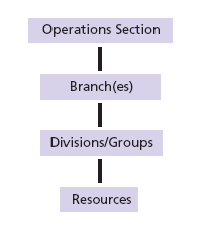
Incident responders located on scene work within the operations functional area of ICS. One person directs all incident-related operational activities and reports back to the Incident Commander. Depending on the complexity of the incident, subunits within this structure establish tactical objectives for each phase of response. Resources refer to the personnel and equipment needed to manage the response. The major organizational elements for the operations area are shown in Figure 4.
Figure 4. Organizational Elements 4
More incident responders are beginning to be trained in ICS and UC in which multiple agencies respond to a single incident. As stated in the Traffic Incident Management Handbook, 1 UC facilitates cooperation and participation between multiple agencies/jurisdictions through the following functions:
- Provide overall response direction
- Coordinate effective communication
- Coordinate resource allocation
- Establish incident priorities
- Develop incident objectives
- Develop strategies to achieve objectives
- Assign objectives within the response structure
- Review and approve incident action plans
- Insure the integration of response organizations into the UC structure
- Establish protocols
Following UC principles permits agencies to more cooperatively work together to achieve common objectives. The required teamwork and communications helps to avoid duplication of tasks and activities.
For example, the first responder on scene is responsible to assess the incident, secure the scene, provide emergency care, and call for additional response resources. As response activities occur, incident command shifts as the priority mission changes:
- Emergency response to treat and transport victims and establish scene safety
- Investigate incident
- Clean up/restore/repair incident scene
Effective communications between agencies is critical for successful management of the incident and resumption of normal traffic flow.
Shared Facilities
Shared facilities encompass a variety of locations in which multiple agencies operate jointly, both during the course of an incident and in settings that include debriefing and planning sessions. Traffic operations/management centers (TOC/TMC) can house transportation, public safety, and other personnel who are able to share both communications and information systems, allowing the facility to become a focal point for sharing incident status information in the region. Examples of other shared facilities include 911/dispatch centers and mobile command posts. Co-location of personnel, often initiated through an inter-agency Memoranda of Understanding/Agreement (MOU/MOA), allows partners to work side-by-side within the facility, strengthening relationships between responders as a result of the interpersonal contact. Such facilities evolve to become the focal point of information sharing in a region, beginning with information exchange through face-to-face communications and shared system access.
Planning/Debriefing Sessions
Another important means of information exchange is via incident-related, non-emergency meetings between responders. Such meetings are often held by multi-disciplinary traffic incident management (TIM) teams and task forces that debrief major incidents in order to find ways to improve TIM response. Recommendations from TIM teams range from immediate response improvements to longer term strategic suggestions that may require time, resources, and other commitments for implementation. Regular TIM team meetings provide a neutral environment to effectively discuss lessons learned as well as resolve issues that may have arisen during the management of an incident. Debriefing steps should include:
- Incident re-creation
- Agency input for aspects that worked well and those that did not
- Discussion of potential improvements
- Development of consensus for future events
- Documentation of findings and update of response plans, if appropriate
Remote Voice
The most common ways incident responders share information between the incident scene, operations centers, and public safety facilities using voice communications are:
- Land line telephones
- Wireless telephones
- Land mobile radios
These remote voice tools are often used in combination by all of those involved in the incident and response:
- A disabled or passing motorist dials 911 or a non-emergency assistance number via cellular telephone to notify public safety personnel about an incident
- First responders relay information about the incident via their land mobile radio network
- Response agencies speak to each other via the wired telephone network to coordinate their responses
With voice communications to transmit information to and from the incident scene, responders can quickly adjust to changing conditions. Responders must use clear-text transmissions, mandated by NIMS-ICS guidelines 4 , to prevent misunderstandings of their transmissions. Remote voice information exchange also facilitates the adjustment of response resources and provides an easily used pipeline of information to information dissemination services for the motoring public.
Land-line Telephones
Wired telephones are sometimes the only means available to share information between separately housed response entities. Wired telephones include voice and facsimile transmissions. They are critical for public safety communications, including 911 calls, and some portions of the cellular network make use of the land-line telephone network.
Wireless Telephones
Cellular phones, and less commonly used satellite telephones, are used between on scene and in-facility incident responders. Motorists, both those involved in an incident as well as passers-by, use cellular phones to call for assistance; however, there can be accuracy issues as unfamiliar motorists incorrectly identify incident locations. Cameras in cellular telephones have become common place and can be used to wirelessly transmit visual information; however, image transmission via wireless telephone is usually not a first action by incident responders. Cellular capabilities are improving as the network matures—both in terms of use of the network and cellular phone features (push-to-talk networks that sometimes replaces land mobile radios, text messaging, internet access, and still/video camera phones).
Land Mobile Radios
Radios can be used by incident responders to communicate directly with each other. While they are typically used within a single agency because of interoperability issues, sharing the radio frequency with other incident responders can facilitate response. For example, service patrol personnel may operate on a law enforcement radio network to communicate directly with law enforcement, both at the incident scene as well as with a dispatch center, with the result that response times may be reduced. Safeguards, including specialized training and procedures, must be put into place to overcome security concerns about sensitive information for shared communications with law enforcement agencies. One alternative is to allow civilian personnel to listen, but not talk, over the radio. Another benefit of sharing radio communications is that transportation personnel can handle minor incident response issues and communications, freeing public safety responders to handle emergency issues.
Electronic Text
Electronic text messaging is an automated way to share incident-related information quickly with large numbers of agencies and people with minimal resources. While not the primary method for inter-agency communications, electronic text messaging can be used to share information broadly and quickly. Categories of electronic text systems are:
- Alphanumeric pagers
- Traffic incident-related systems, including computer aided dispatch (CAD)
Pagers can be used to transmit abbreviated messages to incident responders; email text can be more detailed. Both are quick means to broadcast information to predefined response groups. Additionally, pages and email blasts can be sent to the public as a subscription service, sometimes in conjunction with 511 traveler information services, so motorists can be advised of traffic conditions. If necessary, they can avoid becoming part of the incident queue through route diversions and adjustments, reducing the overall incident’s impact and duration.
CAD sharing by law enforcement is becoming more common. Because the information entered into CAD is sensitive, non-law enforcement personnel must undergo certain precautions (background checks, training, etc.) to satisfy security requirements. Read-only, sometimes filtered, access allows other responders to call for and adjust response resources more effectively. For example, transportation personnel can monitor CAD systems to track incident progress and adjust their own response efforts. CAD systems also become a valuable record keeping tool when debriefing or analyzing an incident’s response for areas of improvement. Interoperability issues can impact information exchange using CAD, since many CAD systems are proprietary and, therefore, pose technological challenges to sharing information. Integration can occur; however, institutional and technological barriers must be overcome to do so effectively.
Other Media and Advanced Systems
Other integrated technologies can be used to share incident-related information between transportation and public safety agencies. Advanced traffic management systems (ATMS) normally include surveillance and communications technologies. They also address the needs of two different audiences: response personnel from the public and private sectors, and the motoring public trying to navigate around an incident.
Intelligent transportation systems (ITS) field devices for incident detection and verification include in-ground and mounted sensors and closed-circuit television (CCTV) cameras. Visual verification allows increased accuracy of response because agencies can see what resources are needed for incident response and repair and, therefore, dispatch them more quickly and accurately. Images and detection data can be readily shared with co-located agencies or remotely if integration needs have been addressed. Visual imagery allows response agencies to adjust their response, manage traffic, and disseminate information.
Information dissemination occurs through the use of electronic message signs (both portable and fixed), highway advisory radios, and telephone- and web-based 511 traveler information services. Information shared in this manner can be received by motorists, who can then evaluate roadway conditions, and decide if and how to adjust their travels during the course of an incident. This same information is useful to response agencies that need to travel on the roadway network quickly and efficiently, helping them reduce their own response times. Real-time information regarding roadway conditions, congestion, and scene details helps responders arrive, respond, and leave an incident scene more quickly.
ITS media allow more accurate, timely, and reliable information sharing through an important technological set of tools that can be used by multiple responders to support traffic incident management response efforts. However, because ITS applications can have greater communications bandwidth requirements than remote voice or electronic text methods, especially when video is involved, the quality of the information shared may be impacted. For example, video may need to be reconfigured to snapshot or streamed images over the internet. Dynamic map displays, part of a traveler information system, may not provide the level of detail desired for the roadway network because of the time needed to load and refresh the information. These issues must be addressed during the developmental stage so that the varying audiences can obtain the correct information and appropriate level of detail for effective actions and decision making.

