INFORMATION SHARING FOR TRAFFIC INCIDENT MANAGEMENT
The Incident Command System and Unified Command
Incident Command System
Incident responders, particularly law enforcement and fire-rescue personnel, use the federally adopted Incident Command System (ICS), for all types of incident management. ICS was originally developed in the 1970s as an approach for managing responses to rapidly moving wildfires. In the 1980s, federal officials transitioned ICS into the National Incident Management System (NIMS), the basis of response for highway and other incidents. ICS is a standardized, on scene traffic incident management concept that allows responders to adopt an integrated organizational structure without being hindered by jurisdictional boundaries.
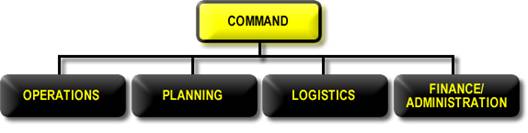
ICS includes five major functional areas shown in Figure 1: command, operations, planning, logistics, and finance and administration. These major areas are further broken down into specialized subunits. The area of Intelligence may be included if required.
Command – overall authority associated with the incident, responsible for determining size and magnitude of response and involved personnel
Operations – activities necessary to provide safety, incident stability, property conservation, and restoration of normal highway operations
Planning – activities associated with maintaining resource/situation status, development of incident action plans, and providing technical expertise/support to field personnel.
Logistics – services and support for incident response effort in the form of personnel, facilities, and materials.
Financial and Administration – tracking of incident costs/accounts for reimbursement.
Intelligence – analysis and sharing of information and intelligence during the incident.
Figure 1. Incident Command Functional Areas 4
ICS outlines roles and responsibilities for incident responders. Rather than defining who is in charge, ICS provides the management structure for who is in charge of what. ICS allows agencies to work together using common terminologies and operating procedures, leaving command personnel with a better understanding of other agencies’ priorities.
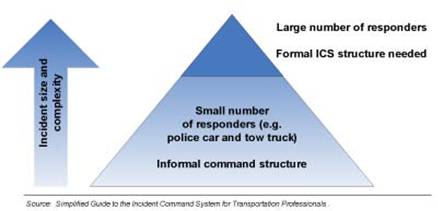
ICS is scalable to the level appropriate for the incident and surrounding conditions. Responses can be transitioned from small, single agency to large, multi-agency and vice-versa with minimal adjustments for the agencies involved as shown in Figure 2. ICS provides the structure to allow flexible, agile responses that adapt to real-time field conditions.
Figure 2. Incident Command Structure Needs 5
Unified Command
Unified command (UC) defines the application of ICS when there is more than one agency with incident jurisdiction or when an incident crosses multiple jurisdictions. UC provides a management structure that allows agencies with incident responsibilities to jointly work within an established set of common objectives and strategies that include:
- Agency assignments
- Incident priorities
- Assignment of agency objectives
- Communications protocols
- Knowledge of duties within agency responsibilities
- Acquisition and allocation of materials and resources
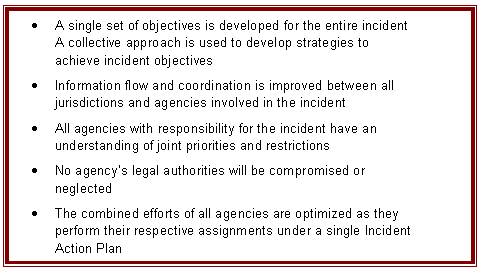
When applied effectively, UC facilitates interagency communications and cooperation, leading to efficiencies in response. UC allowsall agencies with jurisdictional authority to provide managerial direction at an incident scene while maintaining a common set of objectives and strategies. Command staff report directly to the Incident Commander. The identity of the Incident Commander is dependent on the priority mission at the time. Until the injured are treated and moved, fire-rescue or emergency medical services (EMS) will probably be in charge. When the priorities shift to investigation, law enforcement will take over. As the incident moves into clean-up/recovery, command can shift to the transportation agency or towing contractor. Personnel participate actively until they no longer have a role at the incident. During this process, other agencies have the opportunity to participate in decision making and provide direction to their own personnel; however, overall charge resides in the Incident Commander. A key component of success is the ability to communicate between the varied entities with roles to play in the response effort. Another key factor is the strength of interpersonal relationships, often built in other settings, that allows responders to communicate clearly and effectively with each other during the management of an incident. Some key advantages of UC, as listed in the United States (U.S.) Department of Homeland Security’s National Incident Management System Manual,4 are:
Figure 3. Advantages of Using Unified Command 4