




INFORMATION SHARING FOR TRAFFIC INCIDENT MANAGEMENT
Information Sharing Case Studies
NCHRP Report 520 Case Studies
NCHRP Report 520, Sharing Information between Public Safety and Transportation Agencies for Traffic Incident Management (2004)3 reviews the effectiveness of information sharing for the following nine locations with active traffic incident management programs that involve public safety, transportation, and other public and private sector entities. Key stakeholders are transportation departments and local/state law enforcement agencies. Whether or not these agencies are physically co-located at the common facility, the sites provide varying examples and levels of success with the information sharing practices previously described in this section for the purposes of incident detection and notification, response, and site management.
- Albany – close working relationships between two transportation agencies (New York Department of Transportation (DOT) and New York State Thruway Authority) two law enforcement divisions (New York State Police and Albany Police Department); regional coordination and various information-sharing applications in place for a long time period.
- Austin – Texas DOT, Austin Police Department, Austin Fire Department, and Travis County EMS are co-located in a TMC facility that serves as a focal point for information exchange through cooperatively developed technologies. The agencies have shared radio and video systems, and they have also integrated the CAD and traffic management systems.
- Cincinnati – Ohio and Kentucky transportation agencies have joined to regularly and routinely share traffic information through the Advanced Regional Traffic Interactive Management Information System (ARTIMIS). Strong regional TIM teams convene at the center to handle major incidents with involvement by relevant public safety and transportation partners in the region. This mature interagency operation includes a partnership with CVS Pharmacies to provide roadway service patrols.
- Minneapolis – Minnesota DOT and Minnesota State Police operate in a co-located TMC facility with a shared radio communications system (800 MHz) that includes workstations for media, and transportation and law enforcement. Additional joint communications centers throughout the state are also in place.
- Phoenix – Arizona DOT, Maricopa County DOT, and Phoenix Fire Department share radio systems, phone lines, traveler information workstations, facsimile and pagers, and CCTV images in their efforts to overcome institutional barriers to information sharing.
- Salt Lake City – strong inter-agency relationships between Utah DOT and Utah Highway Patrol leveraged upgrades resulting from the 2000 Winter Olympics to enhance information sharing both in the operations facility and on scene. Technical challenges were overcome by incorporating the same radio communications and CAD systems. Agencies share video images as well.
- San Antonio – strong institutional framework and joint activities of key transportation and public safety agencies have led to highly integrated communications and information sharing. Representatives include Metropolitan Transit Authority, San Antonio Public Works Department, Alamo Dome, San Antonio Police Department, Bexar County Sheriff Department, EMS, county health departments, and private sector towing and recovery providers. Texas DOT (TxDOT) and the San Antonio Police Department work together in the TransGuide Operations Center, a central point for incident and emergency response.
- San Diego – CalTrans and the California Highway Patrol have undertaken a CAD interface project to bridge communications between transportation and public safety agencies; while the project itself was only partially successful, the technical and institutional barriers identified have laid the foundation for a similar future project that will build upon the agencies’ commitment to share information.
- Seattle – Washington DOT (WSDOT), Washington State Police (WSP), and the Washington State Legislature share a common focus that has led to coordinated traffic incident management and strong information sharing practices in the Seattle region. Together WSDOT and WSP have developed and implemented advanced technologies for inter-jurisdictional and inter-disciplinary communications.
Table 1. Methods of Sharing TIM Between Transportation and Public Safety Agencies at Survey Locations.3
| Geographical Region |
Face-to-Face |
Remote Voice |
Electronic Text |
Other Media and Advanced Systems |
|---|---|---|---|---|
Albany, NY |
State Police co-located with State DOT at one center; State Police co-located with Thruway Authority at another center. |
State DOT Service Patrols share public safety radios; State Police and Thruway share a radio system and dispatchers; Senior staff use commercial wireless service “talk groups.” |
Joint CAD system shared at Thruway center. |
ATMS data, images, and video shared remotely through experimental wireless broadband service. |
Austin, TX |
State DOT, city fire and police depts., and county EMS will be co-located at center. |
Service Patrols equipped with local police radios. |
Capability under development to share traffic incident data from public safety CAD data remotely. |
Control of transportation CCTVs shared with local police. |
Cincinnati, OH |
Transportation center hosts regional Incident Management Team operations. |
ARTIMIS shares public safety radios; multiple agencies use commercial wireless service “talk groups.” |
Capability under development to share CAD data with ARTIMIS. |
Transportation CCTV images available on traveler information website. |
Minneapolis, MN |
State Patrol and State DOT staff co-located at a regional center. State Patrol and service patrol staff co-located at another location. |
State Patrol and State DOT share the 800 MHz radio system. Senior staff use of commercial wireless service “talk groups.” |
Service Patrols have read-only terminals from State Patrol CAD. State DOT can access State Patrol CAD. |
State DOT CCTV and other traffic management systems are shared with State Patrol. |
Phoenix, AZ |
— |
Service Patrols equipped with State Patrol and State DOT radios. |
State DOT highway condition workstations provided to local fire dept. and emergency services div. County DOT incident response teams use alphanumeric pagers. |
State DOT CCTV shared with local fire dept. |
Salt Lake City, UT |
Highway Patrol and State DOT staff co-located at the regional center, but separated by elevated soundproof glass partition. |
All Highway Patrol and State DOT field units use the same radio system and dispatchers. Service Patrols are fully integrated into law enforcement radio system. |
State Patrol CAD shared with State DOT |
State DOT CCTV and other traffic management systems are shared with Highway Patrol. |
San Antonio, TX |
Local Police and State DOT co-located at the regional center. |
Service Patrols equipped with local police radios. New radio system will provide common channels for State DOT and local police and fire. |
Incident data from local police CAD shared with State DOT traveler information system. |
State DOT CCTV images are shared with local government and news agencies. |
San Diego, CA |
State Patrol and State DOT co-located at the regional center. |
Service Patrols equipped with local police radios. |
State DOT has read-only access to Highway Patrol CAD. |
Incident information from Highway Patrol CAD is provided to State DOT traveler information website. |
Seattle, WA |
— |
Service Patrols equipped with State Patrol radios. Intercom system (with handsets) is used between State DOT center and State Patrol 9-1-1 call center. |
State DOT partially shares State Patrol CAD system. State DOT has CAD terminal for entering traffic incident information. |
State DOT CCTV shared with State Patrol (includes control of cameras). |
All locations use standard telephones and facsimile machines for information sharing.
ARTIMIS = Advanced Regional Traffic Interactive Management Information System.
ATMS = advanced traffic management system.
CAD = computer-aided dispatching.
CCTV = closed-circuit television.
DOT = department of transportation.
EMS = emergency medical services.
Additional Case Studies
Kentucky’s Intelligence Fusion Center 8
Kentucky’s Intelligence Fusion Center, a unified hub that uses a remotely accessed data sharing and analysis system, coordinates and connects all levels of law enforcement and public safety agencies as well as the private sector. The center’s goal is to improve intelligence sharing between responders. The public is also encouraged to report suspicious activities through a telephone hotline. While this exchange of information is done primarily in the context of enhancing domestic security and reducing criminal activity, improvements to information sharing also enhance traffic incident management activities as some of the same organizations involved in the center deal with traffic incident management. Agencies involved in the Kentucky Intelligence Fusion Center include:
- Kentucky Office of Homeland Security
- Kentucky State Police
- Kentucky Transportation Cabinet
- Kentucky Department of Corrections
- Kentucky Department of Military Affairs
- Kentucky Vehicle Enforcement
- Federal Bureau of Investigation
- Bureau of Alcohol, Tobacco, Firearms, and Explosives
- United States Department of Homeland Security
- Lexington Division of Police
A fusion center is a unified information hub linking all types of information collected by law enforcement and public safety agencies that is necessary to combat criminal activity and domestic and international terrorism; the ultimate result of this linkage is to bring together agencies with common purpose. These same agencies are also charged with the responsibility of being the first responders for emergency and incident management. It is a natural extension of this mechanism to also serve as the basis of the necessary communication, coordination, and cooperation among these agencies charged with first response to traffic incidents. To this end, the capabilities of the Kentucky Intelligence Fusion Center, relative to information sharing for incident response, include:
- Shared database to assist federal, state, and local law enforcement agencies with information requests, reporting requirements, and /or performance measures
- Receipt of law enforcement field reports from in-car mobile data computers
- Radio communications dispatching for state police
- AMBER Alert notification
- Connection to multiple intelligence and information sharing networks
- Traffic and TIM center monitoring of highway construction, maintenance, weather, and other events
- Monitoring and updating of the Kentucky 511 traveler information system
- Monitoring of regional traffic center Web sites in Louisville, Lexington, and the Northern Kentucky-Cincinnati area
FDOT District Five and Florida Highway Patrol 9
FDOT’s District Five Road Ranger Service Patrol is currently operating on the State Law Enforcement Radio System (SLERS). This pilot project is in the Orlando metropolitan area where the Florida Department of Transportation (FDOT) TMC is co-located with the Florida Highway Patrol (FHP) Communications Center. The radio system allows Road Rangers to communicate directly with FHP Troopers at incident scenes and also with FHP dispatchers. Response times have been reduced as incidents are identified more quickly by multiple responding entities, either by having a Road Ranger come upon a disabled vehicle and making the first call into the dispatch center, or by having a Road Ranger hear the dispatch call over the radio.
These varied locations have demonstrated that no single approach to information sharing is best. Local factors and organizational issues must be identified and addressed to achieve effective interagency communications practices that are influenced by interoperability issues and interpersonal relationships.
SAFECOM10, 11
The lack of interoperability between emergency responders—the ability for agencies to exchange voice or data with one another via radio communication systems—has been a long-standing, complex, and costly problem that has affected their responses to incidents and emergencies. In addition to incompatible communications equipment, responders also have to deal with funding issues, insufficient planning and coordination, a limited radio spectrum, and limited equipment standards. Wireless devices can provide some relief, but the cellular network is quickly overwhelmed during an incident or emergency and then becomes unreliable and unavailable. This issue was highlighted during the tragic events of September 11, 2001. As a result, the SAFECOM program was established as a communications program within the Department of Homeland Security’s Office for Interoperability and Compatibility. SAFECOM “provides research, development, testing and evaluation, guidance, tools, and templates on communications-related issues to local, tribal, state, and Federal emergency response agencies working to improve emergency response through more effective and efficient interoperable wireless communications.”10
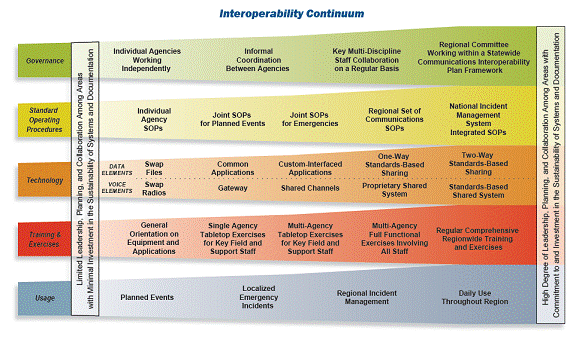
SAFECOM is a practitioner-driver program; i.e., local and state emergency responder input and guidance are heavily relied-upon in the pursuit of solutions to interoperability issues. Based upon the results of a pilot initiative in ten urban areas completed in 2004, five factors critical to the success of interoperability were identified in an “Interoperability Continuum” or guiding principles as follows and shown in Figure 5:
- Governance
- Standard operating procedures
- Technology
- Training and exercises
- Usage
Figure 5. SAFECOM Interoperability Continuum 12
Public safety communications requirements for voice and data interoperability were first released in 2004. These requirements serve as a first step for establishing base-level communications and interoperability standards for emergency response agencies, a process that is expected to take up to 20 years to achieve. In the interim, SAFECOM has11:
- Created the Federal Interagency Coordination Council (FICC) to coordinate funding, technical assistance, standards development, and regulations affecting communications and interoperability across the federal government;
- Published a Statement of Requirements which, for the first time, defines what it will take to achieve full interoperability and provides industry requirements against which to map their product capabilities;
- Issued a request for proposals for the development of a national interoperability baseline;
- Initiated an effort to accelerate the development of critical standards for interoperability;
- Created a Grant Guidance document that has been used by the Federal Emergency Management Agency, Community Oriented Policing Services, and Office of Domestic Preparedness state block grant program to promote interoperability improvement efforts.
- Established a task force with the Federal Communications Commission to consider spectrum and regulatory issues that can strengthen emergency response interoperability;
- Created a model methodology for developing statewide communications plans;
- Released a Request for Information to industry that netted more than 150 responses; and
- Worked with the emergency response community (local, tribal, state, and federal) to develop a governance document that defines both how SAFECOM will operate and how participating agencies will work within that framework.

