Travel and Emissions Impacts of Highway Operations Strategies
Executive Summary
Purpose and Background
This research project addressed the short- and long-term impact of highway operations strategies on travel and emissions. Operations strategies are aimed at reducing congestion and improving safety without major physical of highways. Key research questions addressed include:
- The extent to which highway operations strategies affect throughput, travel delay, and travel-time reliability.
- The extent to which these improved travel conditions result in demand changes, in both the short term and long term.
- The system-level traffic flow and emissions impacts of these projects, after accounting for demand changes, including the production of both criteria pollutants and greenhouse gases.
Operations strategies provide highly cost-effective solutions to congestion and safety problems. Compared to capacity expansion projects (new highways or additional lanes), their cost is low and the fact that they work within existing rights-of-way means that their environmental footprint is minimal and they can be implemented quickly. Rapid project turnaround is a major benefit of operations strategies because not only do benefits start accruing immediately and lengthy and distressful work zones are avoided, but the public sees that agencies are dealing with current problems. Further, many operations strategies deal with disruptions on the roadway system – incidents, inclement weather, work zones, and special events – which are not only highly visible and a source of frustration to travelers, but contribute substantially to both total congestion and the unreliability of travel.
In the past several years, transportation strategies of all kinds have come under increased scrutiny due to heightened concern for air quality and especially for the climate change potential of greenhouse gasses (GHG), a major by-product of the fossil fuels consumed by the major of on-road vehicles. With regard to operations improvements, two primary issues are at the heart of this scrutiny:
- Demand Effects – Does reducing congestion by deploying operations strategies lead to increased traveler use of the improved facility and to more highway trip-making in general?
- Emissions Impacts – To what extent do changes in travel behavior reduce short-term emissions gains?
Study Approach
After dismissing analysis of travel surveys, the approach relied on two types of analysis. First, empirical before/after data analysis was selected because it was felt that roadway surveillance data had matured to the point of being capable of detecting changes in travel conditions (travel times and demand) due to operational improvements. Atlanta, Georgia was selected as the study location.
Second, because travel-time reliability is a major – and often ignored – benefit of operations improvements, original research on the impact of reliability on land use development patterns was undertaken. The results of this research were then added to a special version of the UrbanSim land use model, which was then integrated into a complete modeling framework with the Metropolitan Transportation Commission travel demand model.
Third, the project team proposed to use advanced modeling frameworks both to estimate the emissions impacts of operations strategies and to study demand impacts. For the emissions impacts of operations, the Integrated Corridor Management (ICM) framework previously used in the San Diego, California I‑15 corridor was selected. For emissions analysis, we developed a postprocessor that translated individual vehicle trajectories (produced as microsimulation output) into operating mode distributions. The Motor Vehicle Emission Simulator (MOVES) model was then run in project-level mode to develop emission estimates.
Fourth, the choice of an advanced modeling framework to estimate demand changes due to operations was more problematic, confounded by the fact that the ideal framework to study this issue currently does not exist. The final framework for the advanced modeling phase of the approach is shown in Figure 1. It combines the use of the MTC travel demand model with the reliability-enhanced UrbanSim model.
Figure 1. Flowchart. Final study approach, advanced modeling phase.
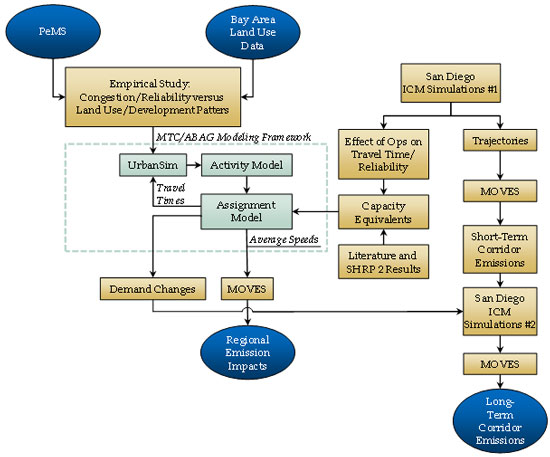
(Source: Cambridge Systematics, Inc.)
Conclusions
This study examined the effects that operations strategies have on demand and emissions, especially greenhouse gas emissions, in both the short and long terms. Many past studies have documented the positive effect of operations strategies immediately after implementation – the so-called “opening-day effect” – due to their ability to reduce delay at modest investment costs. The findings of this study reinforce that earlier work. However, a major reason for undertaking the study was to determine the extent to which opening-day emissions would endure potential increases in travel demand resulting from improved travel conditions.
Past studies of induced demand have not specifically addressed the effect of operations strategies. Rather, most have focused on the effect of how changes in a supply variable (e.g., lane-miles) result in changes in travel demand, the idea being that additional highway supply results in lower transportation costs by reducing travel times. However, adding supply (whether it be lane-miles or other form of effective capacity) will only lower travel times for an existing facility during times that the facility is congested, making highway supply a crude indicator of how travel times will change. Because of this indirect linkage, some studies have looked at the direct relationship between travel times and demand.
Past studies distinguish between short-term and long-term effects. Short-term effects include diverted trips (route, temporal, and destination shifts) and new or longer trips resulting from latent demand and mode shift. In the long term, relationship is more complex. Improvements in travel time lead to changes in development patterns, which in turn lead to changes in residential and commercial location choice and car ownership. Many authors have argued that diverted trips are not true induced demand. In general, the size of the long-term effect, in terms of the elasticity of demand with a supply variable, has been found to be higher than the short-term effect.
The applicability of past studies of induced demand to operations strategies is dubious for several reasons:
- Relationships based on areawide lane-mile additions versus vehicle-miles of travel (VMT) changes are too crude for judging operations strategies. Operations strategies are only going to be invoked when congestion is present on specific facilities, most often during peak periods, while it is impossible to tell where and when the areawide lane-miles in the studies were applied. There also is the problem of equating operations strategy effects to lane-miles, but this tractable.
- Relationships based on travel time changes versus VMT are based on travel times for an entire trip. Operations strategies are concentrated on higher order facilities, and therefore a trip will only be partially exposed. This means that the travel time savings on the operations-improved facility is less than the overall trip travel time, and therefore an adjustment would have to be made. This is important because the study is concerned specifically with the long-term effects of a deployed operations strategy.
The issue of operations influence on travel-time reliability also is often cited as a reason that historical induced demand relationships do not apply. While it is true that operations strategies do improve reliability, it also is true that other types of highway improvements do as well. Do travelers respond differently to reliability changes than they do to changes in typical travel times? Recent research from the SHRP 2 program suggests that both typical travel time and reliability are components of total transportation cost (i.e., travelers’ utility) and that they respond similarly to changes in them. Accounting for reliability as an extra component of total travel cost would be a desirable feature not just for this project but for any analysis that encompasses traveler behavior.
Traditional four-step travel demand models are ill-equipped to capture induced demand because of the lack of feedback to trip generation (including vehicle ownership) and land use. Much has changed in the past decade with the advent of activity-based models, especially those that are linked to land use models. An exploratory analysis of the induced demand effect of operations was conducted as part of the preparatory work to the analysis work described above. The effect of improved signal timing in a corridor was used to replicate the effect of arterial operations strategies (e.g., traffic adaptive control systems). The performance was worsened with the induced demand but is still better than the baseline conditions. A 3 percent increase in volumes was derived by considering tour-based elasticities, which account for trip generation effects (as well as route and time-of-day shifts) but not longer-term effects, such as land use and car ownership shifts. The 3 percent increase in volumes worsens travel time performance by only 1.2 percent, still much better than the base condition. Even a 10 percent increase in through volumes has a better performance than baseline conditions with existing signal settings.
A second case study was undertaken using empirical data from the Atlanta metro area. The study was based on calculating facility travel times using continuously collected speed data from ITS sensors and automatic traffic recorders, in a before/after operational deployment setting with control sections. The results found that at several locations, ramp metering (one of the operations strategies used) did not have an appreciable effect on travel times. In locations where the operations strategies did improve travel times, no discernible increase in VMT occurred, based on an after period of more than one year. This finding corresponds to several studies of matched facility pair comparisons in the literature.
The MTC travel model was used to examine land use and regional demand effects of operations. The MTC model links an advanced iterative land use simulation model (UrbanSim) with an activity-based travel model, so that a more comprehensive treatment of demand effects is possible. Original research was conducted with the UrbanSim model and data from the Bay Area. The results found that development patterns are affected by changes in reliability in additional to typical travel times. This finding mirrors that of the Strategic Highway Research Program 2 research that found traveler behavior also is influenced by both travel time and reliability. Essentially, reliability is an extra congestion-related cost that heretofore has not been accounted for in traveler behavior analyses. The relationships developed by the research were imbedded in a special version of UrbanSim for use in this project.
The enhanced UrbanSim version of the MTC modeling framework was used to conduct tests of deploying operations strategies. This framework includes feedback loops for travel time to the activity model and for both travel time and reliability to the land use model. Congestion in the network was high. Results show that the deployment of operations strategies increases regional VMT, and the increase is proportional to the travel time savings. For the network that was tested, which was significantly congested, for strategies that represent a reasonably high impact on congestion (e.g., bundles of strategies) the VMT increase does not fully erode the CO2 emissions benefits of operations; small benefits remain after accounting for both short-term and long-term demand effects at the regional level. Strategies that have a lower congestion impact (e.g., ramp metering deployed alone), a marginal increase in CO2 emissions was found.
The long-term demand increases observed in the MTC model were used to update the I‑15 traffic simulation runs. Results showed that the increased demand runs showed less benefit than the original runs, but for the majority of cases, there was a small net reduction in emissions relative to the base case. The demand adjustment procedure used was crude, but necessary given that an integrated model capable of estimating demand changes and refined speed/delay estimates currently is not available.
All of the review and analysis conducted in this study points to several overall conclusions:
- Operations strategies have an effect on short-term and long-term demand patterns, based on the regional modeling conducted. Because operations strategies improve travel time, there is no a priori reason to expect them to behave any differently than capital expansion projects in this regard. However, the strategies tested in this study were all supply related. Traveler information, which affects demand, was tested using a simulation model, but the results were deemed to be problematic. In the short term, traveler information may reduce demand on congested facilities by allowing travelers to make different choices for destinations, modes, or to forego a trip altogether. (Shifts in routes and departure times effected by traveler information are likely to have a negligible impact on demand.) However, in the long term, to the degree that traveler information has the global effect of reducing travel times, we would expect it to have similar demand characteristics of other strategies.
- An empirical before/after analysis of operations deployment (ramp metering and incident management) revealed neither significant changes in travel time or demand. This may be due to relatively small decrease in travel times observed (compared to what would be achieved through capacity expansion or bottleneck removal), indicating that travelers require a significant change in travel time before they adjust their short-term behaviors.
- Travel-time reliability affects land use decisions. Recent SHRP 2 research found that reliability affects traveler behavior and that, along with typical travel time, is part of the overall disutility associated with trip-making. This project has extended that finding to include the behavior household and business land use decisions. Because reliability is affected by many factors – including disruptions, demand, and their interaction with physical capacity – we expect that other improvements beyond operations would have a similar effect.
- A microsimulation model, TransModeler previously calibrated for the Integrated Corridor Management Analysis in the I‑15 corridor in San Diego, was used to gauge the effects of operations strategies. Individual vehicle trajectories were obtained from the model runs and converted to operating mode distributions for input the MOVES model to produce emissions estimates. This approach was deemed to be superior to using average speeds for MOVES input because it captures vehicle modal activity. However, there has been recent skepticism about the ability of microsimulation-based vehicle trajectories to replicate real-world trajectories. The reason is that the models have been internally calibrated to reproduce macrolevel performance, not individual vehicle performance. This discrepancy is a major concern for trying to obtain an absolute number for emissions; it is probably not as important for judging the relative differences in strategies, as done here.
- Under the assumption that there is no short- or long-term change in demand, operations strategies produce emissions benefits at the corridor level, including the primary greenhouse gas, CO2. The reduction in emissions range from two to nine percent, depending on the type of operations strategy deployed. These results are based on using a microscopic simulation model to develop trajectories for the MOVES model.
- Accounting for demand changes created by the improved travel conditions resulting from operations, the emissions benefits at the regional level are less than at the corridor level. Regional CO2 emissions varied from -1.5 to +1.0 percent, depending on the strategy deployed. This result is based on the regional modeling framework used in this study.
- Accounting for increased demand due to the original deployment of operations at the corridor level, emissions reductions are still present, although the reductions are not as great as if no demand increase is assumed (one to nine percent emission reductions). This result is based on using the demand shifts determined from the regional travel model and applied to the microscopic simulation/MOVES model framework. Because the simulations were unable to account for all of the additional VMT estimated by the regional modeling, we expect the emissions benefits to be overstated. Had the simulations accounted for all of the additional VMT, we believe that emissions benefits would have been either neutral or slightly positive.
- Microsimulation models are excellent tools for assessing roadway performance in terms of travel time and delay. Our experience indicated that their handling of demand changes is more problematic. This manifested itself the most in the analyses where traveler information was implemented – some of the results appear to be counterintuitive. Also, trying to match roadway VMT targets by modifying the trip table based on a “select link” analysis is performed is a difficult task. Finally, even for routine scenarios the model’s shifting of demand makes it hard to compare the effects of one strategy versus another. VMT is a legitimate effect of network conditions, not a static input, but it is difficult to know if the model’s treatment of demand replicates reality.
- The study stretched the limits of current modeling capability by stitching together results from one model (demand estimates from the MTC travel model) with another (speed estimates from the I‑15 microscopic simulation model). The ideal modeling framework to study this problem would have a single model that has the land use and travel activity components of the MTC model with the traffic assignment portion replaced with mesoscopic simulation model. Even then, there is a question whether the vehicle trajectories produced by mesoscopic simulation adequately reflect real-world trajectories. In fact, the accuracy of microscopic simulation produced trajectories have been called into question. Until this issue is resolved, a good deal of uncertainty will remain in any modeling framework that is employed to study the long-term effects of operations strategies on emissions.
Recommendations
Based on our experience with this project, the team offers the following recommendations for future work:
- Fully integrated modeling frameworks with advanced features should be promoted in order to understand the supply demand implications for alternative investments. These features should include:
- A land use model that is sensitive to changes in transportation network conditions.
- An activity-based travel demand model.
- Traffic assignment via simulation procedures (e.g., mesoscopic simulation) that employs dynamic traffic assignment.
- Travel-time reliability should be both an output of the modeling process as well as an input. Traditional travel demand and microsimulation models should produce reliability measures as output for assessing system performance. Research should be on alternative methods for doing so, including postprocessing and scenario-based analysis. Further, reliability should be part of the feedback process in the modeling chain, in the same way that typical (average) travel times currently are used. This study showed a method for incorporating reliability in land use projections; a similar effort should be undertaken to incorporate reliability into activity models, both as an adjunct to existing models and in the development of new ones.
- When operations projects are evaluated, demand changes over a short-term horizon should be included. Evaluations of completed projects is an important component of a performance management system. Before/after evaluations have traditionally focused on fairly short time periods. With the inclusion of reliability, the time periods must be at least one-year long. We recommend an even longer time horizon – perhaps two years – so that demand shifts can be observed and correlated with improvements in travel conditions. Challenges exist for conducting these studies, including the impact of diversion on facility traffic volumes and changes in the drivers of ambient demand such as economic fluctuations and fuel prices. These studies will add to the knowledge gained here in the Atlanta case studies.
- Empirical analyses of traveler responses (demand) to changes in system condition should be undertaken. Previous efforts to study demand changes – induced or otherwise – have suffered from objective measurements of travel time changes. Either surrogates such as lane-miles of self-reported travel times have been used. However, new forms of data have allowed the direct measurement of travel times on a regional network. These data can be used in conjunction with either longitudinal or cross-sectional studies of travel demand.
- Emissions estimates derived from simulation model trajectory outputs should be investigated further. Specifically:
- Comparison of emissions derived from simulated trajectories versus real-world trajectories.
- Comparison of emissions derived from simulated trajectories versus the use of average speeds.



