






Project-Level Public Information and Outreach Examples

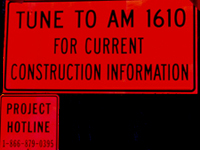
At the project-level, work zone public information and outreach strategies are used to communicate with road users, the general public, area residences and businesses, and appropriate public entities about project information; road conditions in the work zone area; and the safety and mobility effects of the work zone. According to some states, public information is one of the most cost effective work zone impacts mitigation strategies, in both urban and rural areas.
Effective use of public information and outreach strategies can lead to improved driver and worker safety, less traffic delay, and reduced driver frustration. The Work Zone Safety and Mobility Rule requires that public information and outreach strategies be included in Transportation Management Plans (TMPs) for significant projects.

Project-level public information and outreach often includes a combination of strategies. To make the examples on this page easier to view, they are listed under specific strategies. While one particular strategy may be highlighted because it was primary or innovative, the project may have used a combination of strategies.
- Guidance on Public Information and Outreach from States
- Large-Scale Public Outreach Campaigns
- Social Media Use
- Surveys of the Public
- Videos
- Web Sites
- Work Zone Best Practice Fact Sheets on Information/Outreach
Guidance on Public Information and Outreach from States
NCHRP Synthesis 413: Techniques for Effective Highway Construction Projects in Congested Urban Areas
NCHRP Synthesis 413 (PDF 5.1MB) identifies strategies and successful practices used by transportation agencies to address the challenges and impacts of construction projects in congested urban corridors. The study found that stakeholder communication is an essential part of every urban construction project, and consequently, the use of the media has become routine in these projects. The report offers strategies for stakeholder and public involvement in Chapter 6 and for Media Relations in Chapter 7.
Arizona Department of Transportation
The Arizona Department of Transportation (ADOT) places importance on including the public in the development of transportation management plans (TMPs), construction communication, and traffic management outreach strategies. By definition, all funded Arizona projects are significant and therefore a public information and outreach component is included in all TMPs. ADOT's Communication and Community Partnerships Division (CCP) is responsible for developing work zone public outreach and communications plans in conjunction with TMP development. Before and during construction projects, CCP coordinates Transportation System Management (TSM) meetings to review traffic management issues, propose alternatives, and discuss community implications. The TSM meetings involve ADOT staff and a variety of stakeholders relevant to the corridor (e.g., public safety agencies, contractors, businesses, schools, neighborhood groups) and are valuable to ensuring the coordination of multiple projects in a corridor. Work Zone Safety and Mobility Public Information and Outreach Strategies (PDF 492KB) discusses media relations, general public communication, project communication and coordination, outreach tactics, and budgeting for ADOT road construction projects.
Colorado Department of Transportation
The Colorado DOT has a special provision for Public Information Services within its Standard Specifications for Road and Bridge Construction. This provision calls for the contractor to provide public information services on an ongoing basis throughout the duration of the project, through the use of a Public Information Manager (PIM). The required qualifications of the PIM vary depending on whether or not the project is a significant project. The provision also describes the duties of the PIM and the specific public information and outreach strategies to be used for a project.
Illinois Department of Transportation
The Illinois Department of Transportation (IDOT) Bureau of Design and Environment Manual chapter on Work Zone Transportation Management (PDF 593KB) includes a section on developing a successful Public Information Plan (PIP). The guidance recommends identifying the scope of the plan, potential partners, and target audiences; developing the message; determining communication strategies and timing; and evaluating the PIP. The Manual also includes a chapter on Public Involvement Guidelines (PDF 1.9MB), with procedures for public participation in the highway location and design proposal process to ensure that potential adverse economic, social, and environmental effects are considered in project development.
Maryland State Highway Administration
The Maryland State Highway Administration (MDSHA) provides guidance for developing public information and outreach plans as part of a TMP for a project. Project managers and engineers are required to work with the MDSHA Office of Communications to develop an organized approach to the communication needs of any project. Coordination with the Office of Communications is intended to help to ensure success of public information and outreach effort, particularly for significant projects.
- Public Information and Outreach Plans Development Guidance (PDF 165KB)
- Public Information and Outreach Template (PDF 88KB)
Large-Scale Public Outreach Campaigns
I-405 Full Closure – Los Angeles, California Example
Both directions of a 10-mile stretch of the I-405 Freeway in West Los Angeles were fully closed the weekend of July 16-17, 2011 for 53 consecutive hours to demolish the Mulholland Drive Bridge. This freeway segment has very high average daily traffic and is regularly one of the top-10 freeway bottlenecks in the U.S. Officials warned motorists to plan ahead, stay home, or avoid the area. The Los Angeles Police Department, Los Angeles Fire Department, California Highway Patrol, Los Angeles Department of Transportation, Metro, and Caltrans conducted extensive public outreach to warn motorists far in advance of the closure. Outreach efforts included public service announcements in English and Spanish starring celebrities, Twitter messages from celebrities, numerous news releases and fact sheets, and a count-down clock that other organizations could post to their web sites. In addition, JetBlue Airlines created a special flight route between Burbank and Long Beach and offered $4 flights for the weekend to help the public get around without driving. The closure did not have the catastrophic effect that was anticipated and many believe it is due to the intense use of social media and other public outreach strategies to warn motorists far in advance of the closure. Officials successfully used similar strategies for a second closure in September 2012.
- I-405 Project Web Site
- "JetBlue Offers Solution to 'Carmageddon'", article on CNN.com, July 14, 2011
- "The Carmageddon Effect", article on Planetizen, July 18, 2011
- "Carmageddon II: Officials likely to use same fear-factor approach", article in LA Times, July 17, 2011
- "Carmageddon – A word that got attention and creator gets his due", article in LA Times, July 16, 2011
- "Once Again, Carmageddon II Was Practically a Non-Issue", article in the Atlantic Cities, October 1, 2012
Social Media Use
Willow Road Reconstruction – Illinois DOT Example
The Illinois DOT (IDOT) used several social media channels to share information about the reconstruction of Willow Road from IL 93 to IL-94. This $27 million project, began in March 2013 and was completed in October 2014, corrected existing safety and geometric deficiencies along Willow Road and improved mobility for all users (pedestrian, bicyclist, and motorist). In addition to a project web site, efforts to share information about the project included a blog, a Facebook page, a Twitter feed, and an Instagram account to share project photos.
Surveys of the Public
FHWA Innovator Article on Customer Satisfaction Surveys
One of the key goals of most highway agencies' construction programs is to satisfy the desire of motorists for a good driving experience. One way agencies determine how well they're meeting that goal is with customer surveys. Surveys are often conducted before, during, or after construction, and are used to help agencies plan projects, adjust construction and traffic management strategies, and improve success on future projects. The June/July 2008 issue of FHWA Innovator describes customer satisfaction surveys for projects in Minnesota, Georgia, and Utah.
Public Input for I-96 Reconstruction – Michigan DOT Example
The Michigan Department of Transportation (MDOT) asked motorists, businesses, and local leaders for their input on what traffic scenarios to consider for construction of I-96 from Newburgh Road to Telegraph Road. Input was collected via a survey on the project web site. The project involved the reconstruction of the road and rehabilitation of bridges in a seven-mile corridor and will affect 130,000 — 143,000 vehicles on a daily basis. With more than 1,700 responses to the survey, 56 percent of the respondents indicated they preferred a full closure in order to restore all lanes of travel within one year. MDOT followed the public opinion began the full closure in April 2014. The freeway reopened in September 2014.
- 96Fix Project Web Site
- Full Closure Press Release (PDF 98KB)
- Survey Results (PDF 1.4MB)
I-64/US 40 Closure – Missouri DOT Example
In St. Louis, Highway 40 (Interstate 64) — the region's central artery — was closed for nearly 2 years as part of a $535 million rebuilding effort. The closure was expected to bring massive traffic disruption, so the Missouri DOT (MoDOT) treated the closure as if it was a catastrophic event and committed to delivering up-to-date information about the closure and its impacts to the public. MoDOT set up a command center that was staffed 24 hours a day, 7 days a week, where highway engineers gathered information on traffic volumes and tie-ups and analyzed the data to let the public know where bottlenecks were and congestion was growing. Twice a day, the department held internal briefings and news conferences to update the public. MoDOT collected information from the public about how they were impacted by the closure through an online survey linked from the project web site.
As a result of the extensive public outreach effort, the command center, and traffic management efforts, MoDOT found that commutes during the closure went fairly smoothly. Drivers adjusted their work hours and avoided routes that were known to be problem spots and MoDOT responded quickly to problem spots and incidents. An editorial in the St. Louis Post-Dispatch even apologized for assuming that the closure would lead to a disaster and admitted the effort went well, "…we were wrong about the Missouri Department of Transportation and Highway 40. The alternative routes devised by MoDOT and its experts have worked spectacularly well. Public works departments in St. Louis County and affected municipalities synchronized traffic lights brilliantly." (From the editorial, "Bigly Goatish", February 12, 2008, St. Louis Post-Dispatch). A grand opening celebration was held in December 2009 to thank St. Louis citizens for their patience during the closure and included a ribbon-cutting ceremony, a 5K run, and a food drive.
- Public Survey Results and Overall Communications Assessment Report
- Command Center Keeps Eyes on Road – Data on Traffic Conditions Are Analyzed So Problems Can Be Fixed Quickly, article in St. Louis Post-Dispatch, January 9, 2008. Reprinted with permission of the St. Louis Post-Dispatch, copyright 2008.
- Interstate 64 stretch in St. Louis to open early, under budget, article in the Columbia Daily Tribune, November 7, 2009.
- I-64 Grand Opening Celebration – "Fun on the Freeway!" (PDF 175KB)
Highway 36 – Minnesota DOT Example
In 2007, the Minnesota DOT (MnDOT) embarked on a five month full closure for reconstruction of a 2-mile segment of Highway 36, a high-volume, commuter-heavy roadway, that passes through North St. Paul. MnDOT performed extensive outreach and market research before, during, and after the project to gauge acceptance of the closure and help the public and businesses cope with the closure. In addition to surveying the community, MnDOT held open houses and workshops to educate the community about the project and answer questions. During construction, they also provided regular updates at city council meetings and business/local organization gatherings, and worked with businesses to help them incorporate the closure into advertising/marketing. MnDOT coordinated public events throughout the project, such as celebrations to mark the start of the closure and other milestones, and disseminated project information through the project web site, email, and the media. A survey held before the project indicated that respondents were split 50/50 over using full closure versus partial closure. The survey after the closure found that 90 percent of respondents were happy with the closure, which can in part be attributed to the outreach efforts. Because this was the largest full closure in Minnesota history, MnDOT funded a study by the University of Minnesota to evaluate all traffic operation alternatives in the greater project area, compare costs and benefits with other construction alternatives, conduct market research to identify the public's acceptance of the project during and after completion, and identify lessons learned with the goal of using this information for future projects.
- TH-36 Full Closure Construction: Evaluation of Traffic Operations Alternatives
- "A Mix of Innovations Succeeds in Minnesota", article in May/June 2009 issue of Public Roads
- Transforming Highway 36 Through Innovation – Presentations from a November 2007 event held to discuss the innovations used on the Highway 36 reconstruction project, including marketing and outreach.
Videos
I-90 Summer 2012 Construction Video – Washington State DOT Example
The Washington State DOT (WSDOT) developed a six-minute video providing motorists with information about construction projects that are part of the I-90 Snoqualmie Project. Phase 1 of the project, which is located in a heavily traveled mountain pass between major population centers, is scheduled for completion in 2017. The video is unique in that it tells a story through hand drawn animations along with a voice-over that uses language that makes it easy for motorists to understand what is happening and why. The video describes how motorists can plan their summer trips and avoid construction delays. It also provides background on the project and information about why WSDOT is improving this 5-mile section of roadway and making other improvements along the corridor.
I-15 CORE Project – Utah DOT Example
The Utah Department of Transportation (UDOT) made a significant effort to help motorists and local businesses cope with construction during the I-15 CORE project, which was completed in December 2012. The project involved rebuilding 24 miles of I-15 in Utah County and took 35 months, the fastest billion dollar public highway project ever built in the U.S. UDOT developed 35 videos, available on the UDOT YouTube channel, to inform motorists about the project. This includes a video, entitled "End is Near", which described what can be expected in the last phases of the project, and was shown as a movie trailer in Utah County movie theaters in July-August 2012. In addition to the videos, traffic management and outreach efforts included a real-time arterial traffic information, comparing local road travel times to freeway travel times and disseminating the information through VMS so motorists could take the least congested route; a series of workshops targeted at business owners; and a project web site with significant information including a section dedicated to employers and tips for truck drivers and dispatchers.
- Video: Innovation in Motion, Utah DOT's I-15 CORE Project – AASHTO Transportation TV video that showcases the innovations used in the project.
- Utah DOT YouTube Channel – Features 35 videos on I-15 CORE
- "UDOT Reaches Out on Big Screen" – Article in July 19, 2012 issue of the Daily Herald
- "Innovative Traffic Information System" – Article in May 31, 2011 issue of ITS International
- "New Signs Help Drivers Find Best Route from Provo to Lehi" – Article in November 4, 2010 issue of the Daily Herald
Full Closure Project Videos – Caltrans Example
These documentaries demonstrate to the public mobility and safety benefits that are attainable through the use of full freeway closures to allow fast track improvement or repair projects.
- "Amazing: The Rebuilding of the MacArthur Maze" – about the collapse and rebuilding (in only 26 days) of a key portion of the Bay Area's MacArthur Maze.
- "A Span in Time" – about the 2007 Labor Day weekend full closure of the Bay Bridge.
- "Rebuilding the Boat: Fixing I-5 in Sacramento" – about the full closure of one of Sacramento's heaviest traveled roads.
Web Sites
Consolidated Web Sites for Multiple Projects
- Statewide Example: Virginia – The Virginia DOT (VDOT) VirginiaRoads Web site provides information on road projects across the state. The site includes interactive maps that show latest paving conditions and construction projects, as well as real-time traffic information, the status of snow plowing and other maps. It provides information for all road construction projects included in the Six Year Programming Cycle.
- Countywide Example: DuPage County, Illinois – DuPage County posts a list of all proposed road projects for the upcoming year to their web site. The list provides information on project location, type of work, estimated cost, anticipated opening bid, and anticipated completion. The County also posts a list of current projects, which describes location, type of work, start and end dates, and impacts to travel. The page includes links for more information, including current status, about each project.
- Citywide Example: Seattle, Washington – The City of Seattle web site includes a city-wide Planned Construction Map that lists projects over the next year, with project descriptions, the affected streets and sidewalks, detours, bicycle and freight routes, and a link to real-time congestion information so that travelers can make informed decisions about their route through the city.
Project Web Sites
The following links provide several examples of work zone project web sites. This list of examples is not exhaustive but provides a range of ideas for what to include on a project web site and how to design a project Web site.
- Rebuild US 27 (Chattanooga, Tennessee)
- I-405 Sepulveda Pass Improvements (Los Angeles, California)
- US 41 Project (Brown County and Winnebago County, Wisconsin)
- I-70 Mountain Corridor (Denver to Grand Junction, Colorado)
Work Zone Best Practice Fact Sheets on Information/Outreach
- "Communicating Work Zone Information to Truckers in North Carolina" (HTML, PDF 239KB)
- "Arkansas Uses Public Outreach to Pave The Way During Interstate Rehabilitation" (HTML, PDF 125KB)
- "Delaware's Survival Plan for the I-95 Shutdown" (HTML, PDF 1.6MB)
- "Oregon's Quickfax Service" (HTML, PDF 1.7MB)
PDF files can be viewed with the Acrobat® Reader®
PPT files can be viewed with the Microsoft PowerPoint Viewer.

