



Cross-town Improvement Project Evaluation
Executive Summary
Even with the recent recession, the volume of freight moved through seaports and major inland ports in the United States has more than tripled over the past 25 years. The growth in urban goods movement that has accompanied this increasing trade has created a number of challenges for large cities, especially those where high volumes of intermodal transfers are taking place. These challenges include severe truck traffic delays around seaports and inland ports, general traffic congestion on urban highways and arterials, and negative regional effects related to air quality, noise, and safety. Freight delays themselves also have a negative economic impact on the private sector.
These issues have spurred considerable research towards identifying promising technological solutions to urban freight management. The FHWA Office of Freight Management and Operations (FHWA-OFM) has sponsored several research projects in this arena, the most recent of which is the Cross-town Improvement Project (C-TIP) in Kansas City. Kansas City is the second largest rail hub in the nation by tonnage after Chicago and has significant volumes of cross-town intermodal handoffs between western and eastern railroads as well as local deliveries to industry. ( Missouri Economic Research and Information Center, Missouri Freight Transportation: Economy on the Move.) This activity requires cross-town dray truck trips between railheads and from intermodal terminals to shippers around the region. However, due to deficiencies in information sharing and business practices, this commerce also generates a significant amount of bobtail and chassis repositioning moves which generate little or no revenue for carriers while contributing to congestion and other issues in the Kansas City region.
C-TIP seeks to mitigate these problems through:
- A collaborative dispatch model (allowing freight railroads and dray carriers to easily identify load matching opportunities);
- An in-cab smart phone application that provides real-time traffic and routing information to dray truck drivers; and
- An Open Source Architecture Package (C-TIP OSAP) that provides dray dispatchers with real-time driver location data and a wireless communications platform for delivering work orders to drivers, allowing for easy identification of load matching opportunities and thereby reducing unproductive bobtails.
An initial C-TIP system was deployed by Science Applications International Corporation (SAIC) for a four-month period from October 2010 through January 2011 in Kansas City. This evaluation was conducted by Cambridge Systematics (CS) in collaboration with RMI and Occur2Strategies. The evaluation methodology was based on an evaluation plan developed by CS. (Cambridge Systematics, C-TIP Evaluation Plan, April 2010.) The evaluation strategy was designed to quantify the time savings and emissions associated with C-TIP, and also to assess nonquantitative factors such as software usability and overall viability in a commercial trucking environment. The evaluation included collection of both publicly available data to assess factors such as emissions reductions as well as proprietary private sector data sets from rail and trucking industry stakeholders who were involved in the test. These data were input into RMI’s Vantage software, which is a specialized performance monitoring solution used by railroads and intermodal terminals to maximize efficiency. Vantage is able to provide real-time dashboard displays of key performance metrics for the evaluation, such as emissions reductions, time savings, and bobtail reductions.
This evaluation shows that there is scope to address some of the challenges of urban freight movement with technologies such as C-TIP. A summary of test results is provided in Table ES.1:
- A C-TIP OSAP deployment by IXT in Kansas City eliminated 137 bobtail truck trips even as revenue loads remained stable.
- An automated dispatch system developed for Chicago-based Pride Logistics using C-TIP OSAP allowed Pride dispatchers to better allocate resources throughout the day, eliminating most of the manual effort involved in the dispatch operation and better identifying load matching opportunities. This helped eliminate 30 bobtails while the number of total loads grew.
- Out of 95 total trips on five intermodal lanes in Kansas City, DRG redirected trucks 30 times on three lanes, with travel time savings ranging from five to seven minutes per trip. On average, this corresponded to a 21 percent improvement in travel times.
- Through initial route recommendations at trip outset, RTTM saved drivers on one Kansas City intermodal lane an average of six minutes travel time per trip, corresponding to a 19 percent reduction in travel time.
- In Kansas City, Real-Time Traffic Monitoring (RTTM) and Dynamic Route Guidance (DRG) combined were able to achieve greenhouse gas emissions reductions of about 163,000 grams of CO2 equivalents during the test period, and over 1,200 grams of criteria pollutants. (Criteria pollutants include diesel particulate matter, volatile organic compounds, oxides of nitrogen, and carbon monoxide.) This corresponds to a 10 percent emissions reduction for DRG, and a 6 percent reduction for RTTM.
- An Intermodal Move Exchange (IMEX) simulation found that the system could have eliminated 135 bobtail trips in Kansas City over a four-month period, thereby eliminating over 1,000 empty truck miles and saving 180 gallons of diesel fuel. The reduction in bobtails would have reduced greenhouse gases by about 2.6 million grams and criteria pollutants by almost 19,000 grams, if C-TIP were fully utilized by all stakeholders.
- Another IMEX simulation using gate move data between two railroads in Chicago found that C-TIP could have matched 1,654 loads during a four-month period, assuming a three-hour cross-town delivery window. This would save 6,864 gallons of diesel fuel, with concomitant reductions in greenhouse gas and criteria pollutant emissions.
It is interesting to note the variability in terms of bobtail reduction between the different IMEX tests. Simulated results in Kansas City and Chicago indicated that reductions of 8 percent and 17 percent respectively could be achieved. Actual results from IXT in Kansas City and Pride Logistics in Chicago found reductions of 13 percent for IXT and 52 percent for Pride. There could be many reasons for this variation, including:
- The Chicago and Kansas City simulations were limited to cross-town moves between rail terminals, whereas the IXT and Pride tests encompassed all move types including trips to and from customer loading docks. This means there were probably more opportunities for Pride and IXT to locate a bobtailing driver near a load opportunity, thus eliminating an empty trip.
- IXT and Pride are separate drayage firms that probably have different operational characteristics tailored to their own markets, as well as differing levels of IT investment. This likely explains the large difference in the results for the two tests.
- Although the prevailing cross-town rail traffic pattern in both cities is similar (western railroads to eastern railroads), it is possible that a greater proportion of trucks hauling cross-town containers in Chicago are coming back empty, leading to a greater share of matched loads in Chicago.
These efficiency improvements led to demonstrable reductions in harmful diesel emissions during the test period. As shown in Figure ES.1, RTTM and DRG combined were able to achieve significant percentage reductions in various pollutants compared to what would have happened without implementation of the technology:
- Carbon monoxide (CO) emissions were reduced by 10 percent;
- Oxides of nitrogen (NOx) were reduced by eight percent;
- Volatile organic compounds (VOC) emissions fell by 10 percent;
- Greenhouse gas emissions were reduced by eight percent; and
- Particulate matter (PM10) and fine particulates (PM2.5) were each reduced by 14 percent.
Figure ES.1 C-TIP RTTM and DRG Kansas City Emissions Benefits
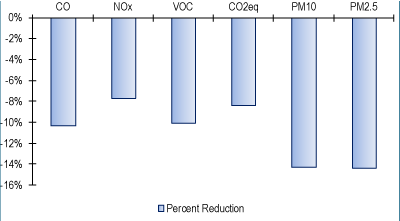
Source: CS analysis of RTTM and DRG move records.
There were some operational constraints to full utilization of C-TIP in Kansas City. For instance, the IMEX dispatch model assumed a loaded container could wait in an intermodal terminal as long as necessary to be matched as a dray backhaul. In practice, this is rarely the case as terminals typically want to move grounded containers out of the yard as quickly as possible. More broadly, the railroad and dray trucking industries may lack the collaborative mentality that would be required for a common dispatch platform to work. This contributed to the lack of railroad participation in the program, which necessitated a ‘what if’ simulation analysis of the IMEX component.
Nonetheless, this initial deployment of C-TIP technologies in Kansas City did prove the concept that such applications can provide public and private sector benefits, including congestion mitigation, emissions reductions, and truck travel time savings. Due to the scale of the test, the measured benefits are relatively modest. Nevertheless, it is reasonable to expect that much greater benefits could be achieved in a larger intermodal market like Chicago, where large scale cross-town container moves between rail yards occur on a daily basis. To assess this scalability, this evaluation implemented a Delphi assessment of a theoretical Chicago C-TIP deployment. (Delphi is an analytical method that relies on a panel of subject matter experts to develop a consensus opinion on a given topic through iterative polling.) The results of this assessment revealed general agreement among intermodal industry experts that substantial benefits could be achieved. For example, panelists’ expert consensus was that RTTM and DRG could achieve travel time savings of 5-10 percent per trip for Chicago cross-town dray movements, and that bobtails could be reduced by more than 15 percent per day.
The positive results obtained from DRG and RTTM in Kansas City, along with drayage optimization tests in Kansas City and Chicago, suggest that future research may be best targeted towards freight information exchange, improving the truck dispatch operation, and in providing real-time information and tools to support truck routing decisions. However, use of C-TIP by the intermodal industry was more limited than expected, and a key factor here was the choice in taking a government systems engineering approach to developing a system from the ground up. This approach, while technically sound, took several years to complete, by which time both the initial C-TIP industry champions and the smart phone and information technologies available in the marketplace had changed.
The C-TIP experience points out an opportunity for future U.S. DOT tests to be based more on emerging applications being developed by the private sector. Mindful of the C-TIP experience, FHWA-OFM already is moving in this direction with the Freight Advanced Traveler Information System (FRATIS) Concept of Operations. As part of a new, more responsive private-sector-centric approach to testing and deploying freight technologies for U.S. DOT programs, this project will develop concepts for three FRATIS application ‘bundles:’ freight real-time traveler information with performance measures, freight dynamic route guidance, and drayage optimization.
previous | next
