




INFORMATION SHARING FOR TRAFFIC INCIDENT MANAGEMENT
Coordination between Public Safety and Transportation Agencies
Information dissemination is most effective when a centralized location, such as a TMC, is used as an information clearinghouse for response efforts. This reduces redundant notifications, improves accuracy, and keeps on scene responders from being distracted by repeated requests for information that detract from activities that require their attention. It allows responders to focus on their mission and adjust as scene conditions warrant until the roadway is finally reopened.
Inter-agency communication is critical to achieving effective on scene traffic incident management. Issues with intra- and inter- agency communications become more critical when the incident response is complex or spread out over a large area. Strategies used to improve communication include the following:
- Conducting traffic incident management preparedness training exercises,
- Adopting common communications and data transmission standards,
- Adopting and using ICS practices to manage traffic incidents,
- Establishing electronic paging or an email alert system for notifying incident responders, and
- Developing a matrix of radio frequencies used by scene incident responders.
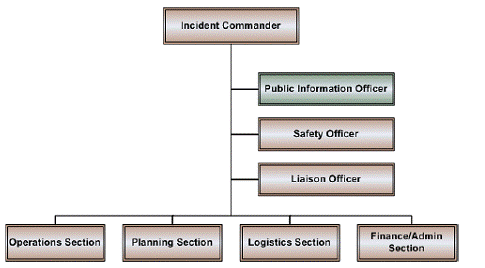
One way to achieve coordination between agencies is to make use of a public information officer (PIO) as described in the National Incident Management System (NIMS). This person is a central point of contact, reducing redundant information requests made by the public, news media, and other entities regarding incident-related information. As shown in the ICS Organizational Chart in Figure 6, the PIO reports to the Incident Commander and communicates with the public, media, or other agencies regarding incident-related information. These efforts are critical to effectively help the response and public community as they navigate around the incident scene.
Key steps that a PIO (or other individual designated as a point of contact) follow are:
- Gather information from the Incident Commander and general staff who comprise the source of official outgoing information on response efforts
- Verify information by consulting with response specialists
- Internally coordinate the information
- Disseminate the information externally to the public, affected jurisdictions, private sector, media, and other impacted groups
Figure 6. ICS Organizational Chart 4
Another aspect to consider when coordinating between agencies is public outreach during non-incident situations. PIO staff can assist with education efforts about traffic incident management procedures, motorist assistance or courtesy patrols, “Move-It,” or quick clearance policies, etc., through public education campaigns and press releases. These activities can greatly enhance compliance with “Move-It” laws and, thereby, enhance responder safety.
The media should also be considered a partner in disseminating information about incidents and TIM procedures and policies as they can be a fast, reliable means of disseminating information about incident conditions and travel alternatives to the traveling public.

