






About the Guidebook
Work Zone Operations Best Practices Guidebook
U.S. Department of Transportation
Federal Highway Administration
Office of Operations
Work Zone Mobility and Safety Program
1200 New Jersey Avenue, SE
Washington, DC 20590
Phone: 202-366-9210
Fax: 202-366-3225
Web site: https://www.fhwa.dot.gov/workzones
July 2013
Publication No. FWHA-HOP-13-012

Foreword and Acknowledgments
This Guidebook is the third release of a resource designed to give State and local transportation agencies, construction contractors, transportation planners, trainers, researchers and others with interest in work zone operations access to information and points of contact about current best practices for improving work zone mobility and safety. The Guidebook is available in two formats: a print version, which can be ordered by mail or downloaded as a PDF and printed, and a web-based, searchable version. The PDF and web-based versions of the Guidebook are available via the Federal Highway Administration Office of Operations work zone website: https://www.fhwa.dot.gov/workzones. Printed copies of the Guidebook can be obtained by sending an email with the name of the publication you are requesting, number of copies needed, and shipping directions, to workzonefeedback@dot.gov.
In addition to the collection of work zone best practices and associated cross-references, the Guidebook includes three forms designed to make the Guidebook more useful to current and future users. These are 1) a registration form, 2) a best practices submission form, and 3) a best practices review and comment form. Please complete the registration form so that you can be included in distributions of future editions of this document and notified when updated information is available.
The Guidebook's origins date back to the June 1999 American Association of State Highway and Transportation Officials (AASHTO) Meeting of the Subcommittee on Traffic Engineering (SCOTE). At that meeting, the Director or FHWA's Office of Transportation Operations and the Chairman of the AASHTO SCOTE Best Practices in Work Zones Task Force agreed to collaborate on the development, publication, and distribution of a Work Zones Best Practices Guidebook that would give practitioners easy access to these best practices. Since then, AASHTO and FHWA have continued to work together in the development of the Guidebook. AASHTO provides subject matter expertise and access to practitioners, while FHWA provides national coordination, research, and publication support.
In preparation for this version of the Guidebook, the Task Force provided a review of new practices being considered for addition to the Guidebook and provided recommendations for deleting, revising, and combining existing best practices. In addition, State points of contact reviewed their practices and provided recommended updates and additions, as well as deletions of practices no longer in use. FHWA also reviewed all practices, and combined some similar practices to avoid repetition. As a result of these efforts, the Guidebook has been significantly updated:
- 23 new practices were added to the Guidebook in this version.
- 66 out-of-date practices were deleted.
- 3 practices were combined with others for clarity
- Nearly all of the 172 practices were updated.
Notice
The Federal Highway Administration provides high-quality information to serve Government, industry, and the public in a manner that promotes public understanding. Standards and policies are used to ensure and maximize the quality, objectivity, utility, and integrity of its information. FHWA periodically reviews quality issues and adjusts its programs and processes to ensure continuous quality improvement.
Overview of the Guidebook
This Work Zone Best Practices Guidebook provides an easily accessible compilation of work zone operations best practices and policies used by various States and localities around the country. The Guidebook is a reference document that can be updated with new approaches, technologies, and practices for effectively managing work zones and reducing the impacts of work zones on mobility and safety. The best practices are descriptive, not prescriptive. That is, they describe approaches that have been successfully used by transportation agencies, along with contact information to find out more from the agency using the practice. Each organization must determine which of these practices are best suited for its particular situation, considering all the site-specific factors that affect work zone operations.
The best practices are grouped into 11 major categories to help practitioners easily find practices that deal with a particular topic. Each of the 11 major categories has its own section in the Guidebook. Each section has a description of the category and a brief summary of the types of activities found in that category, followed by each of the work zone best practice entries in the section. The entry for each practice includes:
- Category/Subcategory Name and Reference Number for the Best Practice
- Best Practice Title
- Description of the Best Practice
- Reason(s) the Agency Used the Best Practice
- Primary Benefit(s) Being Realized from this Best Practice
- Most Applicable Location(s) and Type(s) of Projects Where this Practice Is Most Effective
- Contact(s).
In addition to the category and subcategory designations, practices can be found via cross-references, a subject index, and an online keyword search. The six cross-references allow practitioners to identify best practices based on where they were observed, when in the project life cycle stage they are used, the nature of the work zone activity, traffic conditions in the work zone, geographic or demographic characteristics, and the type of roadway involved. The Guidebook also contains a subject index that has 49 topics and subtopics for more specific searches. The online version at http://www.ops.fhwa.dot.gov/wz/practices/best/bestpractices.htm also enables users to find practices by searching on a keyword/term of interest.
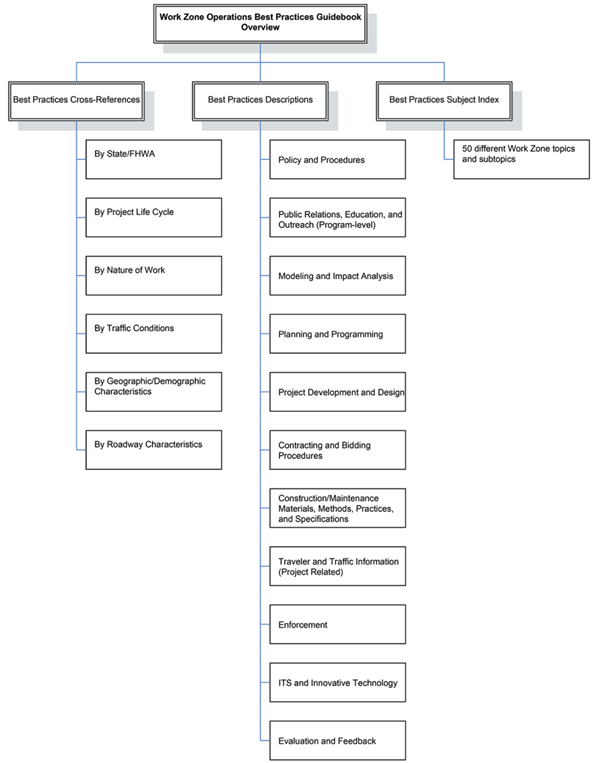
Figure 1. Guidebook Organization
Technical Report
| 1. Report No. FWHA-HOP-13-012 |
2. Government Accession No. | 3. Recipient's Catalog No. | |
| 4. Title and Subtitle Work Zone Operations Best Practices Guidebook |
5. Report Date July 2013 |
||
| 6. Performing Organization Code | |||
| 7. Authors Various |
8. Performing Organization Report No. | ||
| 9. Performing Organization Name and Address Science Applications International Corporation (SAIC) 11251 Roger Bacon Drive Reston, VA 20190 |
10. Work Unit No. (TRAIS) | ||
| 11. Contract or Grant No. DTFH61-06-D-00005 |
|||
| 12. Sponsoring Agency Name and Address Federal Highway Administration 1200 New Jersey Avenue, SE Washington, D.C. 20590 |
13. Type of Report and Period Covered | ||
| 14. Sponsoring Agency Code HOTO |
|||
| 15. Supplementary Notes Project Leader - Tracy Scriba, FHWA |
|||
| 16. Abstract This Work Zone Best Practices Guidebook provides an easily accessible compilation of work zone operations practices used and recommended by various States and localities around the country. The Guidebook is a reference document that can be updated with new approaches, technologies, and practices for effectively managing work zones and reducing the impacts of work zones on mobility and safety as they are identified. The best practices are descriptive, not prescriptive. They describe approaches that have been successfully used by transportation agencies, along with contact information to find out more from the agency using the practice. Each organization must determine which of these practices are best suited for its particular situation, considering all the site-specific factors that affect work zone operations. The best practices are grouped into 11 major categories to help practitioners easily find practices that deal with a particular topic. Practices can also be found via six cross-references that enable users to find best practices in several different ways, and a subject index that offers 49 topics and subtopics for more specific searches. The Guidebook is available in two formats: a print version, which can be ordered by mail or downloaded as a PDF and printed, and a web-based, searchable version. |
|||
| 17. Key Words Work zone, best practice, safety, mobility, guidebook, construction, maintenance, road rehabilitation, policy, planning, design, traffic analysis and modeling, construction methods, contracting, traveler and traffic information, traffic management planning, work zone management, worker safety, work zone ITS. |
18. Distribution Statement No restrictions. This document is available to the public. |
||
| 19. Security Classif. (of this report) Unclassified |
20. Security Classif. (of this page) Unclassified |
21. No of Pages 292 |
22. Price N/A |
Form DOT F 1700.7 (8-72) Reproduction of completed page authorized.

