John Austin, Janet Walker, and John Miles
March 4, 2002
Introduction
This review of the document ATIS U.S. Business Models Review [5] is written from a European perspective and is provided for use by members of the ATLANTIC forum (Telematics-based Traffic and Travel Information (TTI) services). It aims to investigate what lessons can be drawn for Europe from the US experience, and to offer examples of European projects in this field to aid US practitioners [6]. It is being placed on the ATLANTIC website for use by members of this forum and is arranged in the following sections.
The report includes a number of hypertext links direct to documents on the Web. These documents are not yet available on the ATLANTIC website itself.
1 Justification / Priorities for ATIS in the US
The justification and priorities for ATIS in the US seem to differ somewhat from those in Europe. This affects the mix of ATIS projects receiving investment in the two areas.
In general terms, Europeans are not as reliant on the car as Americans. In Europe there is widespread use and support of public transport and multimodal public transport. The US does not have the level of modal integration found in Europe. Indeed, we infer that continued, coordinated investment in transit ITS applications is generally a low political priority because to make it otherwise would challenge a prevailing political and social consensus (see Section 3 below).
Another relevant factor is that many European cities are much older than their US counterparts and consequently there is a stronger commitment in Europe to protect cities from traffic-induced cultural damage.
So in Europe the emphasis on intermodality is clear, starting with The Citizens' Network [7], which argued that car use actually contributes in many urban areas to a loss of mobility, through more pollution, accidents and congestion. It emphasized that R&D priorities (including those in the areas of ITS) should be aligned with user needs and as part of that there had to be a strategy for increasing the use of public passenger transport. Alongside the publication of The Citizens' Network was the European Commission's Transport Intermodality task force, which aimed to contribute to the development of technologies and systems which improve intermodal transport operations. More recently, the European Commission has just produced its White Paper 'European Transport policy for 2010: time to decide' [8], which states that "journeys have to be thought of as continuous, which means land-use and town-planning policies will play a vital role. The main, metro, train and bus stations should be geared towards exchanges between the car and public transport, ..., and so encourage the use of public transport, which causes less pollution." [9] There is an implicit recognition here that for many journeys it is not practical or desirable to use the car for the complete length of a journey.
Increasing safety and allowing increases in speed are still very important for Europe, and the former is particularly important for raising the level of Europe's competitiveness. However, they are far from being the only issues.
2 Organizational / Governmental and Business Structural Factors and Impacts
2.1 Europe
Increasingly, traffic management in Europe is having to be carried out at a European scale – in France during peak holiday periods, about one third of cars are foreign. Traffic on Europe’s roads is increasingly being managed by a growing number of national, regional and local traffic centers whose operators speak more than 20 languages. Cross-border traffic is growing faster than national traffic in many cases, and interoperable data exchange is therefore a prerequisite for almost all ITS services. Thus European systems need to become compatible, transferable and interoperable – this would make things easier for consumers and also expand the market for services and products.
Within Europe there is considerable diversity amongst countries in the basic institutional and legal frameworks related to transport, particularly in the roles of the road and police authorities and in the involvement of the private sector. Setting a framework of rules and guidance, and removing institutional barriers to new patterns of service is seen as one of the key roles that the public sector has to assume, given its concern with safety, protecting natural resources and securing efficient mobility.
In order to stimulate the deployment of road transport telematics within Europe the European Commission has recently launched a 'Recommendation on the development of a legal and business framework for the participation of the private sector in deploying TTI services in Europe'. It forms the principal reference for the description of the national context and singular services, in particular concerning the following key tasks for TTI service deployment: [10]
This recommendation encourages European countries to take a harmonized approach to trans-European telematics-based traffic and travel information services. It encourages the public sector to take full advantage of data and information sources that are available through public authorities in order to secure economy (and reliability) of supply, which are necessary for the widespread deployment of TTI services. Although there are widespread differences in approach between countries, particularly regarding the level of public-private sector involvement in telematics services, they all have the basic requirement that the information chain must be complete in order to be able to deliver the service.
Recognizing the need to stimulate the provision of high-quality travel information across Europe, the European Union (EU) has also been pro-active in integrating different approaches for the exchange of traffic and travel data/information into an interoperable solution that is known as the DATEX-Net specifications. The relevant Memorandum of Understanding provides the basis for cooperation between authorities on information exchange, and between the private and public sectors.
2.2 US
By contrast it appears that the present organization of the public sector can pose significant barriers to the delivery of ATI services in the US. The fact that both state and union have transport departments can create a tension between federal and state priorities. Responsibility for transport may be divided between a number of politically separate agencies that are competing for public funds: this can lead to an adversarial culture. Examples of the different types of transportation agency below the level of the state include county Department of Transport, City Department of Transport, separate highways agencies for tolled and non-tolled roads, and multiple levels of transit agency for regions and cities within those regions). However, in Europe this structure is comparatively rare. Indeed where different agencies exist they may be required by law to work together on certain tasks. In the UK local metropolitan district highways agencies are required to work with metropolitan transit authorities (PTAs: Passenger Transport Authorities) to produce area five-year Local Transport Plans.
The difficulties in inter-agency cooperation necessary for ATIS introduction in the US are implicitly recognized by the fact that overcoming them is seen as a mark of success. For instance, the Georgia Navigator website [11] states that "What sets Georgia's system apart from other transportation management networks around the country is the high level of inter-agency integration it has achieved."
Another complication arises through geography, where several significant urban areas (and therefore potential areas for ATIS) cross state lines. Examples include New York / Newark (NY / NJ), greater Chicago (Illinois / Indiana), greater Washington (D.C / Maryland / Virginia), Kansas City (Kansas / Missouri) and St Louis (Missouri / Illinois). In Europe the crossing of state lines by travel-to-work areas is perhaps less common, but the fact that cross-border travel is growing substantially has increased the rationale and pressure for European-wide compatibility and solutions.
Although the unification of traveler information services in the US requires the cooperation of numerous organizations, there may be no incentive or business case for cooperation, while sometimes there may be an actual disincentive to cooperate. The implication of this is that different data collection methods may be in operation. Another consequence of the difficulties of inter-agency cooperation may be that it can be easier to solve problems through technological solutions, made possible as federal or other government funding becomes available, rather than through ensuring inter-agency partnership.
The building of effective business relationships may also be constrained by the motivation of public agencies that can be less to grow their income in order to finance future investment than to preserve what has been funded by tax dollars. This would particularly be the case if the financial structure of the public authority allowed no link between departmental revenue and benefit to that department. The report on the ATI system in the Boston Metropolitan Area (in Appendix A of the US ATIS update report) seems to support this view. However, a culture of preservation and safeguarding what has already been spent could result in a tendency to avoid innovation and to be wary of business relationships with the private sector.
For the delivery of transit or multimodal ATI systems the use of different data systems means that integration of information focuses upon integrating multiple data sources for a single mode, rather than the integration of information about multiple modes into a single information source. Urban transit services rely heavily on public funds and can therefore change significantly at quite short notice due to changes in political control and changes in tax funding. Therefore it may not seem worthwhile to produce integrated transit and road traffic information.
3 Socio-economic Factors (Land-use planning / population spread / cultural determinants impacting on spending priorities)
There are several socio-economic factors which impact on the success and characteristics of ATI systems and which are different as between the US and Europe.
Firstly, in the US the car culture is firmly embedded. Because of land-use patterns, ownership and access to a car is necessary in nearly every part of the US, since transit is non-existent or very infrequent. Also, normal travel distances tend to be much longer than in Europe, and, partly as a result of both of these factors, car ownership and the freedom that it gives is seen as a fundamental right.
Secondly, bus transit services are viewed as the transport mode of the poor, whilst suburban rail transit services may be slow and sometimes infrequent, particularly if the tracks are shared with freight services. This therefore means that there are formidable social barriers to the provision of public transport information and this makes it hard for politicians to challenge the car culture by investing in ATI systems that provide both transit and traffic information.
The older settlement pattern in Europe, and the lack of availability of land for expansion means that, despite the personal freedom and benefits that car travel brings, there is a growing recognition that intermodality between private and public modes has to increase (see Section 1 above).
4 Business Contract Issues
4.1 Europe
At the start of the information chain, many European countries are developing business frameworks for the supply and use of public data and information sources, contracts for deployment of privately operated traffic monitoring equipment on the highway, and guidelines for the design and installation of private traffic monitoring units.
In the Ile-de-France the "Agence de Presse" model has been developed. The Agence de Presse acts as wholesaler of traffic information to private sector providers such as Skipper and Mediamobile. Bilateral contracts between each information producer and service operator define the specifications to be respected and a moderate tariff.
4.1.1 Public-Private Partnership and Use of Private Finance: The Highways Agency Traffic Control Centre (TCC) Project – UK
In England the Highways Agency is responsible for the maintenance and operation of strategic highways. A new national traffic management and information system has been procured through private finance and is due to be operational by 2004. The TCC project objectives are achieved through the promotion of information services, in part operated by the concession-holder on behalf of the Agency, with payment on a service-output basis, and in part data and information services supplied on a fully commercial basis. Specific objectives of the project are to:
A private finance contract was chosen because of the relative success of PFI contracts in the UK road-building sector. The PFI contract provides the opportunity for some risk transfer from the public to the private sector, and also to develop services with a strong customer focus. The TCC contract is intended to be a vehicle to exploit commercial value of Highways Agency data and encourage growth of a market in Value-Added Service Providers (VASPs).
A 10-year concession has been negotiated between the Agency and the TCC consortium. What is especially interesting is the way the contract is structured around service output requirements. This leaves the consortium free to adopt any cost-effective system design that would meet the specification.
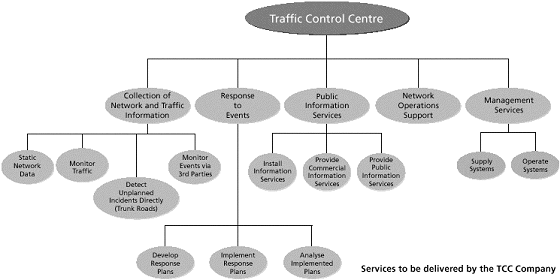
The services are grouped into 5 main categories (see diagram), of which Group A Collection of Network and Traffic Information and Group C Provision of Public Information Services are central to the delivery of information services. The second diagram shows the conceptual basis for the information services.
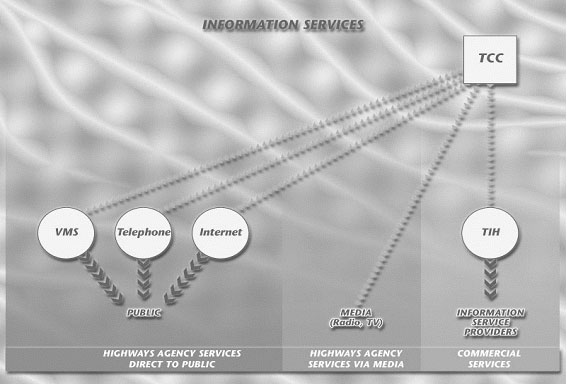
Specific data collection requirements for the TCC to secure (on a service charged basis) are:
The public information services that the Agency requires are:
However, the TCC consortium also has the opportunity to service commercial information services through contract "rights" to exploit the TCC data, under certain conditions:
The wider issues raised by this project, for discussion in the ATLANTIC forum, are:
4.2 US
According to the US ATIS Update Report there appears to be low profitability for the private sector through participating in ATI systems. It is conceivable that the amount of complexity involved in negotiating agreements and in obtaining robust data means that the private sector's business case for involvement is weak.
In Europe it seems that value-added comes through multiple deals with agencies in different sectors (including intermodality, which is largely not an issue in the US), and through establishment of a single data source for the base traffic / real-time data to provide a one-stop shop. In the US this appears not to be possible because there is not one single-source of traffic data. Also if the right to drive freely is seen as a "fundamental human right" then there will be a belief that information to assist this should not be charged for. So consumers will be reluctant to pay directly for travel information.
5 Data Collection Issues
In Europe there is a growing recognition that high quality data is an essential prerequisite for the development of travel information systems. Generally the recognized role of the public sector is to ensure the provision of better information so that the traveling public can make better informed choices about whether or not to travel, when to travel, and which mode and route to take.
Within Europe most traffic information is collected by public road authorities and their agents as an essential part of traffic management and control. Some have invested heavily in traffic monitoring equipment, installing loop detectors and other sensors. Increasingly probe vehicles are being utilized to provide traffic data, often involving commercial interests. In France and the Netherlands traffic monitoring on public highways (not toll roads) is solely the responsibility of the owners and operators of the road infrastructure. This is not the case in Germany and the UK where agreements are in place for the private sector to install independently operated detection and monitoring sites. For fixed infrastructure-based data collection there are four alternative organizational models in Europe:
6 Data Fusion Issues
Processing raw data to produce useful and marketable information is a key step in the information chain. In some European countries (e.g. France and the Netherlands) the business of processing information content from public data sources is retained under public sector control. Service providers may take these official feeds along with their own independent data sources to develop the information content for their products. In Germany the joint venture company DDG supplies raw data to two competing service providers – Tegaron and Mannesman Autocom. The two partners therefore collaborate on data collection but compete in the market on their information supply and product ranges.
In the UK Trafficmaster is entirely privately financed and has gradually extended its span of operation. The Trafficmaster operation covers the entire information chain, from data collection, through to information dissemination to the end-users. The company has clear entitlements to install its own traffic monitoring equipment on motorway overbridges under the licenses granted by government. Control of the entire information chain means that Trafficmaster can direct all aspects of its operation including coverage (both in time and space), reliability and, more importantly its own costs.
In the US, by contrast, it appears that there are many formats in which traffic and transit data are currently collected and provided. Technical protocols for data differ across organizations. Individual websites can often not interrogate other web sites to provide integrated information because the information is written in a different language or is written in HTML. It seems to be recognized that the lack of data standards is a key barrier to the integration of data.
In Europe the largely coordinated approach to traffic and travel data appears to have resulted in the establishment of a robust value chain and the identification by key players of profitable positioning points within that value chain. For instance, Webraska, now an important worldwide provider of location-based services and telematics software solutions, was able to establish itself by opening new markets through integrating mobility, Internet technology and navigation. The existence of coordinated and compatible data relating to travel meant that there was a profitable opportunity for car manufacturers to nurture their relationship with their customers beyond vehicle purchase by providing map-based traffic and travel information while on the move; and Webraska was able to provide them with the means to do this. Because the raw data exists in a suitable format, Webraska can supply its clients with integrated, platform-ready datasets created from data on digital maps, real-time traffic and public transport networks sourced from other suppliers.
A limited parallel can be drawn between car traffic and travel information services in the US and the Traveline public transport (transit) information service in the UK. Both involve multiple data sources, sometimes with data structures that may be difficult to integrate or data definitions that involve compatibility problems. However, the initiative for the Traveline service has come from central government, national standards are being devised, larger service-provider groupings are beginning to emerge, and increasingly partnerships are being formalized (e.g. limited companies are being set up to deliver regional services). Traveline is effectively a precursor of Transport Direct (see Section 8A). And a number of UK data standards and consistent databases are being devised, including TransXchange for transferring transit data, JourneyWeb for allowing one transit travel-information enquiry system to interrogate another, and a national database of bus stops. At a European level there is the Transmodel data structure, whilst EU-Spirit is an enquiry protocol similar to the UK's JourneyWeb.
7 Issues of Data Repackaging / Transforming
In Paris, Mediamobile provides a commercial traffic information service - Visionaute is a graphical display that provides travel time estimates and route selection to motorists in Paris. Real-time information is collected from various sources, and gathered and broadcast to in-vehicle terminals, which then present the data according to the trip selection made by the driver. The successful launch of these services in part reflects the lengthy discussions that have taken place between public and private partners to determine the legal and contractual framework under which these services may operate. Much of the data comes from a taxi company.
Several of the French autoroute companies are undertaking pilot trials forecasting travel time to users. Some are using an expert system that also simulates how congestion will build up.
RDS-TMC important is now becoming available in Europe. The first commercial RDS-TMC service in the UK (ITIS's Traffic Message Channel) uses data from a growing variety of reliable sources and this data is integrated with the car itself. ITIS uses both data from the Trafficlink network of journalists and helicopter sources and also "floating car data" obtained, through exclusive deals, from the major scheduled inter-city bus ("coach") operator National Express Ltd, (akin to Greyhound but with a much more intensive service on some inter-city routes) and Eddie Stobart Ltd., a major hauler company.
ITIS has developed a range of location-based services for delivery in conjunction with an in-vehicle GPS/GSM data collection unit. One example is TrafficWatch, a proactive traffic alert system that uses the Telematics Unit to establish and track a customer's position. Users are then informed via their mobile phone of any significant traffic problems ahead of them as and when they occur. If the driver deviates from the suggested route, the system is sophisticated enough to automatically recalculate the journey using the new route, advising the driver of the traffic conditions ahead on this route.
Such services can be branded for ITIS's own business customers.
Trafficlink is another provider of travel information services, serving a relatively small, tightly populated area (i.e. the UK) over which it is possible for journalists to gather data. Trafficlink was launched in 1995 and now has over 60% of the radio broadcasting market and also delivers to other industry sectors. It has a large team of traffic analysts with extensive experience in collating, interpreting and understanding transport data. They use sources as diverse as the emergency services, road traffic monitoring cameras and urban CCTV cameras, taxi, courier, utility and public transport companies. With around 25 million weekly listeners to their traffic bulletins on client radio stations, they also learn of a considerable number of incidents from calls to their "jamlines".
In the UK traffic congestion is a problem in many areas at certain times of the day. In the US it appears to be a problem only in certain areas (cities). So in the UK global solutions can work as the country is small enough for suppliers to be able to manage them.
Trafficmaster is another UK-based service, covering over 8,000 miles of motorway and trunk roads in England, Scotland and Wales. Trafficmaster's real-time traffic information service is derived from data supplied by a network of fixed infra-red sensors mounted on overbridges (motorways) and Passive Target Flow Measurement "blue pole" cameras at the roadside (trunk roads). Traffic information data is further augmented through access to the RAC and several other incident databases, which supply additional information where appropriate to each Trafficmaster service. The Trafficmaster UK network is now claimed to be complete except for minor additions or amendments as new roads are built or reconstructed.
8 Incorporation of Transit Data: Multimodal Travel Information and Integrated Multimodal Travel Information
In the UK, Transport Direct is a recent Governmental initiative to provide a travel information service that can present the public with the opportunity to compare travel options across private and public transport modes.
Underpinning this work are UK initiatives like the Travel Information Highway, which is a mechanism for the exchange of travel data in near real-time for all forms of travel using a common framework over the Internet. The TIH operates across jurisdictional boundaries, protects the ownership and integrity of data, caters for legacy systems, and uses open Internet protocols.
The Traffic Control Centre (TCC) Project will provide real-time information for most of the strategic road network. This information will be integrated with information collected from other Government initiatives looking at other transport modes. The TCC Project is being funded as a Private Finance Initiative, whereby the service provider is allowed to decide how best to carry out the required services in order to meet the performance criteria set by the Highways Agency. The TCC Company will be paid according to the quality of the service outputs; it may also generate additional revenue by providing real-time information to all interested parties on a non-discriminatory commercial basis.
9 Customer Preferences and Priorities: Market for Data Dissemination
Travelers are not a homogenous group and there is an incompatibility between the needs of the traveling public as a whole and the needs of individual travelers. Often there is public ignorance of travel information services, particularly amongst disadvantaged groups who might most benefit from them (e.g. lack of Internet access). Information service providers must be proactive in raising awareness e.g. TheTrainLine in the UK.
The European Webraska Askaroute system claims to offer to any European Wireless Application Protocol (WAP) phone user, a service to find his way anywhere in his own language, through obtaining information on any mode. In the UK, Kizoom produces services to deliver personalized information over the mobile Internet via WAP, SMS and other relevant protocols. Its first major success was a personalized, mobile version of Railtrack’s web-based national rail timetable.
In Holland, Travelstar provides Dutch motorists real-time traffic and transport information on the move using RDS-TMC technology and pocket color PCs vital for map-based applications.
The EC PROMISE program has pioneered a convenient approach to the need for continuous traveler support by developing a range of portable personal travel assistant terminals – mobile phones and hand-held PCs – which give easy and direct access to dynamic multi-modal travel and traffic information throughout the entire journey, using wireless data communications. Intended for deployment Europe-wide, PROMISE aims to help business travelers and tourists.
10 Consumer Attitudes / Evaluation and Willingness to Pay
Information systems that do not confine themselves solely to travel information are likely to extend the marketability of such systems – e.g. adding tourist information etc.
The UK’s Trafficmaster service is a good example of a commercial information service. This demonstrates that motorists are prepared to pay for personalized in-car travel services and systems. Revenue comes from generating sufficient subscribers, and involves increasing market penetration in line with increased investment in systems to provide enhanced services. Trafficmaster has built its own infrastructure for generating data and, in contrast to multi-modal services that rely on a partnership across organizations in terms of the information chain, Trafficmaster has full control. Partnership is more of an issue for selling services.
Trafficmaster is now expanding in continental Europe. Following an open offer in 1999, Trafficmaster raised £66million to fund its European expansion strategy. A fixed-sensor traffic information network is now in operation across the whole autobahn network in Germany, with France and Italy to follow. Trafficmaster believes it is important that high quality live traffic information is available across the main markets in Europe as car manufacturers are demanding a pan-European solution for in-car systems. Germany is central to the company’s expansion strategy, being the largest single car market and home of the engineering operations of the major manufacturers and to reflect this Trafficmaster has established a new operation in Germany at Hochheim am Main near Frankfurt.
11 Examples of Cross-Atlantic Companies Offering ATIS Services
Trafficmaster has recently acquired Teletrac, Inc of Vista, California and believes that this provides a strong platform for expansion in the US market. Trafficmaster intends to integrate its own proprietary technologies, including fixed and mobile (probe) sensors into Teletrac’s established wireless network, to enhance the latter's capabilities and provide vehicle flow monitoring to supplement its existing services.
12 Effect of Public Sector Support on Business Success
Those US ATI systems that are most successful, as mentioned in Section 4.0 of the US ATIS Update Report, seem to share the characteristics of clear data management systems strongly supported by the public sector and a strong focus from the center on pushing through the project. However, they are also characterized by significant public sector financial expenditure and do not necessarily involve formal agreements. The European experience is that formal agreements are usually a prerequisite for avoiding heavy public-sector financial support. Europe's experience is also that public-sector involvement in providing the data-structure and data-availability frameworks and the policy framework are all vital for profitable private-sector involvement.
13 Policy Recommendations
Business confidence is vital to the participation of the private sector in ATI services and systems. It is suggested that this can be assisted by the following policy features:
14 Conclusions
In general terms European agencies provide a greater amount and range of Advanced Traveler information to road users than in the US, where ATIS systems are often seen as an extension to traffic management systems. European countries have a greater proportion of roads "wired" than the US, although new technologies – such as probe cars – should help to address this problem.
Viable service provision needs close cooperation with all service chain providers, both private and public. Public authorities may need to provide substantial capital investment required to establish the systems and associated infrastructure. Subsequently private sector operators may be in a position to operate the service on a commercial footing – although with an integrated system this would involve more players and possibly greater costs.
14.1 Why the lack of a self-sustaining business model in the US?
ATIS systems in the US are usually extensions of traffic management systems rather than a more embracing concept of an independent information infrastructure. The development and roll out of "Information Systems and Technologies (IST)" in Europe builds on the convergence of information processing, communications and media technologies. The aim is to promote excellence in the technologies that are crucial to the Information Society, to accelerate their take-up and broaden their field of application. IST has an indicative budget of 3,600 Million Euro, and is managed by the Information Society DG of the European Commission. Thus advanced information systems in Europe may cover several modes, tourism, multimedia booking and payment systems, parking availability as well as the more usual traffic data.
In view of the increase in interregional travel concerning all means of transport in Europe, large projects on multi-modal information and traffic management systems for Trans-European networks have played a major role inside the European Community. A more sustainable mobility is a key factor in prospering societies. Transport networks of all modes have reached their capacity limits in an increasing number of critical links and during extended peak hours. Building new transport networks takes years, a relevant capital expenditure and hard decisions for the environment protection.
It is inferred that these issues are not so prominent in the US and that therefore there is not the pressure or incentive to change the organizational environment necessary to make ATI systems a success. The cultural, land-use and demographic conditions are also different between Europe and the US, and these differences are reflected in the degree to which particular actions relevant for successful implementation of ATIS are followed.
Notes / References:
5. - 'ATIS U.S. Business Model Review' prepared for the U.S. Department of Transportation, ITS Joint Program Office, by Rick Schuman and Eli Sherer, PBS&J, November 2001
6. - The authors drew on the document 'Current trends in research into the integration of traveller information research in the USA', by Susan Kenyon (of Transportation Research Group, University of Southampton, UK), and produced for the Highways Agency, London, UK, for insights into the provision of integrated highways and transit information in the US
7. - 'The Citizens' Network - Fulfilling potential of public passenger transport in Europe' (European Commission, Luxembourg, 1996).
8. - 'European Transport Policy for 2010: time to decide', European Commission, Luxembourg, 2001
9. - ibid., p.78
10. - For detailed information see: C(2001) 1102 final
11. - At http://www.georgia-navigator.com/about.html
Return to ATIS Practices in Europe and North America Report