




Active Management Cycle Guide
Printable Version [PDF, 274 KB]
You may need the Adobe® Reader® to view the PDFs on this page.
Contact Information: Operations Feedback at OperationsFeedback@dot.gov

U.S. Department of Transportation
Federal Highway Administration
Office of Operations
1200 New Jersey Avenue, SE
Washington, DC 20590
ops.fhwa.dot.gov
September 2019
FHWA-HOP-19-013
"Active Management" and "Transportation System Management and Operations" (TSMO) are the fundamental concepts that are core to the Active Management Cycle Guide. Active Management is the concept of improving system operations by moving from a fixed strategy to one that is dynamic and adaptive to current and future conditions. This document provides a brief overview of the Guide, located at https://ops.fhwa.dot.gov/atdm/resources/publications.htm
Steps in the Active Management Cycle
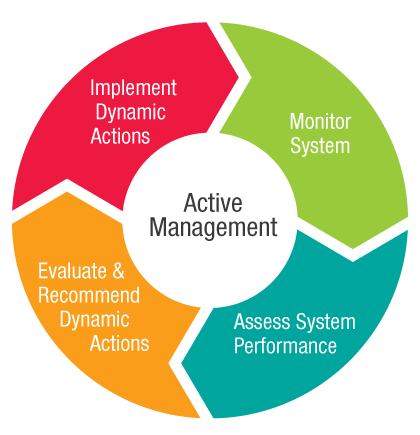
As shown to the right, this cycle recognizes that TSMO strategies are implemented in a standard, and repeating, cycle of activities, including:
- Monitoring the System – Track the transportation system status using real-time and historic data and analysis tools.
- Assessing System Performance – Measure system performance using the collected data and analysis tools to determine if system performance is at the desired level.
- Evaluating and Recommending Dynamic Actions – Identify actions to improve the level of active management.
- Implementing Dynamic Actions – Implement the recommended actions and continue to monitor the system.
Strategy Application; Levels of Active Management
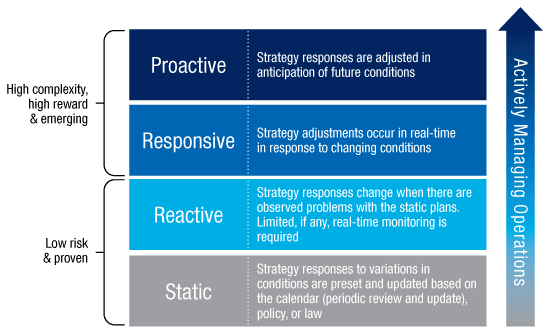
TSMO strategies are designed to improve the operational effectiveness of the transportation system (for example, reduce disruptions, increase reliability, improve safety, or reduce congestion) by reducing the latency between identifying problems and the strategic response. The application of any given strategy (such as incident management, arterial signal optimization, ramp metering) may be based on several time frames for detection and related actions ranging from periodic (in response to changes in conditions) to proactive (in anticipation of imminent changes in conditions). Then the level of active management of any given strategy can be adjusted to be increasingly responsive to actual or even anticipated conditions.
The Active Management Framework
The active management framework combines the concepts of both active management steps and levels. The framework provides a systematic template for transportation agencies to assess their current strategy applications and identify management actions that may be taken to improve the sensitivity of any TSMO strategy to performance (in levels from static to predictive) via specific modifications at each step in the active management cycle. The self-assessment process initially defines the current level of active management for each step in the active management cycle for the selected strategy. Identifying their current level helps agencies identify actions to help them progress to the next level.
Self-Assessment Process Example
The active management self-assessment process can be used by agencies, regions, or states to assess their current Active Management levels, select priorities for strategy improvement, and identify actions needed to make those improvements. It consists of three parts:
- Defining the scope of the self-assessment
- Conducting the self-assessment
- For each individual step
- For the transitions/linkages between steps
- Interpreting the results – developing an action plan
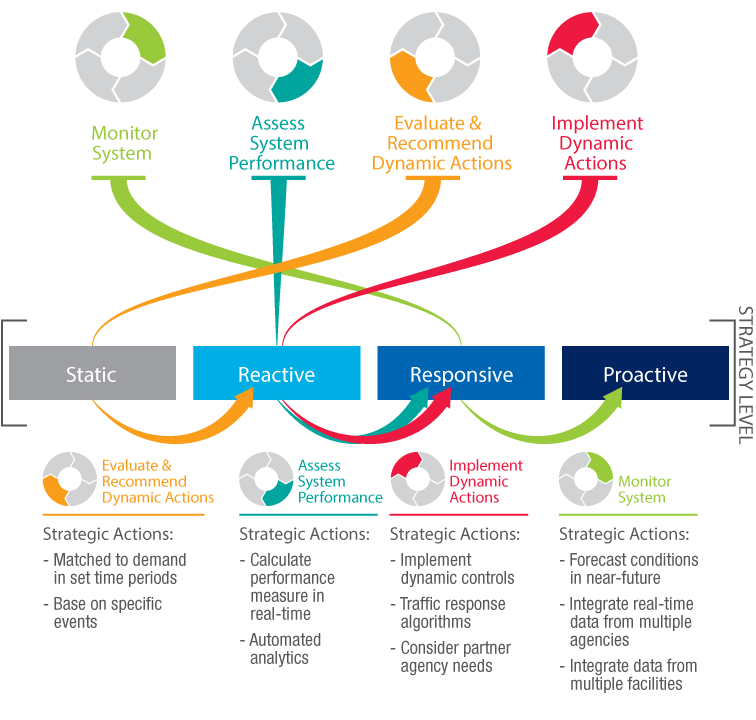
In the example below, for a selected strategy, the agency determined that they currently operated at the "reactive" level for the step Assess System Performance. To improve strategy effectiveness, they then determined that calculating performance measures in real-time and implementing automated analytics would support determining strategy actions in response to specific events, moving them toward the "responsive" level.
For More Information
The Active Management Cycle Guide is available on the Resource page of the FHWA ATDM Program website at: https://ops.fhwa.dot.gov/atdm/resources/publications.htm.
Jim Hunt
Jim.Hunt@dot.gov
(717) 221-4422
James Colyar
James.Colyar@dot.gov
(360) 753-9408
Greg Jones
GregM.Jones@dot.gov
(404) 895-6220

