Office of Operations
21st Century Operations Using 21st Century Technologies

Automated Traffic Signal Performance Measures Case Studies:
Indiana Department of Transportation

Printable Version [PDF, 536KB]
You may need the Adobe® Reader® to view the PDFs on this page.
Contact Information: Operations Feedback at OperationsFeedback@dot.gov

United States Department of Transportation Federal Highway Administration

U.S. Department of Transportation
Federal Highway Administration
Office of Operations
1200 New Jersey Avenue, SE
Washington, DC 20590

FHWA-ATSPM-INDOT

January 2019


INDOT TRAFFIC SIGNAL PROGRAM OVERVIEW

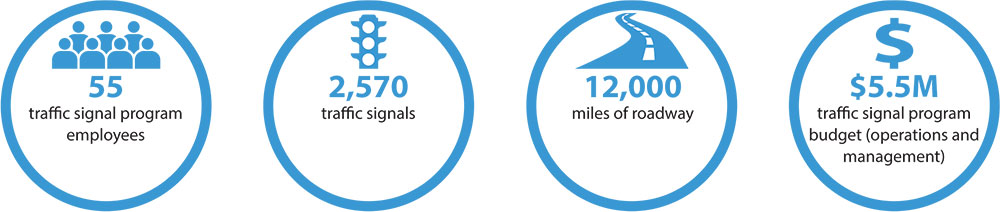
55 traffic signal program employees; 2.570 traffic signals; 12,000 miles of roadway; $5.5M traffic signal program budget (operations and management).

TRAFFIC SIGNAL SYSTEMS CAPABILITY MATURITY SELF ASSESSMENT

The Capability Maturity Model self-assessment framework contains six dimensions of capability. Three are process oriented: 1) Business Processes, 2) Systems and Technology, 3) Performance Measurement. The remaining three are institutional: 1) Organization and Workforce, 2) Culture, 3) Collaboration. With INDOT, All dimensions fall under Level 4, Managed, Low Risk.

Traffic Signal Systems Capability Maturity Self-Evaluation Tool:https://ops.fhwa.dot.gov/tsmoframeworktool/tool/tssc/

ATSPM CAPABILITY

Jim Sturdevant

Photo credit: INDOT

"Our partnerships with the state and local agencies that were part of FHWA Transportation Pooled Fund Study TPF-5(258) were instrumental in developing consensus definitions that the industry could focus on to provide the required data collection capabilities."

Jim Sturdevant, PE
Director of Traffic Management
INDOT

The Indiana Department of Transportation (INDOT) pioneered development of an automated traffic signal performance measures (ATSPM) system as well as the application of ATSPM in real-world decisionmaking. INDOT piloted ATSPMs in 2003 and, by 2008, had implemented systemwide performance metrics supported by high-resolution data. INDOT led the Transportation Pooled Fund Program’s Traffic Signal Systems and Operations and Management TPF-5(258) from 2013 to 2017. The study developed best practices for implementation of ATSPM systems and usage of the data collected. INDOT’s ATSPM system is successfully used to evaluate signal retiming efforts, manage unplanned detour routes and diversions, and monitor programmatic performance measures. INDOT’s ATSPM detection system includes:

  • Stop bar detectors on minor movements
  • Dilemma zone and other detection five seconds prior to stop bar
  • In-pavement detection technologies
  • “Lane-by-lane” detection
  • Product approvals based on performance-based testing
  • Emergency vehicle preemption
  • Railroad preemption

INDOT AND PURDUE UNIVERSITY PARTNERSHIP

INDOT and Purdue University have formed a longstanding partnership that has greatly benefited ATSPM. The partnership was established in 1998 to advance INDOT and Purdue University’s common goal of guiding infrastructure development and procedures to systematically monitor performance and prioritize investments that provide the greatest benefit to mobility.
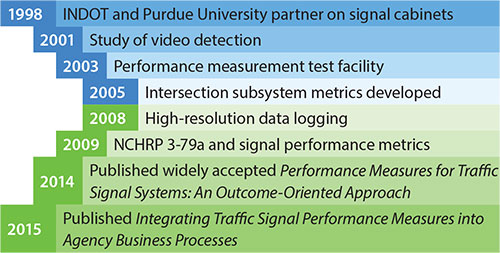
1998 - INDOT and Purdue University partner on signal cabinets 2001 - Study of video detection 2003 - Performance measurement test facility 2005 - Intersection subsystem metrics developed 2008 - High-resolution data logging 2009 - NCHRP 3-79a and signal performance metrics 2014 - Published widely accepted Performance Measures for Traffic Signal Systems: n Outcome-Oriented Approach 2015 - Published Integrating Traffic Signal Performance Measures into Agency Business Processes

INDOT and Purdue University led research that serves as the basis for present day ATSPM programs across the country. In Performance Measures for Traffic Signal Systems: An Outcome-Oriented Approach, the INDOT and Purdue University research team established a methodology for performance evaluation of traffic signal systems using high-resolution controller event data. INDOT and Purdue University share insights regarding the collection and management of signal event data and the infrastructure needed to support ATSPM systems. Performance measures encompass system maintenance, asset management, multimodal signal operations, and assessing the impact of signal retiming activities. INDOT and Purdue University’s Integrating Traffic Signal Performance Measures into Agency Business Processes outlines requirements for implementing data collection and processing into ATSPM programs. This publication uses example performance measures for communication and detector system health, capacity allocation, safety, pedestrian performance, preemption, advanced control analysis, and quality of progression.

Perdue University logo
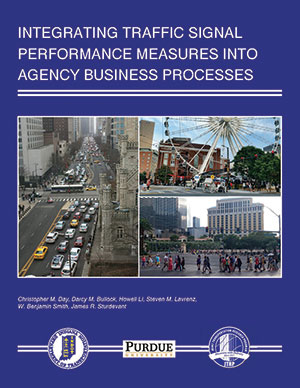
Cover page from Integrating Traffic Signal Performance Measures into Agency Business Processes.
Source: Integrating Traffic Signal Performance Measures into Agency Business Processes (2015, Purdue University)
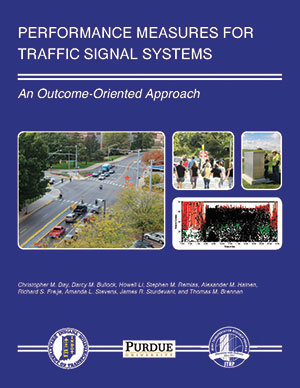
Cover from Performance Measures for Traffic Signal Systems - An Outcome-Oriented Approach.
Source: Performance Measures for Traffic Signal Systems: An Outcome-Oriented Approach (2014, Purdue University)

ADDITIONAL RESOURCES

For additional information please contact:
Eddie Curtis, FHWA Resource Center, 404-562-3920, Eddie.Curtis@dot.gov

EDC Logo

Every Day Counts (EDC), a State-based initiative of FHWA's Center for Accelerating Innovation, works with State, local, and private sector partners to encourage the adoption of proven technologies and innovations aimed at shortening and enhancing project delivery.

www.fhwa.dot.gov/innovation/everydaycounts/

Office of Operations