



Targeted Work Zone Engagement Framework
PDF Version 553KB
PDF files can be viewed with the Acrobat® Reader®.
Contact Information: Work Zone Feedback at WorkZoneFeedback@dot.gov
U.S. Department of Transportation
Federal Highway Administration
Office of Operations
1200 New Jersey Avenue, SE
Washington, DC 20590
FHWA-HOP-17-005
February 2017
TALKING POINTS FOR OUTREACH
Program Purpose
The Federal Highway Administration (FHWA) developed the Targeted Work Zone Engagement Framework to support work zone personnel at State transportation agencies in enhancing the effectiveness of their work zone safety and mobility policies and procedures. This Framework will help FHWA to determine whether a State transportation agency is effectively identifying and eliminating work zone impacts, pursuant to 23 CFR 630.1008. These results will assist State agencies with identifying and assessing their work zone safety and mobility impact mitigation needs, as well as the best resources to improve policies, procedures, and strategy deployments.
Program Features and Benefits
How does it work?
- Uses emphasis areas to help State transportation agencies easily identify goals and mitigation strategies to improve work zone operations with a specific focus.
- Guides agencies trying to assess how policies and procedures align with their emphasis areas.
- Recommends specific resources to best assist agencies in identifying, adopting, and evaluating strategies to improve work zone impact mitigation effectiveness.
What are the benefits?
- Offers a comprehensive, cohesive decision and application Framework for FHWA to best support agencies.
- Assists transportation agencies with determining their strategic needs with respect to work zone safety and mobility improvements.
- Provides strategic assistance on how to best implement improvements in those policies and procedures once they have been determined.
FRAMEWORK PROCESS FLOW
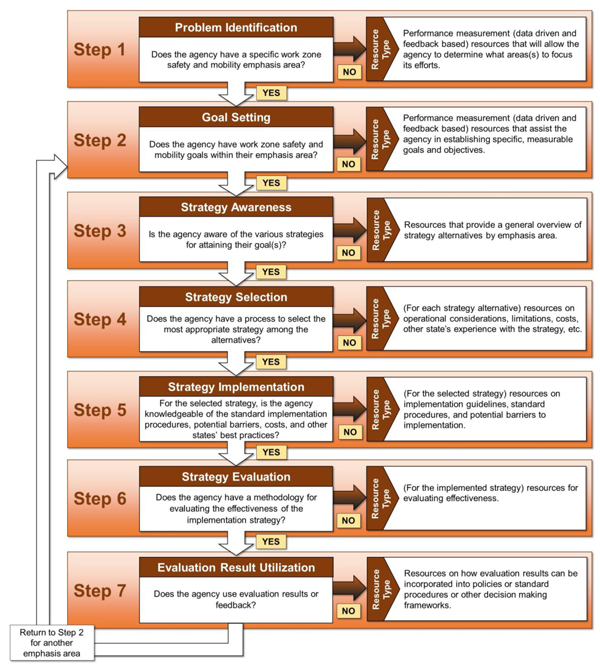
Flowchart Source: Battelle
Frequently Asked Questions
General Questions
What if the State's work zone emphasis areas, goals, and/or mitigation strategies do not fall within those described in the Framework guidance?
This Framework provides guidance to assist States in complying with 23 CFR 630 Subpart J. States may employ emphasis areas not described in the Framework, as long as those emphasis areas create a systematic approach that enables the identification and assessment of safety and mobility impacts in work zones, pursuant to 23 CFR 630.1008. The Framework is structured around four main emphasis areas, with improvement goals and corresponding mitigation strategies that could be employed to help realize those goals. Resources are then cataloged according to the mitigation strategies they touch upon, and the step(s) in this Framework for which they have potentially useful information to agencies. Presently, the Framework is structured heavily around the transportation management planning process established by FHWA several years ago. The FHWA may add new emphasis areas, goals, and mitigation strategies as needed to accommodate advances in technology, business processes, etc.
What if there are resources currently being developed but are not yet listed in the Framework guidance?
The FHWA is continually developing resources to further support transportation agencies in improving safety and mobility within their jurisdictions. As resources are finalized and published they will be available on the following websites:
- National Work Zone Safety Information Clearinghouse: https://www.workzonesafety.org/
- FHWA's Work Zone Management Program Website: https://ops.fhwa.dot.gov/wz/index.asp
How do I get more information regarding the Targeted Work Zone Engagement Framework?
The FHWA's Work Zone Management Team provides information and guidance to FHWA's Division Offices about the Framework to best support State transportation agencies. For more information, contact WorkZoneFeedback@dot.gov or:
Martha Kapitanov
martha.kaptianov@dot.gov
(804) 775-3342
Jawad Paracha
jawad.paracha@dot.gov
(202) 366-4628
Step-specific Questions
Step 1 — What if the State has identified emphasis area(s) but they are vague?
A State agency should be fully aware of its specific work zone challenges and problem areas for FHWA to effectively assist that agency in improving its work zone safety and mobility management. In some cases agency goals and emphasis areas may still be so generic that a clear direction on emphasis areas and possible mitigation strategies to consider does not yet exist. Engagement begins with quantitative and qualitative assessment of current work zone policy and practice outcomes for the first emphasis area.
Step 2 — Must a State agency use the specific goals listed in the Framework?
No, as long as the agency's goals establish a systematic approach that enables the identification and assessment of safety and mobility impacts in work zones, pursuant to 23 CFR 630.1008. Depending on the agency, short-term and/or long-term goals may be established. Agencies may select among the 15 common goals which comprise emphasis areas 2 through 4 of the Framework. Agencies may also choose to combine these common goals and/or develop goals that are similar to, but worded differently, than those shown. In such instances, a review of the listing of mitigation strategies among these generic goals can assist agencies in targeting their efforts. However, goals that are not based on an understanding of when, where, or how work zone safety and mobility issues occur are more difficult to target with mitigation strategies. Such unfocused strategies may not satisfy the requirements of 23 CFR 630.1008 because it is more difficult to target engagement and assistance efforts that will yield measurable improvements in the stated goals.
Step 3 — How does a State determine which mitigation strategies should be considered?
Some agencies choose to implement whatever strategy happens to be popular nationally or regionally, even if a more objective assessment of agency needs and goals would suggest other options. The first step in the Framework reminds agencies to consider the broad range of possible mitigation strategies that may be relevant to their identified needs and selected goals for work zone safety and mobility improvement. The resources provided under step 3 of the Framework provide a basic overview of the strategy or strategies of interest. Many of the resources describe such things as site or project conditions under which the strategies are most appropriate to use; relative costs; expertise required to design, implement, and operate; and examples of other agency experiences with their application.
Step 4 — How does a State determine which factors to consider when selecting a strategy/strategies?
Step 4 of the Framework provides information to help agencies differentiate between strategies when making selection decisions. These could include various operational considerations, limitations, costs, and experiences of other agencies with the strategies. Some resources may cover both awareness-type information of the previous Framework step as well as information useful for making strategy selections. It should be noted that not all of the resources have all of the listed types of information, so agencies may need to review multiple resources during this step of the Framework to obtain enough information upon which to base their decisions. Agency-specific considerations may play a role in this step, such as what strategies (if any) relate to those being considered that are already implemented by an agency, which strategies require staff or consultant training to implement, etc.
Step 5 — How does a State determine how to implement the selected strategy?
Resources that may be useful to agencies at this step include strategy implementation standards, example deployment plans and procedures, staff training requirements, and lessons learned by other agencies that have implemented the strategy.
Step 6 — What types of evaluations are available for assessing the effectiveness of the selected strategy(ies)?
Although evaluations are almost always highlighted as a key activity in any engineering problem-solving Framework, it is something that is usually not planned for or performed. That is why step 6 is explicitly included in the Framework. Depending on the strategy, an agency may desire to assess the level of adoption of the strategy across all or part of the organization, or wish to assess the level of impact that the strategy has had upon the intended goal.

