
Slide 1:
The Development and Evolution of the I-95 Corridor Coalition:
Think Regionally - Act Locally
John Baniak
Executive Director, I-95 Corridor Coalition
Multi-State/Jurisdictional Transportation Issues Forum
June 18 – 19, 2001
Crystal City, VA
Slide 2:
The Coalition is….
A partnership of transportation agencies from Maine to Virginia
A successful model for interagency cooperation and coordination since the early
1990’s
Slide 3:
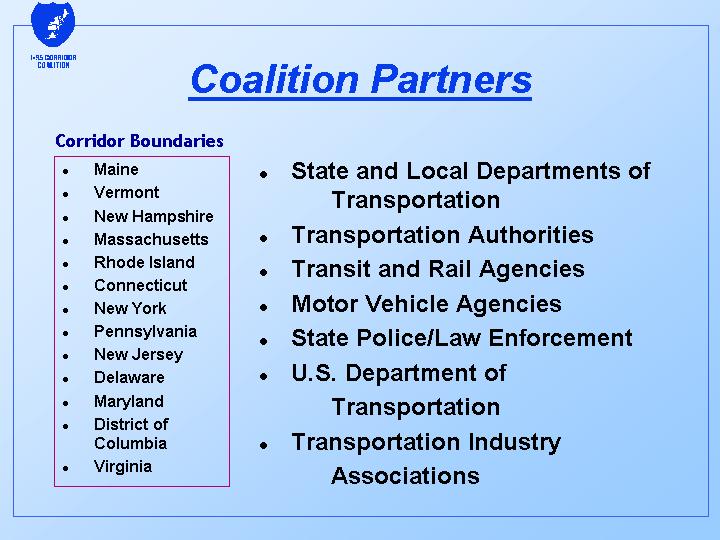
Coalition Partners
Maine
Vermont
New Hampshire
Massachusetts
Rhode Island
Connecticut
New York
Pennsylvania
New Jersey
Delaware
Maryland
District of Columbia
Virginia
State and Local Departments of Transportation
Transportation Authorities
Transit and Rail Agencies
Motor Vehicle Agencies
State Police/Law Enforcement
U.S. Department of Transportation
Transportation Industry Associations
Slide 4:
Vision
The transportation network in the corridor will be safe, efficient, seamless,
intermodal and will support economic growth in an environmentally responsive
manner.
Mission
We are working together to improve transportation services and operations in
the Northeast Corridor through coordinated implementation of advanced technology.
Slide 5:
Goals
Mobility……………....Time
Safety………………...Lives
Economic Vitality…..$$$$
Slide 6:
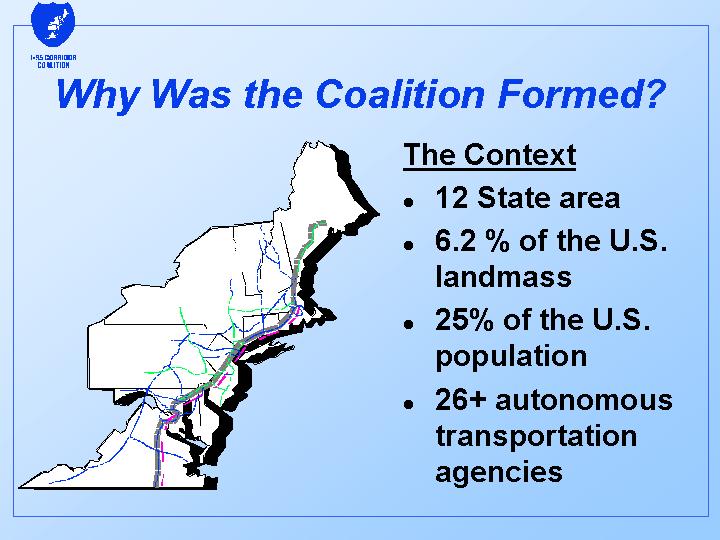
Why Was the Coalition Formed?
The Context
l 12 State area
l 6.2 % of the U.S. landmass
l 25% of the U.S. population
l 26+ autonomous transportation agencies
Slide 7:
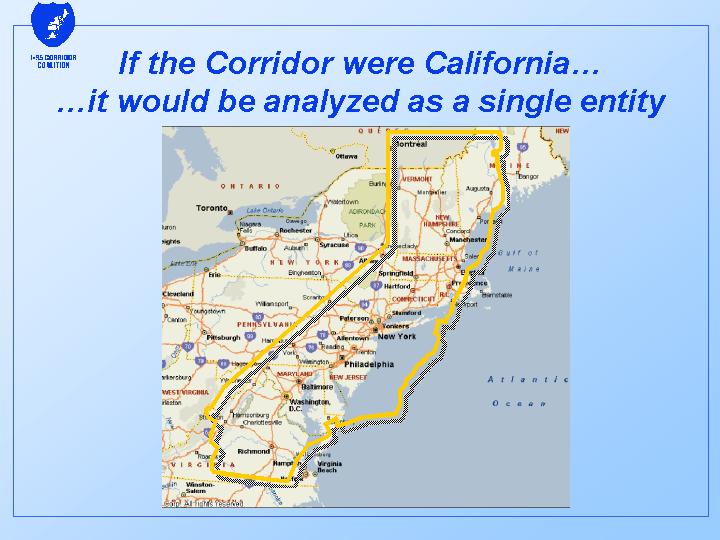
If the Corridor were California…
…it would be analyzed as a single entity
Slide 8:
The Customers
Needed travel information
Concerned about increasing congestion
Traveled across multiple jurisdictions
Desired improved services

Slide 9:
The Partnering Agencies
Recognized the impact of congestion
Couldn’t solve traffic issues by just building more capacity
Took action to improve operations through information & coordination

slide 10:
Organizational Structure

Slide 11:
Organization Structure Evolution
Expanded Role of Volunteers
Executives’ Guidance
Staff Commitment
Consultant Support
Slide 12:
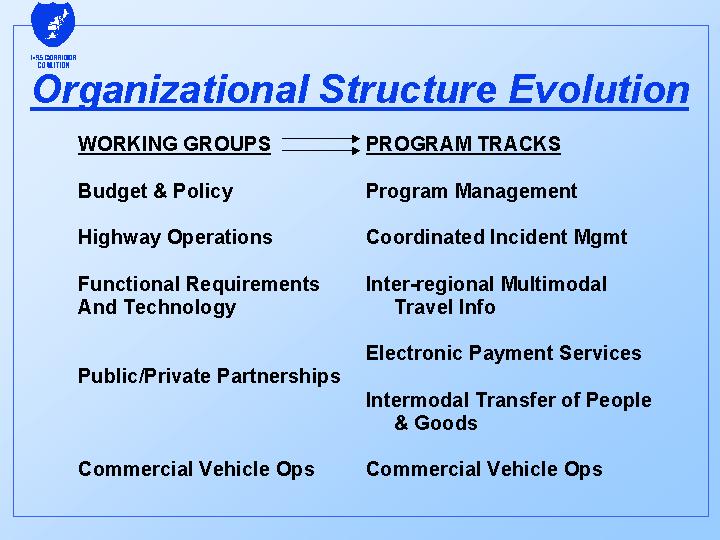
Organizational Structure Evolution
WORKING GROUPS Budget & Policy Highway Operations Functional RequirementsAnd Technology Public/Private Partnerships Commercial Vehicle Ops
PROGRAM TRACKS Program Management Coordinated Incident Mgmt Inter-regional Multimodal Travel Info Electronic Payment Services Intermodal Transfer of People & Goods Commercial Vehicle Ops
Slide 13:
Program Development Evolution
Studies of ITS areas
Field tests
Highway operations focus
Outcome-based projects
Facilitating and adding value
Multi-modal and Intermodal
Slide 14:
Executive Guidance
Focus on Goals and Objectives
Plan for the Longer Term
Consider Intermodal Needs
Consider Information Exchange, Education and Training Needs
Identify Opportunities to Work with Other Organizations
Assess Performance
Corridor Wide Information
Slide 15:
Challenges: Administrative
GOVERNANCE
No By-Laws
Use Procedural Guidelines
Encourage consensus
FUNDING
Federal Funds flow to States
Agencies administer on behalf of Coalition

Slide 16:
Challenges: Administrative
CONTRACTING
Individual states procure services
Assisted by one large team of consultants
STAFFING
Individual staff “on loan” from members
Member agency reimbursed for costs
Slide 17:
Challenges: The Future
Organizational Governance Structure
Program Development and Funding
Facilitate Integrated Deployment
Strengthen Intermodal Seamlessness
Slide 18:
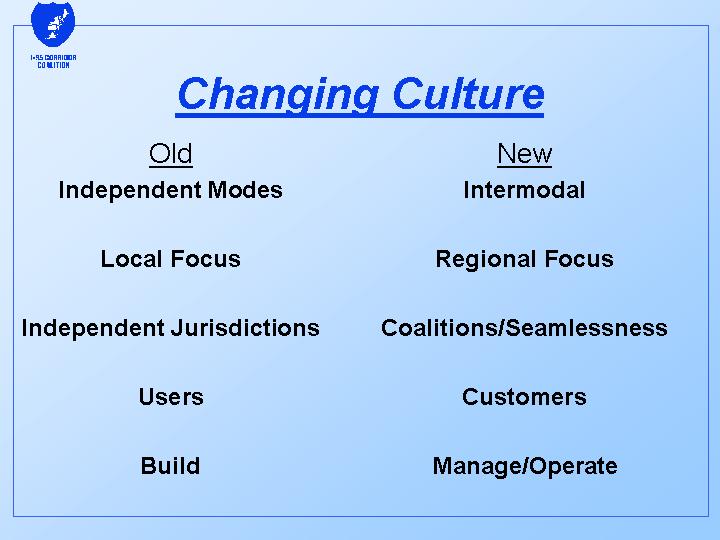
Changing Culture
Old
Independent Modes
Local Focus
Independent Jurisdictions
Users
Build
New
Intermodal
Regional Focus
Coalitions/Seamlessness
Customers
Manage/Operate
Slide 19:
The 6 C’s of the I-95 Corridor Coalition
» Cooperation
» Coordination
» Communication
» Consensus
» Credibility
» Commitment
Slide 20:
I-95 Corridor Coalition Commitment
THINK REGIONALLY
ACT LOCALLY
Slide 21:
Upcoming Event
Regional Workshop on National Operations Initiative
Albany, NY - July 26 & 27
www.i95coalition.org