Slide 1:
ALAMEDA CORRIDOR
“A Project of National Significance”
Slide 2:
Project Purpose
The Alameda Corridor Project is needed to keep pace with the steady growth of
cargo moving through the Ports of Los Angeles and Long Beach
U.S./Pacific Rim trade has doubled during the last decade
The Port’s share of West Coast container cargo increased from 42% in 1976
to 52% in 1999 with increasing market share projected in future years
Cargo volume in 2000 exceeds the forecast by the Independent Cargo Consultant
for 2006
Factors affecting future growth
18 million population in six county area
Larger container ships
Vessel sharing arrangements
Increase in discretionary cargo
State of the art facilities at Ports
Ports are the “Load Center” of West Coast
Slide 3:
Project Schematic
Slide 4:
Project Description
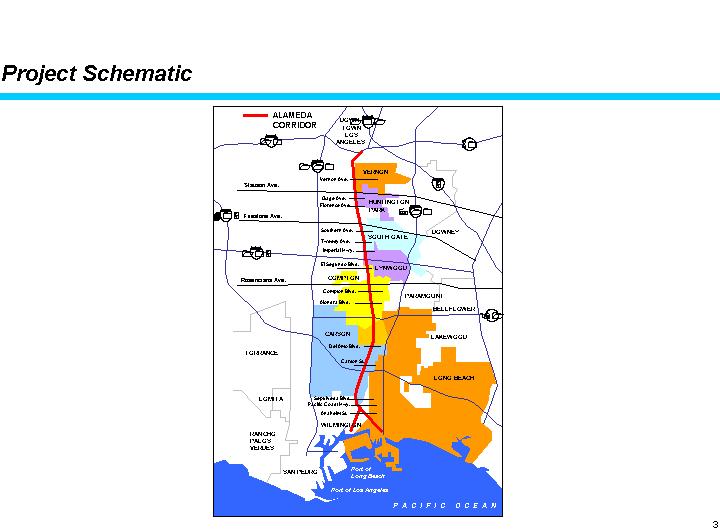
The Alameda Corridor is a 20 mile, multi-track rail transportation corridor,
paralleling Alameda Street, connecting the Ports of Los Angeles and Long Beach
with the transcontinental rail network in downtown Los Angeles
nConsolidates operations of the Union Pacific/Southern Pacific (UP) and Burlington
Northern Santa Fe (BNSF) onto one improved corridor (San Pedro, Wilmington)
nEliminates traffic conflicts at 200 street level crossings with overpasses
and 10 mile long trench
nEstimated cost—$2.4 billion, including contingencies and financing costs
nEstimated completion—Second Quarter 2002
nProjected to reduce train emissions (25%) and vehicular emissions (23%)
nProjected to reduce locomotive hours (30% per day) and vehicle delays (15,000
hours per day)
Slide 5:
Organizing the Solution
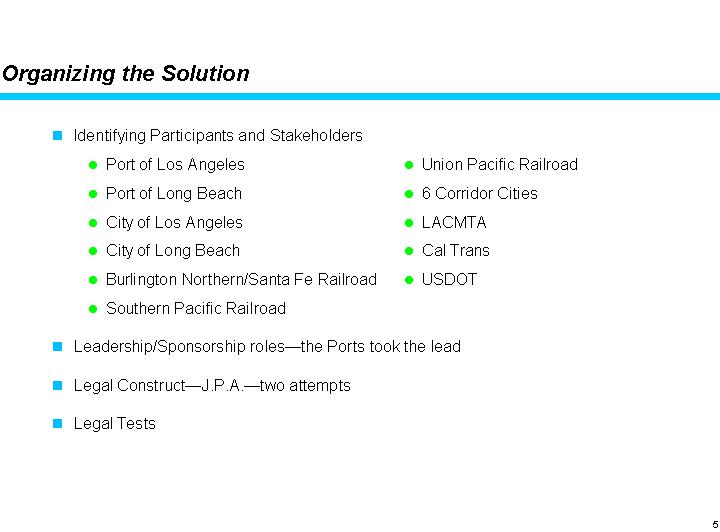
Identifying Participants and Stakeholders
Port of Los Angeles
Port of Long Beach
City of Los Angeles
City of Long Beach
Burlington Northern/Santa Fe Railroad
Southern Pacific Railroad
Leadership/Sponsorship roles—the Ports took the lead
Legal Construct—J.P.A.—two attempts
Legal Tests
Slide 6:
Risk sharing
Slide 7:
ACTA—Financial Feasibility Analysis as a Central Planning
Tool
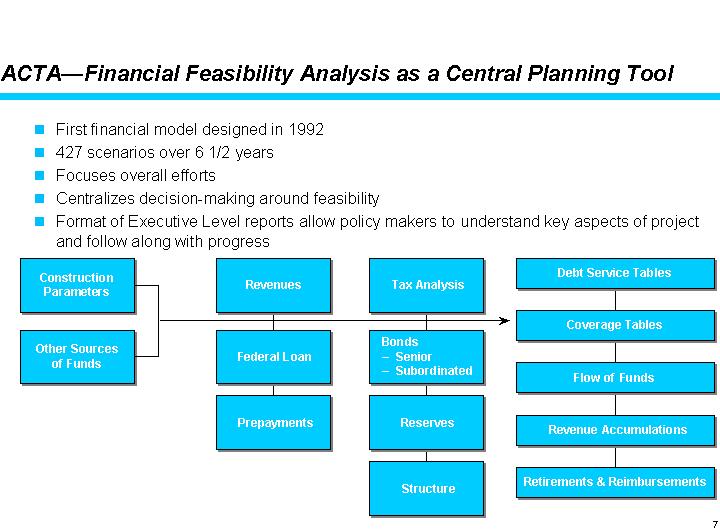
First financial model designed in 1992
427 scenarios over 6 1/2 years
Focuses overall efforts
Centralizes decision-making around feasibility
Format of Executive Level reports allow policy makers to understand key aspects
of project
and follow along with progress

Slide 8:
The Original Funding of the Project
One-time resource:
Federal
Congress, TEA-21 and Demonstration Programs $700
USDOT–Other Programs 30
Air Quality—EPA 8
ISTEA 40
State and Regional 100
LACMTA–Regional STIP 0
Ports 400
Cities 40
Revenues—Recurring Sources—For bonds and/or Loan 600
Ports—Shippers 5% Gross Wharfage Surcharge
Truck Tolls $3 toll
Railroads—User Fees $30/box
Total : $1.838 BB.
Slide 9:
Railroad Sensitivities
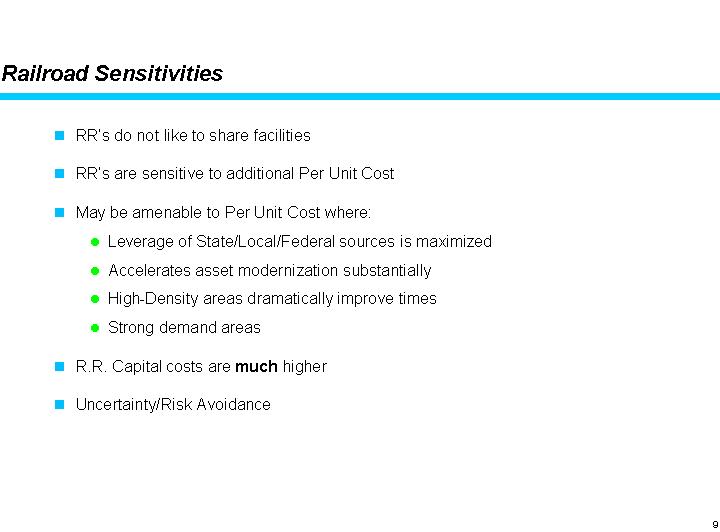
RR’s do not like to share facilities
RR’s are sensitive to additional Per Unit Cost
May be amenable to Per Unit Cost where:
Leverage of State/Local/Federal sources is maximized
Accelerates asset modernization substantially
High-Density areas dramatically improve times
Strong demand areas
R.R. Capital costs are much higher
Uncertainty/Risk Avoidance
Slide 10:
USDOT and ACTA—Precursor to TIFIA
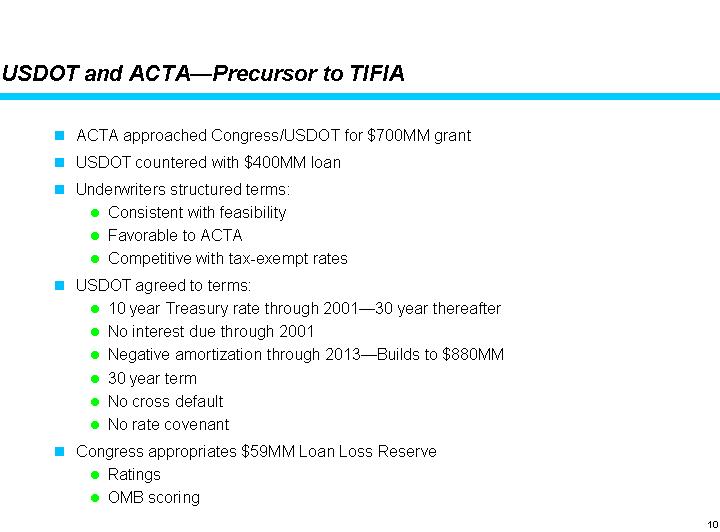
ACTA approached Congress/USDOT for $700MM grant
USDOT countered with $400MM loan
Underwriters structured terms:
Consistent with feasibility
Favorable to ACTA
Competitive with tax-exempt rates
USDOT agreed to terms:
10 year Treasury rate through 2001—30 year thereafter
No interest due through 2001
Negative amortization through 2013—Builds to $880MM
30 year term
No cross default
No rate covenant
Congress appropriates $59MM Loan Loss Reserve
Ratings
OMB scoring
Slide 11:
ACTA and USDOT (cont.)
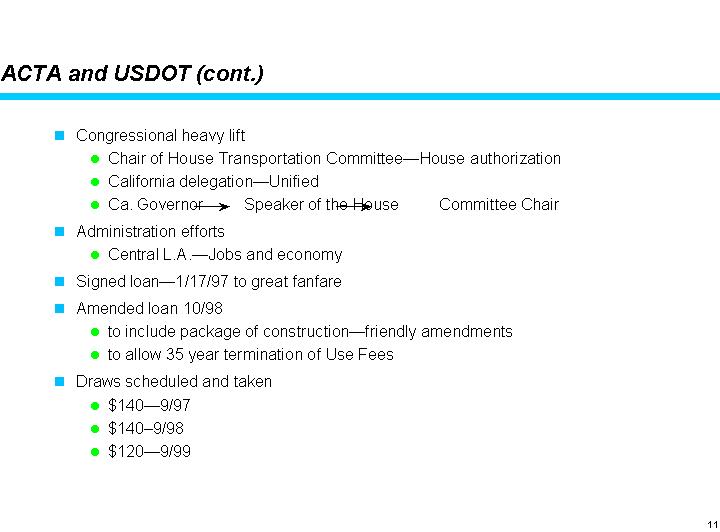
n Congressional heavy lift
Chair of House Transportation Committee—House authorization
California delegation—Unified
Ca. Governor Speaker of the House Committee Chair
Administration efforts
Central L.A.—Jobs and economy
Signed loan—1/17/97 to great fanfare
Amended loan 10/98
to include package of construction—friendly amendments
to allow 35 year termination of Use Fees
Draws scheduled and taken
$140—9/97
$140–9/98
$120—9/99
Slide 12:
Sources and Uses of Actual Funding
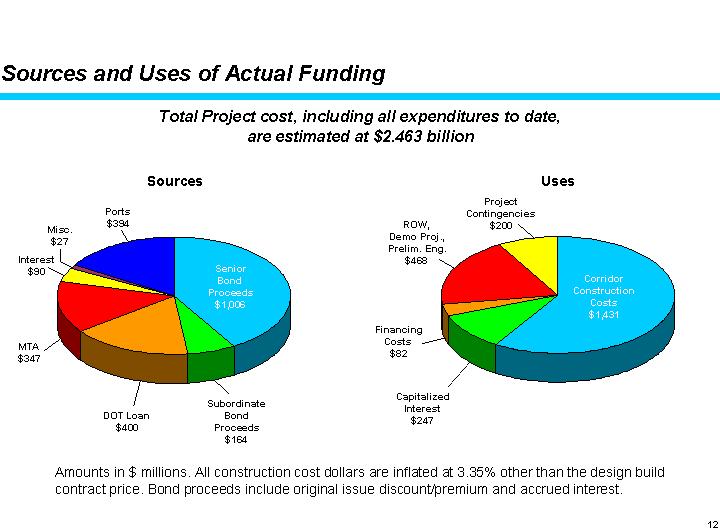
Total Project cost, including all expenditures to date,
are estimated at $2.463 billion
Slide 13:
Other Sources of Funds
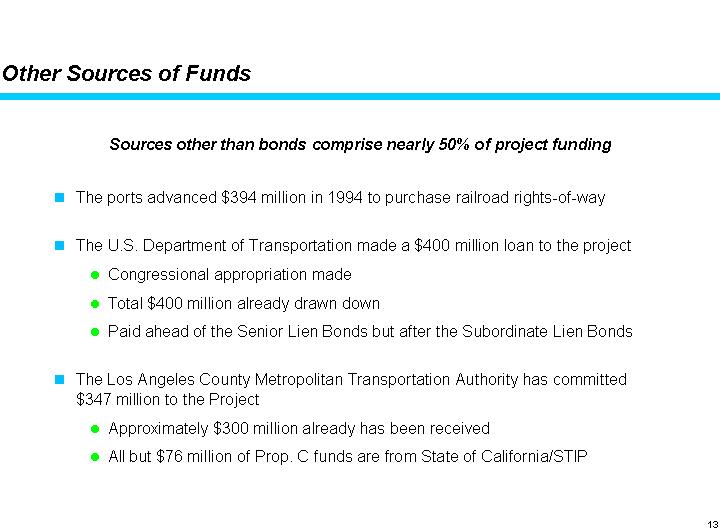
The ports advanced $394 million in 1994 to purchase railroad rights-of-way
The U.S. Department of Transportation made a $400 million loan to the project
Congressional appropriation made
Total $400 million already drawn down
Paid ahead of the Senior Lien Bonds but after the Subordinate Lien Bonds
The Los Angeles County Metropolitan Transportation Authority has committed $347
million to the Project
Approximately $300 million already has been received
All but $76 million of Prop. C funds are from State of California/STIP
Slide 14:
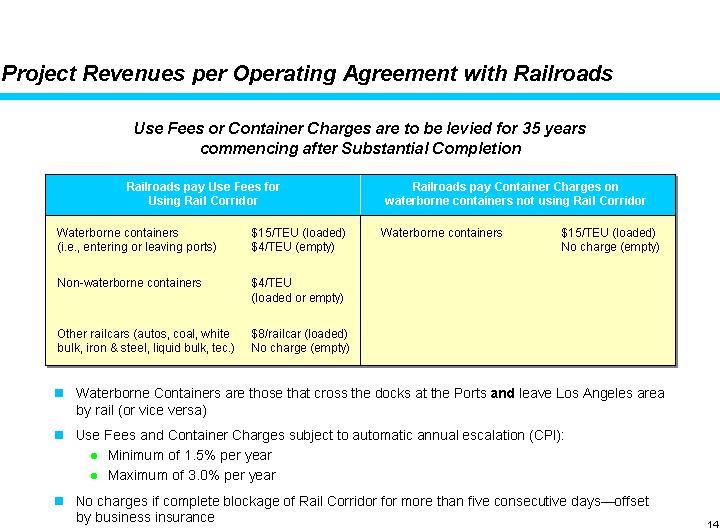
Project Revenues per Operating Agreement with Railroads
Waterborne Containers are those that cross the docks at the Ports and leave
Los Angeles area by rail (or vice versa)
Use Fees and Container Charges subject to automatic annual escalation (CPI):
Minimum of 1.5% per year
Maximum of 3.0% per year
No charges if complete blockage of Rail Corridor for more than five consecutive
days—offset by business insurance
Slide 15:
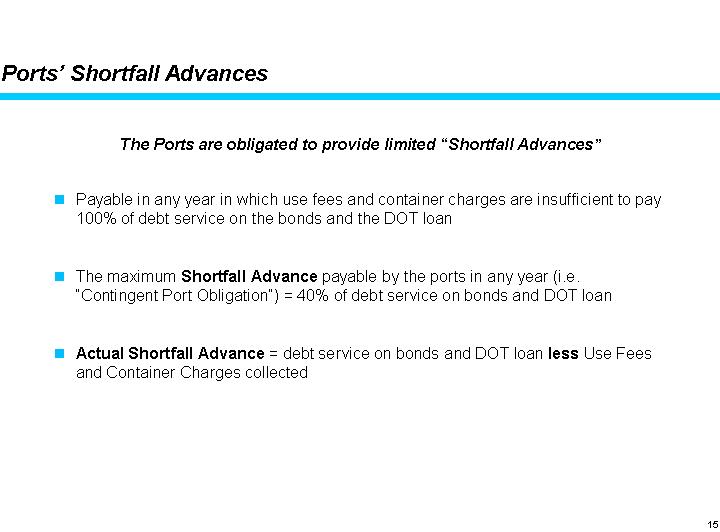
Ports’ Shortfall Advances
Payable in any year in which use fees and container charges are insufficient
to pay 100% of debt service on the bonds and the DOT loan
The maximum Shortfall Advance payable by the ports in any year (i.e. “Contingent
Port Obligation”) = 40% of debt service on bonds and DOT loan
Actual Shortfall Advance = debt service on bonds and DOT loan less Use Fees
and Container Charges collected

Slide 16:
Detail of Revenue Bonds
ACTA has issued/will issue approximately $1.165 billion of 1999 Revenue Bonds
in four series

Slide 17:
Corridor Revenues
ACTA’s repayment obligations will be paid primarily from Use Fees and
Container Charges as projected by BST (based on the Mercer/DRI Cargo Forecast
Slide 18:
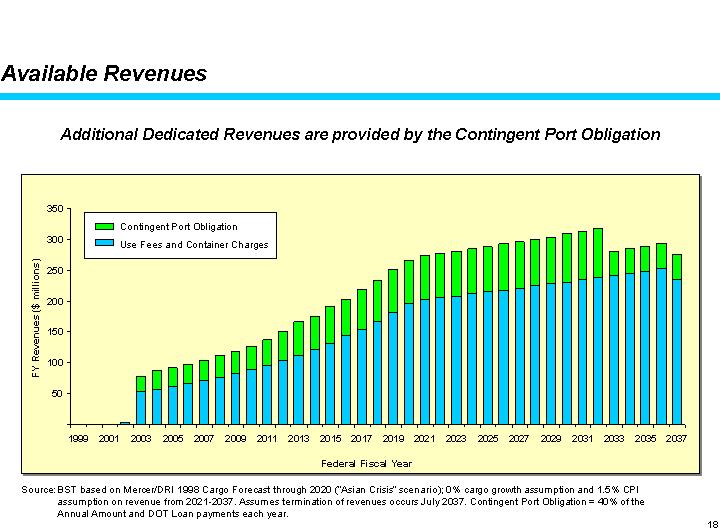
Available Revenues
Additional Dedicated Revenues are provided by the Contingent Port Obligation
Slide 19:
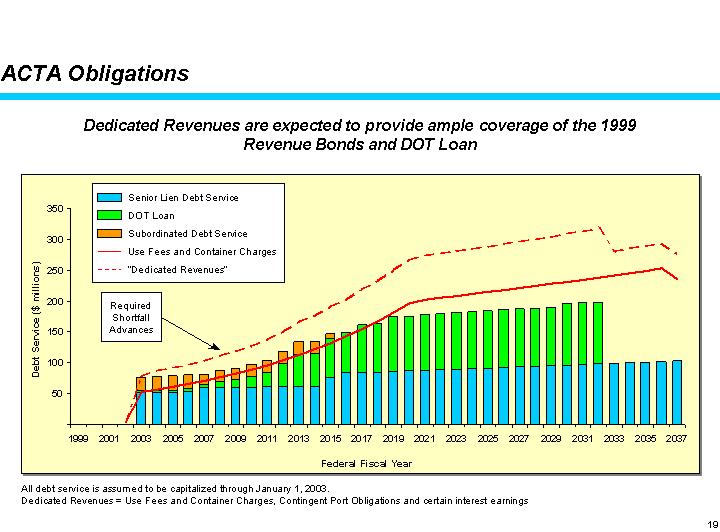
ACTA Obligations
Dedicated Revenues are expected to provide ample coverage of the 1999 Revenue
Bonds and DOT Loan
Slide 20:
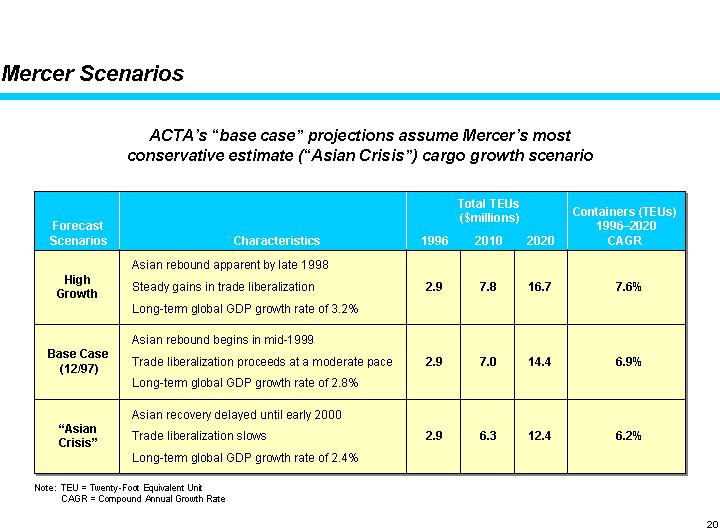
Mercer Scenarios
ACTA’s “base case” projections assume Mercer’s most
conservative estimate (“Asian Crisis”) cargo growth scenario
Slide 21:
Conclusion
Successfully secured the cooperation of major stakeholders including intense
competitors.
Local, state, and national elected officials fully supportive of project with
Federal government designating the Alameda Corridor as a “project of national
significance.
Policy maker decision making process facilitated with well developed model and
feasibility analysis.
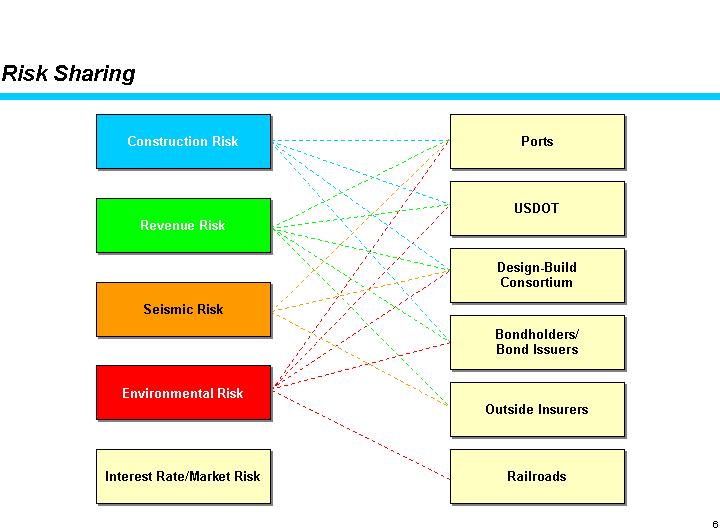
Risk spread among various parties including construction contractor.
ACTA among first to use TIFIA program under TEA-21 resulting in $400 million
federal loan with highly flexible provisions.
Funding shared equally between private and public partners.
ACTA, on time and on budget, has been a public/private partnership success.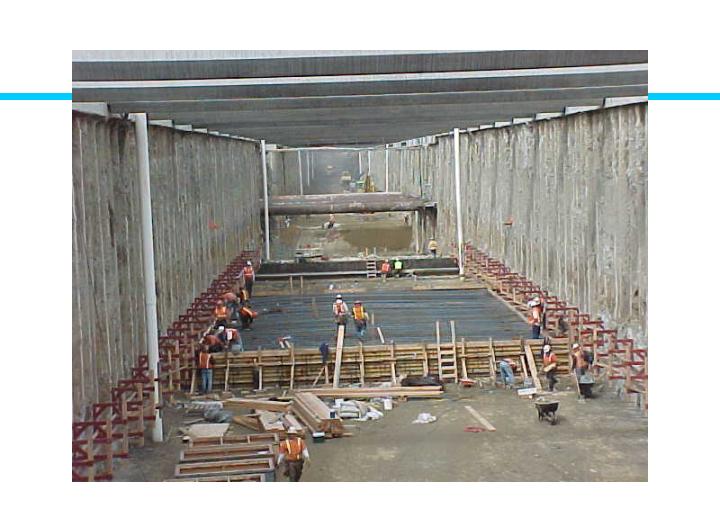
Slide 22:
Workers are working on the site.