Slide 1:
KANSAS CITY TERMINAL RAILWAY FLYOVER PROJECT
A Public / Private Cooperative Success
Slide 2:
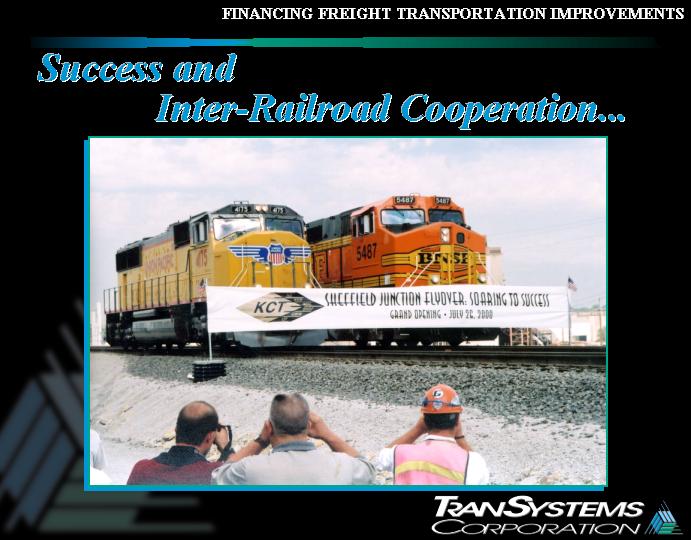
Success and Inter-Railroad Cooperation...
Slide 3:
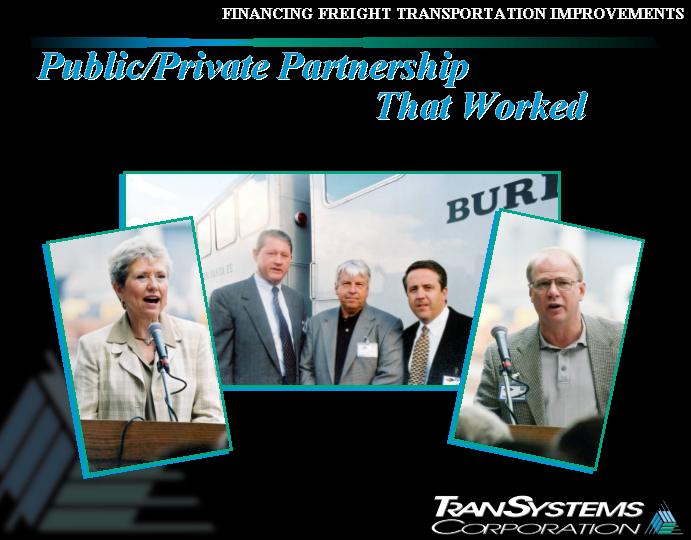
Public/Private Partnership that Worked.
Slide 4:
CURRENT PROBLEM
Slide 5:
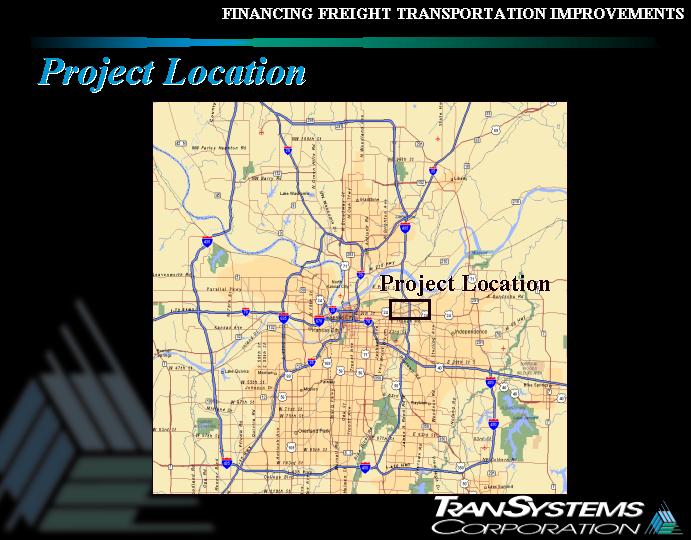
Project Location
Slide 6:
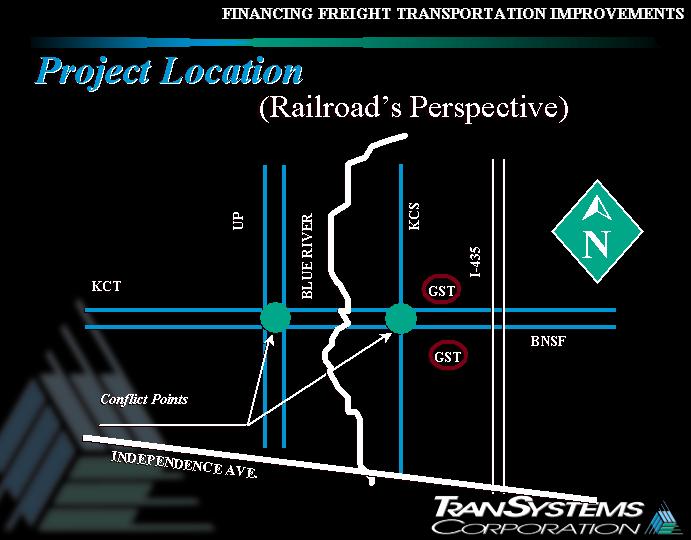
Project Location (Railroad’s Perspective)
Slide 7:
Current Situation
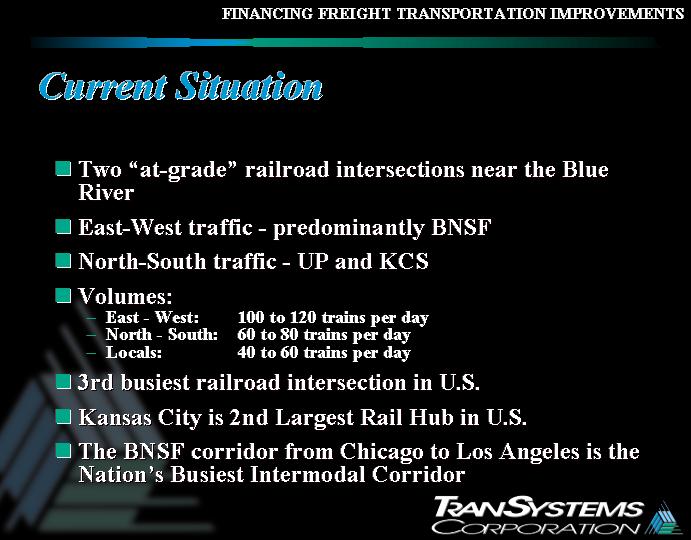
Two “at-grade” railroad intersections near the Blue River
East-West traffic - predominantly BNSF
North-South traffic - UP and KCS
Volumes:
– East - West: 100 to 120 trains per day
– North - South: 60 to 80 trains per day
– Locals: 40 to 60 trains per day
3rd busiest railroad intersection in U.S.
Kansas City is 2nd Largest Rail Hub in U.S.
The BNSF corridor from Chicago to Los Angeles is the Nation’s Busiest
Intermodal Corridor

Slide 8:
The picture of KANSAS CITY TERMINALRAILWAY

Slide 9:
Why Now?
Originally deemed unfeasible to grade separate
Traffic volumes have increased to a point where operating efficiencies have
been lost on the Terminal Railroad
Recent mergers, and subsequent trackage rights agreements, have enabled more
traffic to use the intersection
Inter-railroad cooperation is on the rise
Slide 10:
Solution
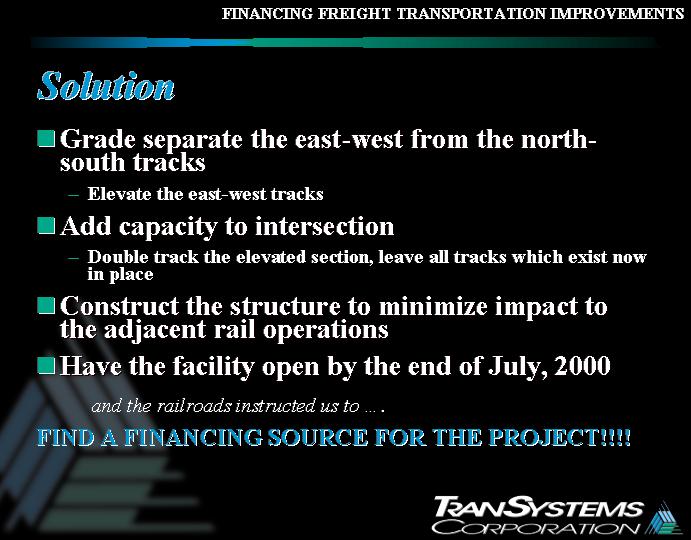
Grade separate the east-west from the north-south tracks
– Elevate the east-west tracks
Add capacity to intersection
– Double track the elevated section, leave all tracks which exist now
in place
Construct the structure to minimize impact to the adjacent rail operations
Have the facility open by the end of July, 2000
and the railroads instructed us to ….
FIND A FINANCING SOURCE FOR THE PROJECT!!!!
Slide 11:
Even Though It Was a Rail Project...
How could the Public Sector Be Brought In?
Slide 12:
Strategy For Agency Buy-in
Appeal to the “Total Transportation” element of the Local Department
of Transportation
Demonstrate the “non-railroad” benefits of this project
Highlight the benefits of the railroad industry on the greater Kansas City area
Evaluate alternatives which the railroads might be forced to use if this project
did not get constructed
Obtain local, private, non-railroad support for project
Identify “non-monetary” methods which could be employed to assist
with the project

Slide 13:
Agencies/People Contacted
City of Kansas City, Missouri
Mid-America Regional Council (MPO)
Missouri Department of Transportation
Economic Development Corporation of Kansas City, Missouri
Missouri Department of Economic Development
Missouri Development Finance Board
Greater KC Chamber of Commerce

Slide 14:
Search for Financial Assistance
Railroads did not mind paying for the project if a source for capital could
be found up front
“OFF BALANCE SHEET FINANCING”
Results of Agency Coordination
– All parties very positive towards project
– Very few programs (economic development) are geared to assist a transportation
related project such as this
– No dedicated monies are available for such projects

Slide 15:
Project Champions
Missouri Department of Transportation
City of Kansas City, Missouri
– Both provided excellent leadership and guidance in finding potential
financing sources
– Both were willing to forget about conventional methods of financing
a project and look towards innovative methods
– State utilized their lobbyist in DC and their relationship with FHWA
Staff to move project along

Slide 16:
Problems Encountered
Kansas City is an Air Attainment City, therefore no CMAQ funds are available
State of Missouri prohibits the use of fuel tax dollars on any other form of
transportation other than highways
Hard to quantify the direct economic benefit of the project due to the unwillingness
of the railroads to divulge future plans
Slide 17:
Help from Washington, DC?
Assistant Administrator Garvey was very helpful. Ms. Garvey set us up with the
FHWA Innovative Finance Team where we had several meetings.
FHWA was supportive of project, but needed to identify the public benefit that
the project would produce.
– The fact that this is the #1 intermodal rail corridor in the U.S. was
not enough – the Team wanted to quantify “hard” benefits to
the public – primarily the highway users of the area.
Slide 18:
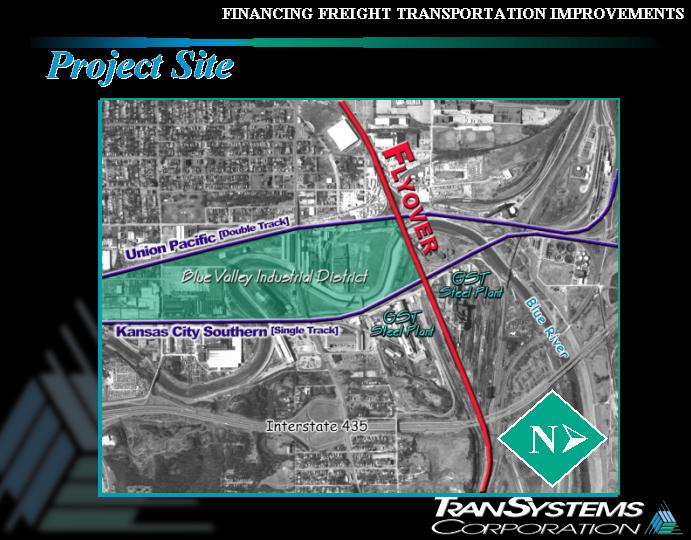
Project Site

Slide 19:
Project Location (Public’s Perspective)
Slide 20:
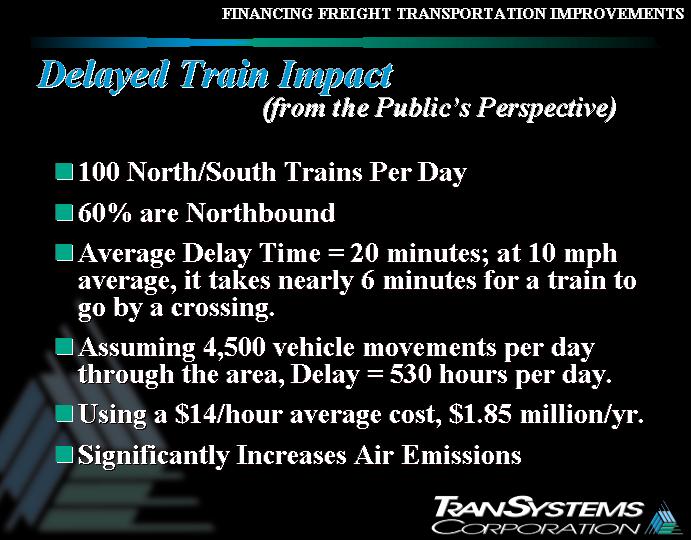
Delayed Train Impact
(from the Public’s Perspective)
100 North/South Trains Per Day
60% are Northbound
Average Delay Time = 20 minutes; at 10 mph average, it takes nearly 6 minutes
for a train to go by a crossing.
Assuming 4,500 vehicle movements per day through the area, Delay = 530 hours
per day.
Using a $14/hour average cost, $1.85 million/yr.
Significantly Increases Air Emissions

Slide 21:
Financial Help from Washington, DC!!!
On May 27, 1997 we received a letter from FHWA approving the project for a Section
129 loan, with a corresponding line of credit provided by future STP Federal-Aid
Highway Funds destined for Missouri.
– The Letter allowed up to 25% of the cost of the project to be funded
this way. 25% was determined to be the public benefit.
– Railroads were pleased as this insured government long-term interest
rates on at least 25% of the project.

Slide 22:
Help Disappears!!!!
A letter dated November 3, 1997 was received by MoDOT stating that the Section
129 Loan was being rescinded by FHWA for the Flyover Project.
Why????
The trucking lobby objected to the use of FHWA funds for this purpose.
Slide 23:
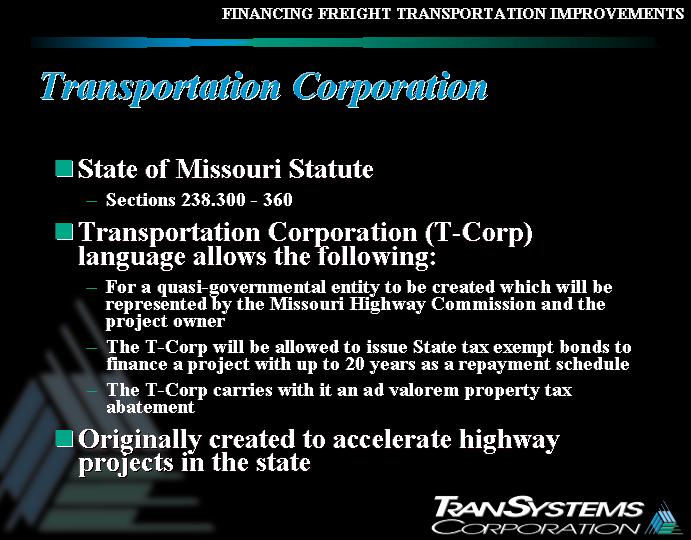
Transportation Corporation
State of Missouri Statute
– Sections 238.300 - 360
Transportation Corporation (T-Corp) language allows the following:
– For a quasi-governmental entity to be created which will be represented
by the Missouri Highway Commission and the project owner
– The T-Corp will be allowed to issue State tax exempt bonds to finance
a project with up to 20 years as a repayment schedule
– The T-Corp carries with it an ad valorem property tax abatement
Originally created to accelerate highway projects in the state

Slide 24:
T-CORP Bond Issues
Need to create “off balance sheet” financing:
– Quasi-governmental entity did the trick
Desire for low (T-Bond) interest rates:
– Underlying credit of the Railroads was OK individually, but increased
significantly when the BNSF and the UP took the project over and agreed to sign
joint/several agreements – to nearly T-Bond rates.
Goldman Sachs, along with a local, Kansas City brokerage handled the transaction.
$75 million was issued, however $172 million was subscribed.

Slide 25:
T-CORP Bond Issues (cont.)
Bonds are retired entirely by railroad activity through this area of Kansas
City – no direct public money went into the project.
State of Missouri did require hard asset pledges from the railroads to cover
their exposure.
T-Corp had to control the land upon which the project was constructed. When
bonds are retired, the land reverts back to railroad control.

Slide 26:
THE CITY’S ROLE
Slide 27:
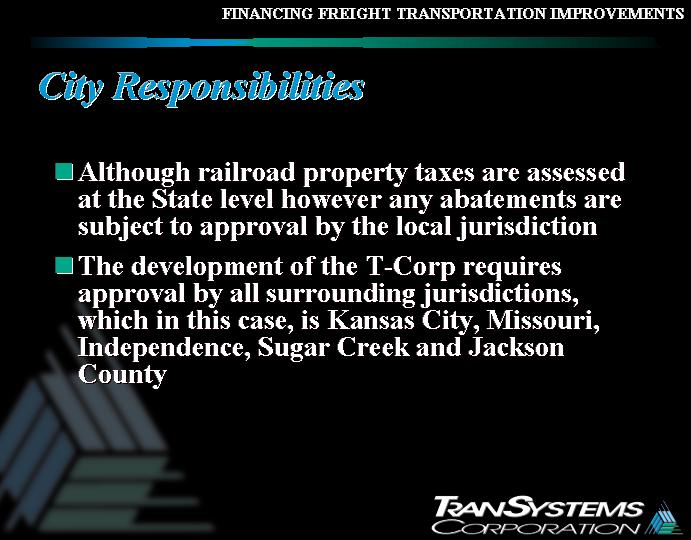
City Responsibilities
Although railroad property taxes are assessed at the State level however any
abatements are subject to approval by the local jurisdiction
The development of the T-Corp requires approval by all surrounding jurisdictions,
which in this case, is Kansas City, Missouri, Independence, Sugar Creek and
Jackson County

Slide 28:
Property Tax Abatement
Single largest financial element of the entire project
The addition of this structure would increase that liability to $1.9 million
per year
The $1.4 million/year abatement makes up for nearly 20% of the yearly bond amortization
Slide 29:
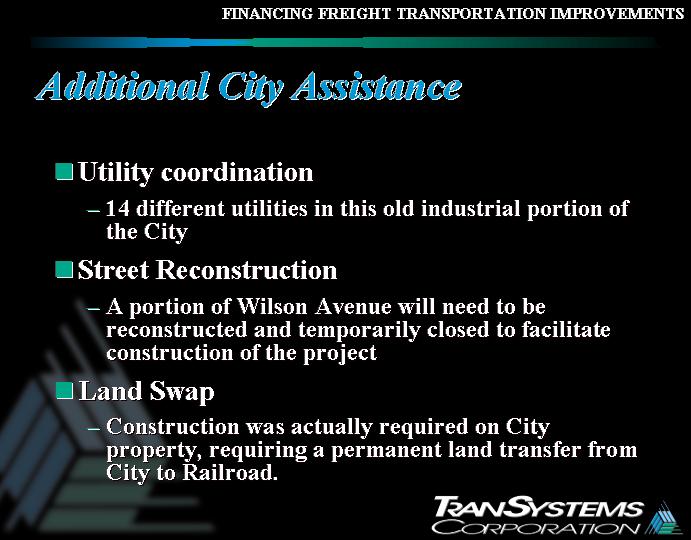
Additional City Assistance
Utility coordination
– 14 different utilities in this old industrial portion of the City
Street Reconstruction
– A portion of Wilson Avenue will need to be reconstructed and temporarily
closed to facilitate construction of the project
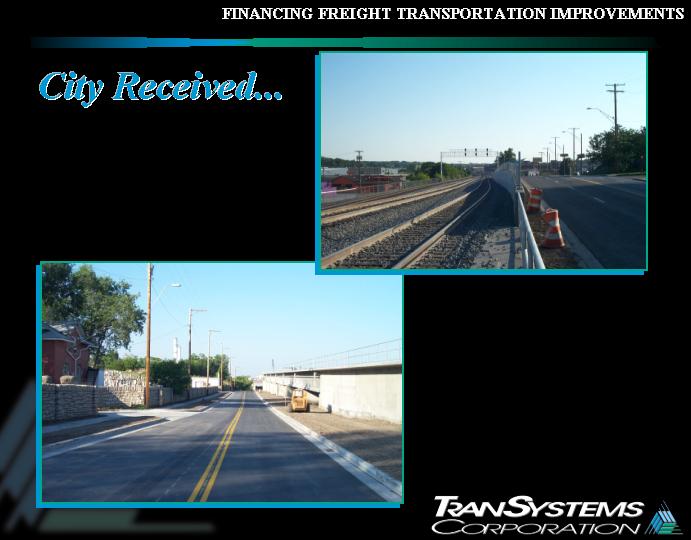
Land Swap
– Construction was actually required on City property, requiring a permanent
land transfer from City to Railroad.
Slide 30:
City Received...

Slide 31:
Solution...
Slide 32:
Benefits of Flyover
Reduces time which nearby industries get “trapped” by trains
– May stimulate economic activity in the Blue Valley Industrial District
– Eliminates problems to area businesses: e.g.. fire protection, emergency
medical service and security issues.
Improves AMTRACK service:
– Reduces delays
– Improves speeds
Environmental Impact:
– Trains idling for up to 2 hours contribute to the areas air pollution.

Slide 33:
BENEFITS (cont.)
This serves as a catalyst project for the area’s railroad industry - it
eliminates the congestion point allowing for a significant expansion of rail
assets in the area:
– BNSF’s Argentine Yard - $100 million
– BNSF’s Murray Yard - $50 million
– KCS’s Richards-Gebaur - $50 million
– KCS’s Knoche Yard - $40 million
– Norfolk Southern’s Auto Mixing Facility - $70 million
– UP’s Line Capacity - $60 million
– Flyover - $75 million
– Argentine Flyover and High Line Rehab. - $115 million

Slide 34:
THE PROJECT
Slide 35:
Project Specifics
Overall project length = 15,300’
Length of main bridge portion = 6,740’
Additional bridges of 890’ and 150’
Double-track structure
Structure will essentially fit on existing KCT right-of-way
Project has been extended east 3/4 mile
Overall Project Cost = $75,000,000

Slide 36:
The picture of project site.
Slide 37:
Project Facts
94,549’ (17.9 miles) of H-Piles
6,567’ of drilled shafts (mostly 54” & 84” dia.)
26,592 cu. yds. of concrete (without drilled shaft concrete)
Over 320 prestressed concrete girders (24,205’ or 4.6 miles)
18,221,225 lbs. (9,110 tons) of structural steel

Slide 38:
A Successful Public/Private Partnership