Overview of the Transportation Planning Process
Improving the transportation planning
process, was the central theme of the workshop
both in the plenary and breakout group sessions. Figure
1 depicts the process as discussed in the workshop and in this Guidebook.
The process, described in
Figure 1 on the next page, can
be summarized in five primary steps. They are: (1) Identify/analyze
issues and deficiencies (current and future), (2) Develop/evaluate alternatives/Establish
priorities, (3) Prepare/adopt the Long-Range Plan (LRP), (4) Prepare/adopt
the State Transportation Improvement Program/Transportation Improvement Program
(S/TIP), (5) ImplementThe five steps of the transportation
planning process are depicted in the rectangular boxes .
The six smaller ovals on
the outside of figure one represent theand factors that influence the process, “enabling elements,” are
depicted in the ovals surrounding the process boxes. and are identified
as “goals/objectives,” “organization,” “public/agency involvement,” “data,”
“technical tools” and the “financial plan.”
These steps
and components are described in more detail
in the following sections.
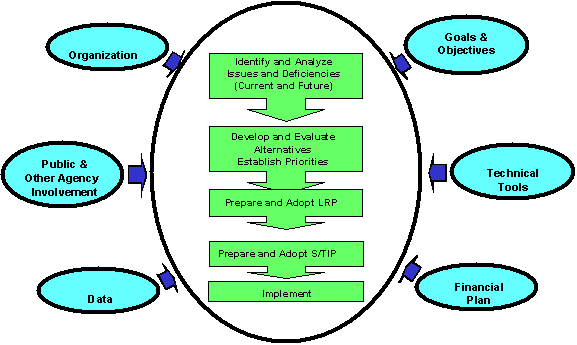
Figure 1: The Transportation Planning Process
A brief overview of each step and enabling element
is provided in Table 1 below:
| Step or Element |
Description of Step or Element |
Step in the Transportation Planning Process |
|
| 1. Identify and analyze issues and deficiencies |
In this step, planners evaluate the current transportation infrastructure in light of established transportation goals, objectives, and performance standards to identifying specific issues or shortfalls that need to be addressed now and in the future. Issues might include physical condition of the infrastructure such as poor pavement, safety, or capacity limitations associated with growth in travel demand. Which ones get addressed first will depend on how they are ultimately prioritized (See Step 2). |
| 2. Develop and evaluate alternatives and establish priorities |
In this step, planners objectively examine causes and develop alternative solutions to address the deficiencies identified in Step 1 in the context of the State and regional goals and objectives and financial plans. Planners work with stakeholders to evaluate and then prioritize the alternatives. |
| 3. Prepare and adopt LRP |
The Long-Range Plan (LRP) documents a State or region’s long-term transportation vision and the incremental plan to achieve that vision. It is updated every three to five years to reflect near-term realities and considerations. It represents the collective priority for long and short-range improvements from alternatives analyzed in Step 2 as a means to address the deficiencies identified in Step 1. Adopted plans are often constrained by financial limitations, especially in urban areas. However, due to its 20-year perspective it is both a vision and a plan. |
| 4. Prepare and adopt S/TIP |
In this step, planners examine the priorities identified in the LRP, available resources, and readiness. The S/TIP is based on the LRP and reflects the immediate priorities of the implementing agencies. When adopted, it represents the list of transportation initiatives to be implemented within the next three years. It is updated at least every two years. |
| 5. Implement |
In this step, implementing agencies take responsibility for getting their projects underway, while transportation planners track progress and adjust the S/TIP as needed. |
Enabling Elements |
|
| 1. Develop goals and objectives |
Goals and objectives for a State or region reflect national, state, and local values. They should be specific and quantifiable and should be associated with performance measures and evaluation criteria. The effective development of sound, realistic yet ambitious goals and objectives is critical to the transportation planning process in that they are used in the identification of deficiencies, the evaluation of alternatives, and the establishment of priorities which are ultimately reflected in the LRP and S/TIP. |
| 2. Organization |
The advent of information technology and its increased incorporation into the transportation planning process represents a breakthrough for transportation planners offering unprecedented opportunities to store, manipulate, sift, gain and share insights from large volumes of data to improve the basis for decision-making. These tools provide information to decision-makers that is richer and more objective than would be possible without the use of such tools. They are key to the analysis and forecasting of future conditions and help to answer “what-if” questions on an area/statewide basis. Examples include travel demand forecasting models, economic/land use forecasting models, pavement management systems, and air quality emission models. |
| 3. Public/Agency involvement |
The financial plan assures that the transportation plan and program are in balance with revenues. It identifies available and anticipated revenue, as well as funding shortfalls. |
| 4. Data |
Policy makers rely on information planning staffs to make critical transportation investment decisions. Planners collect and analyze data that support an informed decision process. All technical tools rely on data and the effectiveness of these tools is directly dependent on the quality of the data used. Examples of data that might be used in planning include: roadway inventory data, traffic volumes, population, employment data, travel survey data, and commodity flow data. |
| 5. Technical tools |
Early and continuous public involvement and involvement of other agencies is critical to an effective planning process. Ultimately, such agencies and the public must support transportation plans and programs in order to ensure smooth implementation. Planning for multiple modes may impact or require involvement of different stakeholders. Planners must keep the public informed throughout the process, inform decision-makers of public views, and demonstrate explicit consideration of public input. |
| 6. Financial plan |
Planning organizations should be structured to support a cooperative partnership among stakeholders and should represent a forum for decision-making. Such organizations typically incorporate all potential stakeholders and include other jurisdictions. In this context, the organization has clearly defined roles and responsibilities for whom will do what in the planning process. Obviously the organization plays a critical role in the accomplishment of the goals and objectives of the LRP and effective planning overall. |
Table 1: Overview of the
Transportation Planning process
The
following section provides useful considerations for implementing and improving
the five phases of the transportation planning process.
The Transportation Planning Process: Step-by-Step |
The following section provides useful considerations for implementing and improving the five phases of the transportation planning process.
Step 1: Identify and Analyze Issues and Deficiencies:
Overview of Step:
In this step, planners evaluate the current transportation infrastructure
in light of established transportation goals and objectives and identifying
specific issues or shortfalls that will need to be addressed in the S/TIP.
Issues might include physical condition of the infrastructure such as poor
pavement (deficiency) or capacity limitations associated with growth in demand
such as congestion and mobility (deficiencies). These are both current and
future issues. Which ones get addressed first will depend on how they are
ultimately prioritized
(See Step 2).
Special Considerations:
It is important in this step to think from a “freight” perspective—a “systems” perspective. Planners should recognize that “freight” timelines are generally much shorter to meet evolving demands of the private sector. Also, planners should recognize there is little consensus on how to deal with private freight infrastructure, yet this must be addressed as it does make up a substantial amount of the transportation infrastructure.
A related consideration is the involvement of the private sector in this step. They are intimately aware of the issues associated with the current transportation infrastructure and may have outstanding ideas on how to improve it or may already be working to improve some element with private funds. In either scenario, planners should be interested in feedback from the private sector.
Planners are encouraged to make their transportation
plans understandable by decision-makers. In order to succeed in getting issues
adequately prioritized, decision-makers must understand the issues—which means
they must be articulated in a language that they can understand.
In other words, an improvement to some aspect of the transportation system (addressing one of the issues for example) will have impacts on other areas of the transportation system. A proposed highway improvement could include unforeseen congestion on another route, which just transfers the problem but does not solve it, or could incentivize greater highway travel which could negatively impact a local railroad, or could have under-appreciated environmental impacts which may energize an obscure environmental organization. All of these potential impacts must be considered in the planning process.
It is important in this
step to think from a “freight” perspective—basically a systems perspective.
In other words, an improvement to some aspect of the transportation system
(addressing one of the issues for example) will have impacts on other areas
of the transportation system. A proposed highway improvement could include
unforeseen congestion on another route
for example,
which just transfers the
problem but does not solve it, or could incentivize greater highway travel
which could negatively impact a local railroad, or could have under-appreciated
environmental impacts which may energize an obscure environmental organization.
All of these potential impacts must be considered in the planning process.
From this “freight” perspective,
planners should recognize that “freight” timelines are generally much shorter
to meet demand. This will undoubtedly present planners with some dilemmas,
however. To not appreciate it will
result in resistance to your plan on the part of the private sector and is,
quite simply, not realistic. Also, planners should recognize there is little
consensus on how to deal with private freight infrastructure, yet this must
be addressed as it does make up a substantial amount of the transportation
infrastructure.
A related consideration
is the involvement of the private sector in this step. They are intimately
aware of the issues associated with the current transportation infrastructure
and a) may have
outstanding ideas on how to improve it or b) may already
be working to improve some element of it with private funds. In either
scenario, planners should be interested in feedback from the private sector feedback. Planners
are encouraged to make their transportation plans understandable by decision-makers.
In order to succeed in getting issues adequately prioritized, decision-makers
must understand the issues—which means they must be articulated in a language
that they can understand. That language may in fact
be numbers or statistics, however freight issues are not quantifiable at this
point.
Opportunities:
Planners are encouraged
to think “cross-modally,” in other words—think systemically in approaching
the issues and dependencies of all modes of transportation. This can strengthen
justification for many of the issues in the plan as they may have impacts
on the broader transportation system while also helping to minimize the likelihood
of unforeseen future issues. To counter resistance to private investment,
it may be helpful to identify the benefits of private
sector investment in transportation to the
public sector. Finally, planners are encouraged to implement a regional approach
to analysis—just as they must think systemically from a “cross-mode” standpoint,
planners are encouraged to think systemically from a regional standpoint—who
outside of our jurisdiction might be negatively or positively impacted by
these recommendations? .Planners are encouraged
to think “cross-modally,” in other words—think systemically in approaching
the issues and dependencies of all modes of transportation. transportation
plan and in identifying cross-modal issues. This can strengthen justification for many of the
issues in the plan as they may have impacts on the broader transportation
system while also helping to minimize the likelihood of unforeseen future
issues downstream. To counter
resistance to private investment, it may be helpful to identify the benefits
of private
sector investment in transportation to the
public sector. Finally, planners are encouraged to implement a regional approach
to analysis—just as they must think systemically from a “cross-mode” standpoint,
planners are encouraged to think systemically from a regional standpoint—who
outside of our jurisdiction might be negatively or positively impacted by
these recommendations? .
Success Criteria:
· Planners should have clearly defined goals and objectives
· Planners have an understanding of the current transportation infrastructure
· Planners are identifying deficiencies in terms of a freight perspective—the end-to-end movement of people and goods.
· Planners have sought and documented inputs from key stakeholders, critical downstream for implementation.
· Planners are able to concisely and clearly summarize issues appropriate to the audience (i.e., “laymen”).
Step 2: Develop/Evaluate Alternatives:
Overview of Step:
In this step, planners objectively
develop alternative solutions to address the deficiencies identified in Step
1 in the context of the region’s short- or long-term goals and objectives and the region’s
financial plan. Planners then work with stakeholders to determine
criteria by which to evaluate and then prioritize the alternatives.In this step, planners are objectively
developing alternative solutions to
addressing the deficiencies identified
in Step 1 in the context of the region’s short- or longer-term
goals and objectives and the region’s financial plan. Planners
then work with stakeholders to determine criteria by which to evaluate the alternatives, evaluate and then prioritize the
alternatives.
Considerations:
As in Step 1, it is critical to approach development and evaluation of alternatives from a freight perspective. This is difficult as many MPOs are driven by mode-specific funding mechanisms. While this may be the reality of current funding mechanisms, it is not the reality of the transportation system or its users. Planners’ thinking must reflect and embrace the reality of the issues of the transportation planning system in order to effectively identify the best solutions.
Opportunities:
Planners are encouraged to prioritize the improvement of freight transportation—the effective end-to-end movement of people and commodities — rather than prioritizing a particular mode. Planners will do the most for their region by evaluating alternatives from a freight perspective to determine the impacts, positive or negative, of any potential solution on total transportation network.
In addition, planners are
encouraged to seek out, leverage, and contribute to the improvement of evaluation
tools for all modes as well as intermodal trade-off analysis. These tools
can greatly enhance the decision-making process by providing an objective
basis for evaluating impacts of proposed alternatives and the weighting of
criteria. Planners are encouraged
to prioritize the improvement of freight transportation—the effective end-to-end
movement of people and commodities — rather than prioritizing a particular
mode. Planners will do the most for their region by evaluating alternatives
from a freight perspective to determine the impacts, positive or negative,
of any potential solution on total transportation network.
In addition, planners are
encouraged to seek out, leverage, and contribute to the improvement of evaluation
tools for all modes as well as intermodal trade-off analysis. These tools
can greatly enhance the decision-making process by providing an objective
basis for evaluating of potential
impacts of proposed alternatives and the weighting
of criteria.
Success Criteria:
· Planners have a clear understanding of their organization’s and region’s goals and objectives.
· Planners think in terms of end-to-end freight as well as passenger movement and do not evaluate alternatives from a “mode-specific” standpoint.
· Planners know what tools are available for developing/evaluating alternatives and are using them where appropriate.
· Planners are communicating proactively with all stakeholders early on to ensure an understanding of priorities.
· Planners have developed, or worked with their organizations to develop objective criteria against which to evaluate alternatives.
Step 3: Prepare/Adopt Long Range Plan:
Overview of Step:
The Long-Range Plan (LRP) documents a region’s long-term transportation vision and the incremental plan to achieve that vision. It is updated every three to five years to reflect near-term realities and considerations. It represents the “best” long and short-range improvements from alternatives analyzed in Step 2 as a means to address the deficiencies identified in Step 1 in the context of a region’s goals for its transportation infrastructure and network. It is often constrained by financial limitations, especially in urban areas, which some view as compromising to the true vision of a region. However, due to its 20-year perspective it is both a vision and a plan and it is the planners’ challenge to balance this.
Considerations:
Planners should be aware of and understand the limitations of the long-range plan and seek ways to address these limitations while not compromising the integrity of the plan. For example, LRPs are frequently criticized for being too long-term, and therefore not realistic. On the other hand, in reality, it takes up to 15 years to get major investments approved and funded which represents the largest rationale for the LRP timeframe. The timeframe issue is a particular concern for the private sector,who consider three to five years a long-term strategic horizon. As mentioned above, ultimately the LRP is constrained by financial realities which some view as negatively impacting the ability to document the true vision of a transportation system unfettered by limitations. Many planners fail to adequately involve the private sector in the development of the LRP—this is definitely a shortfall and will undermine your LRP. Planners are encouraged to be creative and think in terms so “what-if” in this process. Also, it is often the case that prioritization of alternatives is insufficient to provide a solid supportable foundation for the LRP which can also undermine the process downstream. Finally, planners should be cognizant of the changing political landscape and the challenges they present to the LRP and implementation stages.
Opportunities:
In response to these considerations, planners are encouraged to consider creating a vision with no time limits, recognizing that the plan and the pace for implementing the vision will be dependent on resources. Planners are also encouraged to build their LRP from a systems perspective (the improvement of freight transport) and to actively engage the private sector in the development of the LRP.
Success Criteria:
· Planners have a sound understanding of their organization’s and region’s goals and objectives.
· The vision in the LRP reflects “possibilities” without respect, to financial or other limitations.
· The plan for the vision, on the other hand, does reflect real constraints whether fiscal, political, or other and is realistic if ambitious.
· The LRP reflects a systems perspective and the impacts of any proposed solution on the end-to-end transportation network.
Step 4: Prepare/Adopt the State Transportation Improvement Program/Transportation Improvement Program (S/TIP):
Overview of Step:
The S/TIP is based on the LRP, but is the implementation plan. It represents the list of transportation initiatives to be implemented within the next three years. It is updated every two years or more frequently and must be consistent with the transportation plan. Unlike the vision, these are and must be constrained for obvious reasons.
Considerations:
The good news with the S/TIP is that planners find that the private sector is willing to engage here as this is where the rubber meets the road and the timeline is more consistent with theirs, securing their attention and interest. The TIPs are often instrumental in helping local planners find money and so are valuable. Planners are required to report on the status of the previous year’s requests. Issues associated with this include a tendency by planners to “overprogram” as limited funds are spread across too many programs and the insufficient application of performance-based criteria. Also, planners are advised to recognize limitations in funding such as limitations in freight from a CMAQ perspective, though this is slowly changing.
Opportunities:
Planners have some opportunities for addressing these challenges. Consider what would bring the private sector to the table and demonstrate the benefits of public investments to private interests. Some even advocate the development of a public/private comprehensive LRP keeping in mind that the timeframes the respective communities are not necessarily consistent. Finally, consider benchmarking against MPOs that consider freight in the LRP/TIP.
Success Criteria:
·
Planners have a sound understanding
of their organization and region’s goals and objectives, and sees how
the LRP and S/TIP fit in.
· Planners have proactively involved industry as well as other stakeholders in the development of the S/TIP.
· Planners understand fiscal constraints and their plan reflects these realities.
· Planners benchmark a couple of MPOs that consider “freight” in their S/TIP.
Step 5: Implement:
You are on your way!
Enablers of the Planning Process: |
Goals and Objectives:
Overview of Element:
Goals and objectives for a region or an organization such as an MPO reflect national, state, and local values. They should be specific and quantifiable and should be associated with performance measures and evaluation criteria. The effective development of sound, realistic yet ambitious goals and objectives is critical to the transportation planning process in that they are used in the identification of deficiencies, the evaluation of alternatives, and the establishment of priorities which are ultimately reflected in the S/TIP and LRP. The importance of allocating sufficient energy and attention to these cannot be overstated. They represent a key cornerstone to the planning process.
Considerations:
As with aspects of the transportation planning process
itself, the “freight” perspective is often not sufficiently addressed
in the definition of goals and objectives. Often goals for passenger transportation
are emphasized at the exclusion of freight transportation, something planners
must at least be attentive to and aware of. Also, “mode-specific” thinking
often dominates discussions on goals and objectives rather than “systems”
thinking. Planners are strongly encouraged to develop goals and objectives
in the broader scheme of improving the entire transportation network from
a freight as well as passenger standpoint. Planners note that expectations
for achieving goals and objectives at a national level are often unclear in
terms of how MPO/state planning contributes to the national role in freight
planning and who is responsible for what. Finally, a frequent issue with
goals and objectives is that they are too vague to be meaningful or measurable,
or too global in nature to be effectively dealt with at the local level.
Planners should bear these considerations in mind when formulating goals and
objectives or working with others to do so, to lay the foundation for effective
planning and achievement.
Opportunities:
In addition to formulating goals and objectives from a broader freight or end-to-end transportation standpoint, planners are encouraged where possible to involve the private sector in these discussions as well as related jurisdictions that might share an interest in the goals in order to understand their concerns and priorities and to build relationships early on that will support the securing of buy-in downstream for near-term initiatives and implementation. Also, planners are encouraged to educate fellow planners, their organizations, their communities, and their industry partners on the importance of and issues associated with “freight” and a freight perspective in their region, such as the importance of freight on a local economy. With respect to the relationship to federal goals and objectives, local planners should push for maximum flexibility in the implementation of federal funding to maximize support for local priorities from a freight perspective. The better a planner understands these local needs from a broad perspective of freight, the better chance they stand of securing federal and private sector support.
Success Criteria:
· Planners consider this element to be a cornerstone to their planning effort and have allocated appropriate time and energy to ensure it is done well.
· Planners have proactively included the private sector and neighboring jurisdictions in discussions on goals and objectives.
· Planners have worked to educate their community, policy makers, and the private sector on freight issues and benefits, and the importance of freight to the region.
· Planners have defined goals and objectives which are specific and measurable as opposed to visionary and vague, and are able to show a link between national, state, and local values.
· Planners have associated performance measures and evaluation criteria for each goal.
Organization:
Overview of Element:
Obviously the organization plays a critical role in the accomplishment of the goals and objectives of the LRP and effective planning overall. No specific structure is required to optimize the planning process. However, it should be structured to support a cooperative partnership among stakeholders and should represent a forum for decision-making. Planners are encouraged to think outside the physical boundaries of their MPO when thinking about their planning organization and think in terms of a broader, virtual organization that incorporates all potential stakeholders to include other jurisdictions. In this context, planners should establish regional priorities to achieve regional goals with clearly defined roles and responsibilities for who will do what in the planning process.
Considerations:
While significant freight champions exist among stakeholders, and there is federal support for regional approaches (through MPOs), a lack of centralized structure/strategies for focusing freight planning can slow the process. Also, the “regional” view may not cross the state line which can bring additional complications to planners’ jobs. Also, there is frequently a lack of coordination among MPOs and between government levels (i.e., national , regional, and local) as well as a wide variation in MPO and state DOT technical abilities. Another challenge which planners should be aware is the difficulty new constituencies may face in gaining entry to the planning process—this may be due to a lack of understanding in how the process works and how to get involved, or due to entrenched relationships among current players which excludes newcomers, but planners are encouraged to reach out and engage such organizations. Finally, planners are sure to encounter competing issues and interests among stakeholder organizations (such as trucking and rail), which will impede spirit of collaboration in planning as organizations are looking out for their interests, which planners are challenged to balance. A planning leader will do all he/she can to work around and overcome these challenges, improving the planning process as a result.
Opportunities:
Again, the importance of good communication cannot be overstated—planners are encouraged to actively involve all state DOTs, as well as local agencies, industry, and interest groups in freight planning. They are encouraged to incorporate a regional perspective in everything and to work to actively engage regional partners where shared interests are involved. Cooperation is greatly enhanced where relationships exist. Planners are also encouraged to consider a wider scope such as thinking in terms of “corridors” or “trade routes” which may greatly enhance and expand their virtual planning organization. Finally, again, planners should seek to increase the focus on freight in their MPO or state planning organization to reap the benefits of systems-thinking and to optimize resources.
Success Criteria:
· Planners understand the key corridors and trade routes in their regions and have established a relationship with the organizations involved in the making transportation decisions (such as other MPOs and industry players) for those routes--to include other state planners--despite institutional barriers which may exist.
· Planners are reinforcing “freight” as a perspective in their immediate organization.
· Planners know and are actively engaged with the freight champions in their sphere of influence.
· Planners have worked with their organization to encourage new constituencies to enter the planning process.
· Planners are actively seeking to increase their technical planning skills.
· Planners have a clearly defined role which he/she can effectively communicate to others.
Public Agency Involvement:
Overview of Element:
Early and continuous public and agency involvement in the freight planning process is critical as ultimately these are the agencies and people which must support any plan in order to ensure smooth implementation downstream. The freight planner must think even more broadly as multiple modes may impact or require involvement of different stakeholders. Examples of organizations the freight planner should involve early on include average citizens, affected public agencies, private transportation providers, transportation agency employees, and those who are transportation-disadvantaged.
Planners are advised to keep the public informed throughout the process, inform decision-makers of public views, and demonstrate explicit consideration of public input. This element is strongly linked to the requirement to proactively educate constituents on freight considerations so that when planners are seeking support for a freight initiative, he/she is able to work with a base which understands the value of freight to a region’s economy and people’s daily lives as opposed to only the negative implications.
Considerations:
While there are many challenges in public and agency involvement, all planners agreed that public involvement processes are at least well-established and that opportunities explicitly exist to conduct successful public/agency involvement. What is needed most of all to make such initiatives work is planners proactively seizing these opportunities.
Challenges include a lack of sufficient resources, a lack of understanding of the part of many planners of unique freight-related issues and opportunities which results in the inability to identify the proper players, and a lack of understanding on the part of the public of the benefits of freight which can result in disproportionate resistance to freight infrastructure improvements. Other challenges include a lack of participation in these processes by trucking, rail, marine and air organizations as well as imbalances in representation at forums (such as highly vocal community organizations).
Opportunities:
The bottom line for planners is that this element simply cannot be ignored despite the challenges or planners risk late stage obstacles which will greatly increase the cost and stress associated with any freight improvement initiative. Planners are encouraged to attend trade association meetings to develop relationships with these organizations and in order to increase their understanding of the relative positions these organizations might take with respect to proposed initiatives. Planners should also seek to become educated on freight issues as well as benefits and transfer that knowledge through proactive outreach campaigns to the community and related agencies, as most planners agreed that this lack of understanding is what currently makes the public involvement task so challenging. Planners can invite public citizens as well as private organizations to participate in public sector hearings. Some planners might want to consider establishing freight advisory committees in their MPO or state planning organization.
Success Criteria:
· Planners are educated on and understand the freight perspective and approach public/agency involvement strategies from a total transportation network perspective.
· Planners have identified all necessary stakeholders for involvement.
· Planners are sponsoring or supporting proactive initiatives to educate the public and private sector about freight benefits.
· Planners are engaging the public and impacted agencies early on in the planning process, despite challenges with doing so.
· Planners have incorporated public/agency involvement into their planning timeline and have funded appropriately.
Data:
Overview of Element:
Good planning, and the successful execution of any
transportation plan, ultimately relies on a foundation of good data. Bad
data, or insufficient data, will compromise the integrity of the planning
and will likely interfere with planners’ success in achieving goals. All
technical tools rely on data and the effectiveness of these tools is directly
dependent on the quality of the data used. Examples of data that might be
used by a planner in evaluating freight requirements includes roadway
inventory data, traffic volumes, population, employment data, travel survey
data, commodity flow data.
Considerations:
The good news for planners with respect to data is
that there is a lot of it, and it is widely available. The bad news is that
there is a lot of it, and it is widely available. Planners frequently experience
“data overload,” feeling overwhelmed by the sheer volume of data available
and unsure of what to use or where to start. Data is collected but not effectively
utilized largely because planners simply do not know how to use the vast amounts
of data that are available. On the other hand, despite the abundance of data,
there is also a lack of awareness of exactly what is being collected and what
is available. Other data collection management issues exist as well such as the fact that much data
is stratified by mode and isissues exist as well,
such as the fact that much data is stratified by mode and are not conducive to intermodal
analysis, nor is it linked to any economic indicators making economic analysis
from the data difficult or impossible. Also, data is not as timely as most
would like nor is it efficiently gathered—there are many sources actively
working to gather the same information resulting in redundancy and inherent
conflicts in data which undermines users confidence or trust in the data.
These are all serious and real issues today with data used in transportation
planning, so planners must be diligent and proactive in their use of data
to ensure it meets quality standards. Don’t assume all data is necessarily
good or valid!
Opportunities:
The problems referenced above are extremely important as improved data holds one of the most valuable keys to improving the transportation system and the use of existing infrastructure assets. Initiatives are currently being discussed to create some kind of integrated freight data architecture—a consistent set of freight data that would be available at all planning levels (local, state, and federal) which would meet some established quality standards. USDOT would likely coordinate this kind of effort, but local and state planners would drive it in terms of the requirements. As a planner, if you are not currently engaged in efforts to evaluate your data sources and improve your data management, it is advised that you get involved, be aware of, and influence where it is moving.
Success Criteria:
· Planners understand the relationship of data to their planning process and understand their sources of data.
· Planners are aware of efforts to improve data management in freight planning—from ensuring the right data is being collected to ensuring it is managed to established quality standards and that it is available in the right formats.
· Planners are familiar with available tools for managing/analyzing data in their freight planning (See Technical Tools Section).
Technical Tools:
Overview of Element:
The advent of information technology and its increased incorporation into the transportation planning process represents a breakthrough for transportation planners offering unprecedented opportunities to store, manipulate, sift, gain and share insights from large volumes of data to improve basis for decision-making. These tools provide information to decision-makers that is richer and more objective than would be possible without the use of such tools. They are key to the analysis and forecasting of future conditions and help to answer “what-if” questions in planning. Examples include travel demand forecasting models, economic/land use forecasting models, pavement management systems, and air quality emission models.
Considerations:
Today’s freight planning tools are best at forecasting population and engineering data rather than other areas such as cost-benefit models for freight, quick-analysis, or other intermodal planning. Planners are encouraged to educate themselves on available tools and their limitations. Also, planners must understand that the tools are only as good as the data used in the tools, which is often flawed, as well as the analysts’ ability to use the tool. Also, planners should be aware that not everyone will accept the validity or credibility of their analysis if they are using tools, as there are inconsistent levels of faith in outputs in the planning community. This is largely due to the inherent data flaws (See Data Section), but planners need to be prepared for this resistance. Some models are cumbersome to use, so planners should evaluate the value of the output in the process against the relative cost (or pain) of usage.
Opportunities:
How can a planner address these challenges in order
to improve the quality of their planning and to better address freight considerations
in their planning? First, planners should educate himself/herself on the strengths
and weaknesses of available toolsets. Next,
planners should advocate for the development of improved models for freight
such as state of the art commodity flow models, as well as for the linkage
of models through integrated toolsets. Planners are encouraged when thinking
about tools to think in terms of trade requirements versus mode—the need (such
as transporting goods from a port to a warehouse) versus the means of meeting the need (shipping, rail, truck). Similarly,
planners must insist that tools cross state borders in order to accurately
address all of planners’ considerations—otherwise the analysis is necessarily
artificial and the tool will not produce accurate results.
Success Criteria:
· Planners are aware of available tools and how they can assist in their planning efforts, specifically in the understanding of freight-related issues.
· Planners are engaged with their leadership to advocate for development of improved models and for development of integrated toolsets which link models together for more comprehensive analysis.
· Planners are evaluating and using tools with a “freight” perspective in mind rather than a purely regional or mode-specific focus.
· Planners are attentive to data source quality and the analytic rigor of the selected toolsets in order to defend their analytic tool output, and have supplemental data to accompany and reinforce tool output.
Financial Plans:
Overview of Element:
The financial plan assures that the transportation plan and program are in balance with revenues. It identifies what can realistically be done as well as funding shortfalls for requirements and may include strategies to address the shortfalls or innovative funding options.
Considerations:
The primary issue with financial plans in freight planning is that they traditionally do not address cost-benefit analysis for freight projects. There is also a general lack of understanding of total freight funds and the co-mingling of these funds to support a freight project.
Opportunities:
Planners are encouraged to develop plans that co-mingle funds where appropriate to maximize support for freight initiatives.
Success Criteria:
· Planners are educated on and aware of available funding options.
· Planners are willing to think innovatively about how to get the most value from these funding options.
· Planners have realistically estimated resource requirements for initiatives.
· Planners have attempted to do cost-benefit analysis of proposed transportation initiatives from a freight perspective.
Overview of Step:
The Long-Range Plan (LRP) documents a region’s long-term
transportation vision and the incremental plan to achieve that vision. It
is updated every three to five years to reflect near-term realities and considerations.
It represents the “best” long and short-range improvements from alternatives
analyzed in Step 2 as a means to address the deficiencies identified in Step
1 in the context of a region’s goals for its transportation infrastructure
and network. It is often constrained by financial limitations, especially
in urban areas, which some view as compromising to the true vision of a region.
However, due to its 20-year perspective it is both a vision and a plan and
it is the planners’ challenge to balance this.
Considerations:
Planners should be aware of and understand the limitations
of the long-range plan and seek ways to address these limitations while not
compromising the integrity of the plan. For example, LRPs are frequently
criticized for being too long-term, and therefore not realistic. On the other
hand, in reality, it takes
up to 15 years to get major investments approved and funded which represents
the largest rationale for the LRP timeframe. The timeframe issue is a particular
concern for the private sector, who consider
three to five years is considered a long-term
strategic horizon. As mentioned above, ultimately the LRP is constrained
by financial realities which some view as negatively impacting on the ability
to document the true vision of a transportation system unfettered by limitations.
Many planners fail to adequately involve the private sector in the development
of the LRP—this is definitely a shortfall and will undermine your LRP. Planners
are encouraged to be creative and think in terms so “what-if” in this process.
Also, it is often the case that prioritization of alternatives is insufficient
to provide a solid supportable foundation for the LRP which can also undermine
the process downstream. Finally, planners should be cognizant of the changing
political landscape and the challenges they present to the LRP and implementation
stages.
Opportunities:
In response to these considerations, planners are
encouraged to consider creating a vision with no time limits, recognizing
that the plan and the pace for implementing the vision will be dependent on
resources. Planners are also encouraged to build their LRP from a systems
perspective (the improvement of freight transport) and to actively engage
the private sector in the development of the LRP.
Success Criteria:
Planners
have a sound understanding of their organization’s and region’s goals and
objectives.
The vision
in the LRP reflects “possibilities” without respect,
this phase, to financial or other limitations.
The plan
for the vision, on the
other hand, does reflect real constraints whether fiscal, political, or other
and is realistic if ambitious.
The LRP
reflects a systems perspective and the impacts of any proposed solution on
the end-to-end transportation network.
Step 4:
Prepare/Adopt the State Transportation Improvement Program/Transportation
Improvement Program (S/TIP):
Overview of Step:
The S/TIP is based on the LRP, but is the implementation
plan. It represents the list of transportation initiatives to be implemented
within the next three years. It is updated every two years or more frequently
and must be consistent with the transportation plan. Unlike the vision, these
are and must be constrained for obvious reasons.
Considerations:
The good news with the S/TIP is that planners find
that the private sector is willing to engage here as this is where the rubber
meets the road and b) the timeline
is more consistent with theirs, securing their attention and interest. The
TIPs are often instrumental in helping local planners find money and so are
valuable. Planners are required to report on the status of the previous year’s
requests. Issues associated with this include a tendency by planners to “overprogram”
to the detriment of their program as limited
funds are spread across too many programs and the insufficient application
of performance-based criteria. Also, planners are advised to recognize limitations
in funding such as limitations in freight from a CMAQ perspective, though this is slowly changing.
Opportunities:
Planners have some opportunities for addressing these
challenges. Consider what would bring the private sector to the table and
demonstrate the benefits of public investments to private interests. Some
even advocate the development of a public/private comprehensive LRP keeping in mind that the
timeframes the respective communities are working within are not
necessarily consistent. Finally, consider benchmarking against MPOs that
consider freight in the LRP/TIP.
Success Criteria:
Planners
have a sound understanding of their organization and region’s goals and objectives,
and sees how the
LRP and S/TIP fit in.
Planners
have proactively involved industry as well as other stakeholders in the development
of the S/TIP.
Planners
understand fiscal constraints and their plan reflects these realities.
Planners
benchmark a couple of MPOs that consider “freight” in their S/TIP.
Step 5:
Implement:
You are on your way!
|
|
Goals
and Objectives:
Overview of Element:
Goals and objectives for a region or an organization
such as an MPO reflect national, state, and local values. They should be
specific and quantifiable and should be associated with performance measures
and evaluation criteria. The effective development of sound, realistic yet
ambitious goals and objectives is critical to the transportation planning
process in that they are used in the identification of deficiencies, the evaluation
of alternatives, and the establishment of priorities which are ultimately
reflected in the S/TIP and LRP. The importance of allocating sufficient energy
and attention to these cannot be overstated. They represent a key cornerstone
to the planning process.
Considerations:
As with aspects of the transportation planning process
itself, discussed
earlier, the “freight” perspective
is often not sufficiently addressed in the definition of goals and objectives.
Often goals for passenger transportation are emphasized at the exclusion of
freight transportation, something planners must at least be attentive to and
aware of. Also, “mode-specific” thinking often dominates discussions on goals
and objectives rather than “systems” thinking. Planners are strongly encouraged
to develop goals and objectives in the broader scheme of improving the entire
transportation network from a freight as well as passenger standpoint. Planners
note that expectations for achieving goals and objectives at a national level
are often unclear in terms of how MPO/state planning contributes to the national
role in freight planning and who is responsible for what. Finally, a frequent
issue with goals and objectives is that they are too vague to be meaningful
or measurable, or too global in nature to be effectively dealt with at the
local level. Planners should bear these considerations in mind when formulating
goals and objectives or working with others to do so, to lay the foundation
for effective planning and achievement.
Opportunities:
In addition to formulating goals and objectives from
a broader freight or end-to-end transportation standpoint, planners are encouraged
where possible to involve the private sector in these discussions as well
as related jurisdictions that might share an interest in the goals in order
to understand their concerns and priorities and to build relationships early
on that will support the securing of buy-in downstream for near-term initiatives
and implementation. Also, planners are encouraged to educate fellow planners,
their organizations, their communities, and their industry partners on the
importance of and issues associated with “freight” and a freight perspective
in their region, such as the importance of freight on a local economy. With
respect to the relationship to federal goals and objectives, local planners
should push for maximum flexibility in the implementation of federal funding
to maximize support for local priorities from a freight perspective. The
better a planner understands these local needs from a broad perspective of
freight, the better chance they stand of securing federal and private sector
support.
Success Criteria:
Planners
consider this element to be a cornerstone to their planning effort and have
allocated appropriate time and energy appropriate to ensure
it is done well.
Planners
have proactively included the private sector and neighboring jurisdictions
in discussions on goals and objectives.
Planners
have worked to educate their community, policy makers, and the private sector
on freight issues and benefits,and the importance of freight to the region.
Planners
have defined goals and objectives which are specific and measurable as opposed
to visionary and vague, and are able to show a link traceability
between national, state, and local values.
Planners
have associated performance measures and evaluation criteria for each goal.
Organization:
Overview of Element:
Obviously the organization plays a critical role in
the accomplishment of the goals and objectives of the LRP and effective planning
overall. No specific structure is required to optimize the planning process. However, it should be structured
to support a cooperative partnership among stakeholders and should represent
a forum for decision-making. Planners are encouraged to think outside the
physical boundaries of their MPO when thinking about their planning organization
and think in terms of a broader, virtual organization that incorporates all
potential stakeholders to include other jurisdictions. In this context, planners
should establish regional priorities to achieve regional goals with clearly
defined roles and responsibilities for who will do what in the planning process.
Considerations:
While significant freight champions exist among stakeholders,
and there is federal support for regional approaches (through MPOs), a lack
of centralized structure/strategies for focusing freight planning can slow
the process. Also, the “regional” view may not cross the state line which
can bring additional complications to planners’ jobs. Also, there is frequently
a lack of coordination among MPOs and between government levels (i.e., national
, regional, and local) as well as a wide variation in MPO and state DOT technical
abilities. Another challenge which planners should be
aware is the difficulty new constituencies may face in gaining entry to the
planning process—this may be due to a lack of understanding in how the process
works and how to get involved, or due to entrenched relationships among current
players which excludes newcomers, but planners
are encouraged to reach out and engage such organizations. Finally, planners are sure to encounter
competing issues and interests among stakeholder organizations (such as trucking
and rail), which will impede spirit of collaboration in planning as organizations
are looking out for their interests, which planners are challenged to
balance. A planning leader will
do all he/she can to work around and overcome these challenges, improving
the planning process as a result.
Opportunities:
Again, the importance of good communication cannot
be overstated—planners are encouraged to actively involve all state DOTs, as well as local agencies,
industry, and interest groups in freight planning. They are encouraged to
incorporate a regional perspective in everything and to work to actively engage
regional partners where shared interests are involved. Cooperation is greatly
enhanced where relationships exist. Planners are also encouraged to consider
a wider scope such as thinking in terms of “corridors” or “trade routes”
which may greatly enhance and expand their virtual planning organization.
Finally, again, planners should seek to increase the focus on freight in their
MPO or state planning organization to reap the benefits of systems-thinking
and to optimize resources.
Success Criteria:
Planners
understand the key corridors and trade routes in their regions and have established
a relationship with the organizations involved in the making transportation
decisions (such as other MPOs and industry players) for those routes--to include
other state planners--despite institutional barriers which may exist.
Planners
are reinforcing “freight” as a perspective in their immediate organization.
Planners
know and are actively engaged with the freight champions in their sphere of
influence.
Planners
have worked with their organization to encourage new constituencies to enter
the planning process.
Planners
are actively seeking to increase their technical planning skills.
Planners
have a clearly defined role which he/she can effectively communicate to others.
Technical
Tools:
Overview of Element:
The advent of information technology and its increased
incorporation into the transportation planning process represents a breakthrough
for transportation planners offering unprecedented opportunities to store,
manipulate, sift, gain and share insights from large volumes of data to improve
basis for decision-making. These tools provide information to decision-makers
that is richer and more objective than would be possible without the use of
such tools. They are key to the analysis and forecasting of future conditions
and help to answer “what-if” questions in planning. Examples include travel
demand forecasting models, economic/land use forecasting models, pavement
management systems, and air quality emission
models.
Considerations:
Today’s freight planning tools are best at forecasting
population and engineering data rather than other areas such as cost-benefit
models for freight, quick-analysis, or other intermodal planning. Planners
are encouraged to educate themselves on available tools and their limitations.
Also, planners must understand that the tools are only as good as the data
used in the tools, which is often flawed, as well as the analysts’ ability
to use the tool. Also, planners should be aware that not everyone will accept
the validity or credibility of their analysis if they are using tools, as
there are inconsistent levels of faith in tool outputs in the planning
community. This is largely due to the inherent data flaws (See Data Section) as much
or more than flaws in the toolsets, but planners need to be
prepared for this resistance. Some models are cumbersome to use, so planners
should evaluate the value of the output in the process against the relative
cost (or pain) of usage.
Opportunities:
How can a planner address these challenges in order
to improve the quality of their planning and to better address freight considerations
in their planning? First, of all, planners
should educate himself/herself on the strengths and weaknesses of available
toolsets. Next, planners should advocate
for the development of improved models for freight such as state of the art
commodity flow models, as well as for the linkage of models through integrated
toolsets. Planners are encouraged when thinking about tools to think in terms
of trade requirements versus mode—the need (such as transporting goods from
a port to a warehouse) versus the means of meeting the need (shipping,
rail, truck). Similarly, planners must insist that tools cross state borders
in order to accurately address all of planners’ considerations—otherwise
the analysis is necessarily artificial and the tool will not produce accurate
results.
Success Criteria:
Planners
are aware of available tools and how they can assist in their planning efforts,
specifically in the understanding of freight-related issues.
Planners
are engaged with their leadership to advocate for development of improved
models and for development of integrated toolsets which link models together
for more comprehensive analysis.
Planners
are evaluating and using tools with a “freight” perspective in mind rather
than a purely regional or mode-specific focus.
Planners
are attentive to data source quality and the analytic rigor of the selected
toolsets in order to defend their analytic tool output, and have supplemental
data to accompany and reinforce tool output.
Data:
Overview of Element:
Good planning, and the successful execution of any
transportation plan, ultimately relies on a foundation of good data. Bad
data, or insufficient data, will compromise the integrity of the planning
and will likely interfere with planners’ success in achieving goals. All
technical tools rely on data and the effectiveness of these tools is directly
dependent on the quality of the data used. Examples of data that might be
used by a planner in evaluating freight requirements includes roadway
inventory data, traffic volumes, population, employment data, travel survey
data, commodity flow data.
Considerations:
The good news for planners with respect to data is
that there is a lot of it, and it is widely available through
commodity surveys, REEBIE, etc. The bad news is that
there is a lot of it, and it is widely available. Planners frequently experience
“data overload,” feeling overwhelmed by the sheer volume of data available
and unsure of what to use or where to start. Data is collected but not effectively
utilized largely because planners simply do not know how to use the vast amounts
of data that are available. On the other hand, despite the abundance of data,
there is also a lack of awareness of exactly what is being collected and what is available. Other data collection
management issues exist as well such as the fact that much data is stratified
by mode and is not conducive to intermodal analysis, nor is it linked to any
economic indicators making economic analysis from the data difficult or impossible.
Also, data is not as timely as most would like nor is it efficiently gathered—there
are many sources actively working to gather the same information resulting
in redundancy and inherent conflicts in data which undermines users confidence
or trust in the data. These are all serious and real issues today with data
used in transportation planning, so planners must be diligent and proactive
in their use of data to ensure it meets quality standards. Don’t assume all
data is necessarily good or valid!
Opportunities:
The problems referenced above are extremely important
as improved data holds one of the most valuable keys to improving the transportation
system and the use of existing infrastructure assets. Initiatives are currently
being discussed to create some kind of integrated freight data architecture—a
consistent set of freight data that would be available at all planning
levels (local,
state, and federal) which would meet some established quality standards.
USDOT would likely coordinate this kind of effort, but local and state planners
would drive it in terms of the requirements. As a planner, if you are not
currently engaged in efforts to evaluate your data sources and improve your
data management, it is advised that you get involved, be aware of, and influence
where it is moving.
Success Criteria:
Planners
understand the relationship of data to their planning process and understand
their sources of data.
Planners
are aware of efforts to improve data management in freight planning—from ensuring
the right data is being collected to ensuring it is managed to established
quality standards and that it is available in the right formats.
Planners
are familiar with available tools for managing/analyzing data in their freight
planning (See Technical Tools Section).
Public
Agency Involvement:
Overview of Element:
Early and continuous public and agency involvement
in the freight planning process is critical as ultimately these are the agencies
and people which must support any plan in order to ensure smooth implementation
downstream. The freight planner must think even more broadly as multiple
modes may impact or require involvement of different stakeholders. Examples
of organizations the freight planner should involve early on include average
citizens, affected public agencies, private transportation providers, transportation
agency employees, and those who are transportation-disadvantaged.
Planners are advised to keep the public informed throughout
the process, inform decision-makers of public views, and demonstrate explicit
consideration of public input. This element is strongly linked to the requirement
to proactively educate constituents on freight considerations so that when
planners are seeking support
for a freight initiative, he/she is able to work with a base which understands
the value of freight to a region’s economy and people’s daily lives as opposed
to only the negative implications.
Considerations:
While there are many challenges
in public and agency involvement, all planners agreed that public involvement
processes are at least well-established and that opportunities explicitly
exist to conduct successful public/agency involvement. What is needed most
of all to make such initiatives work is the initiative of planners
in proactively seizing these
opportunities.
Challenges include a lack
of sufficient resources, a lack of understanding of the part of many planners of unique freight-related
issues and opportunities which results in the inability to identify the proper
players, and a lack of understanding on the part of the public of the benefits
of freight which can result in disproportionate resistance to freight infrastructure
improvements. Other challenges include a lack of participation in these processes
by trucking, rail, marine and air organizations as well as imbalances in representation
at forums (such as highly vocal community organizations).
Opportunities:
The bottom line for planners is that this element
simply cannot be ignored despite the challenges or planners risk late stage
obstacles which will greatly increase the cost and stress associated with
any freight improvement initiative. Planners are encouraged to attend trade
association meetings to develop relationships with these organizations and
in order to increase their understanding of the relative positions these organizations
might take with respect to proposed initiatives. Planners should also seek
to become educated on freight issues as well as benefits and transfer that
knowledge through proactive outreach campaigns to the community and related
agencies, as most planners agreed that this lack of understanding is what
currently makes the public involvement task so challenging. Planners can
invite public citizens as well as private organizations to participate in
public sector hearings. Some planners might want to consider establishing
freight advisory committees in their MPO or state planning organization.
Success Criteria:
Planners
are educated on and understand the freight perspective and approaches public/agency
involvement strategies from a total transportation network perspective.
Planners
have identified all necessary stakeholders for involvement.
Planners
are sponsoring or supporting proactive initiatives to educate the public and
private sector about freight benefits.
Planners
are engaging the public and impacted agencies early on in the planning process,
despite challenges with doing so.
Planners
have incorporated public/agency involvement into their planning timeline and
have funded appropriately.
Financial
Plans:
Overview of Element:
The financial plan assures that the transportation
plan and program are in balance with revenues. It identifies what can realistically
be done as well as funding shortfalls for requirements and may include strategies
to address the shortfalls or innovative funding options.
Considerations:
The primary issue with financial plans in freight
planning is that they traditionally do not address cost-benefit analysis for
freight projects. There is also a general lack of understanding of total
freight funds and the co-mingling of these funds to support a freight project.
Opportunities:
Planners are encouraged to develop plans that co-mingle
funds where appropriate to maximize support for freight initiatives.
Success Criteria:
Planners
are educated on and aware of available funding options.
Planners
are willing to think innovatively about how to get the most value from these
funding options.
Planners
have realistically estimated resource requirements for initiatives.
Planners
have attempted to do cost-benefit analysis of proposed transportation initiatives
from a freight perspective.