Work Zone Policy Examples
Work Zone Safety and Mobility Policy Library
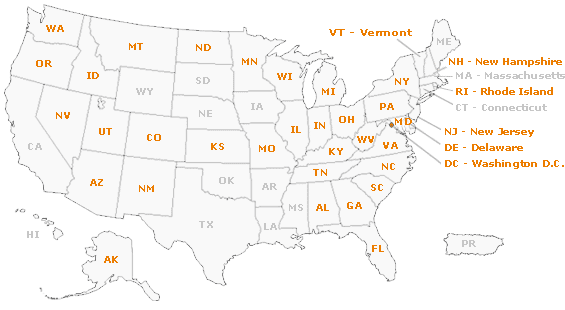
Looking for ideas of how to enhance your work zone policy and guidance? Interested in what other States are doing in this area? Visit the Policy library a compendium of online State Work Zone Safety and Mobility policies and guidance that were developed to meet the requirements of 23 CFR 630 Subparts J and K.
The development and implementation of an overall, agency-level work zone safety and mobility policy is at the heart of the entire Work Zone Safety and Mobility Rule. A work zone safety and mobility policy supports systematic consideration of work zone impacts across all stages of project development and helps agencies address the safety and mobility needs of road users and workers. Having such a policy enables states and other transportation agencies to institutionalize planning, design, and operational strategies that help reduce congestion and crashes due to work zones. More information about work zone safety and mobility policies can be found in Implementing the Rule on Work Zone Safety and Mobility.
The examples provided below are intended to assist agencies in developing or updating their work zone policies. These examples are not the only way to develop and implement policies, and are not meant to advocate a "one size fits all" approach.
Work Zone Safety and Mobility Policies
Work Zone Safety and Mobility Policy Library
This library is a compendium of online State Work Zone Safety and Mobility policies and guidance that were developed to meet the requirements of 23 CFR 630 Subparts J and K. The documents in this library are meant to serve as references for state agencies who want to see what other states are doing or may be looking for ideas of how to enhance their own work zone policy and guidance.
Maryland State Highway Administration
The Maryland SHA Work Zone Policy (PDF 50KB) outlines procedures and identifies responsibilities to achieve safer work zones with minimal impact on the traveling public. The policy applies to all work performed on SHA-maintained roads. The policy describes the fundamentals of work zone safety and mobility, requirements for compliance with the policy, and roles and responsibilities of those implementing the policy. It also includes guidance on identifying significant projects and performing Maintenance of Traffic Alternative Analysis, guidelines for transportation management plans and work zone lane closure analysis, a sample temporary traffic control inspection form and work zone traffic control annual inspection report, and the Maryland Work Zone Accidents Comparison report. Many of these items are described further on the appropriate Rule examples pages within this Web site.
Michigan Department of Transportation
The Michigan DOT (MDOT) Work Zone Safety and Mobility Policy (HTML, PDF 44KB) applies to all state trunklines, regardless of the type of roadway or bridge facility, to both construction work zones and maintenance and permitted activity work zones. MDOT analyzes each type of work zone in the same manner to provide consistency for travelers in Michigan. Specific processes, procedures, and guidelines to support implementation of the policy are described in MDOT's Work Zone Safety and Mobility Manual (PDF 708KB). The manual describes roles and responsibilities, crash data analysis, mobility analysis, TMP development, significant project identification, work zone training requirements by classification, and work zone process review procedures.
Montana Department of Transportation
The Montana DOT(MDT) Work Zone Safety and Mobility Policy (PDF 536KB) was developed to improve safety and mobility in work zones by evaluating construction zone issues and impacts throughout planning and project development, managing construction zones during construction and maintenance operations, and assessing the process for continual improvement and uniformity throughout Montana. The policy, which was developed by a task force of representatives from MDT and FHWA, includes procedures and guidelines for implementation. It also includes eight appendices that cover various elements of the policy in more detail, such as process review guidelines and guidance on defining significant projects training, transportation management plans (TMP), public information, transportation operations, and work zone crash data, as well as strategies for managing work zone impacts.
New York State Department of Transportation
Chapter 16 of the New York State DOT (NYSDOT) Highway Design Manual contains NYSDOT's Policy on the Maintenance and Protection of Traffic in Highway Work Zones. This chapter also contains procedures, guidance, and standards to help implement NYSDOT's policy. The policy includes NYSDOT's overall vision for work zone safety and mobility and its goals and objectives for construction projects. Chapter 16 also includes policy provisions such as guidelines and standards to assist designers in the consistent use of traffic control devices and safety devices and barriers on construction contracts and maintenance operations. It also provides guidance and procedures for the development of Maintenance and Protection of Traffic plans and the selection of traffic management strategies for various project types and situations.
North Carolina Department of Transportation
The North Carolina DOT (NCDOT) Work Zone Safety and Mobility Policy (PDF 448KB) includes a policy statement, goals and objectives, and guidelines for implementation.. Additional specifics for the guidelines are contained in NCDOT Guidelines for Implementation of the Work Zone Safety and Mobility Policy (PDF 134KB). The guidelines include strategies to achieve the goals and objectives, the roles and responsibilities of NCDOT staff, and specific provisions for application during planning, design, construction, and maintenance. Also included is an assessment component to ensure the requirements are effective and the work zone strategy practices and procedures are continuously reviewed.
North Dakota Department of Transportation
The North Dakota DOT (NDDOT) Work Zone Safety and Mobility Policy and Procedures (PDF 420KB) were developed by a task force of personnel from the Design, Planning and Programming, and Construction Services divisions of NDDOT, representatives of several local governments, and a representative from the FHWA North Dakota Division. The document describes the requirements of the Rule, implementation guidance, NDDOT implementation procedures, and how the Rule applies to significant and non-significant projects.
Ohio Department of Transportation
The Ohio DOT (ODOT) Traffic Management in Work Zones Interstate and Other Freeways, Policy No.: 516-003(P) (PDF 128KB) sets limitations on the number of lanes that may be closed for construction activities on freeways and "freeway look-alikes" (other highways that are similar to freeways). The policy defines how many lanes are required to remain open for each segment of an interstate or an interstate look-alike on an hourly basis, based upon needed capacity. The policy also provides for allowable queue thresholds. The ODOT Traffic Management in Work Zones - web page provides a number of other Ohio DOT resources for managing traffic in work zones.
Utah Department of Transportation
The Utah DOT (UDOT) Work Zone Policy and Procedures document (PDF 60KB) contains a short policy statement and the procedures for implementing the policy, indicating the position title responsible for implementing each section of the Rule and the actions needed to implement each section. The document also provides guidelines on general traffic control, full road closure, permits, and traffic modeling, as well as a work zone user impact process flow diagram.
Washington State Department of Transportation
The Washington State DOT (WSDOT) work zone policy (PDF 99KB) is based on a belief that, "effective work zone safety and mobility strategies minimize traffic delays and provide a safe environment in which to work and drive" (as stated in the Policy Purpose Statement). Developed through the collaborative efforts of the WSDOT Development Team, the Work Zone Safety Task Force, Program Managers and the Communications Office, the policy is a four page document that describes WSDOT's overall purpose/approach to work zone management, why WSDOT needs this policy, and what it is intended to do. It then identifies the primary responsibilities of the five program areas that have work zone responsibilities. The intent of the policy is not to provide the details of processes, procedures, and solutions, but to establish roles and expectations for the identified program areas. In this way, WSDOT is not introducing the Rule as a new program or process, but is building it into the existing WSDOT program structure. WSDOT feels that by providing a clear understanding of expectations, the policy allows for greater communication and cooperation from all groups affected by the Rule. A presentation given during a 2007 National Operations Transportation Coalition webinar further describes WSDOT's Rule implementation process and policy (PPT 39KB).
Lane Closure Policies
Many agencies have policy provisions that address specific aspects of decision-making during project delivery. Agencies may choose to develop and implement policy provisions in the form of mandated requirements and/or in the form of policy guidance, as appropriate to their individual operating environments. Several States have policy provisions for lane closures. These lane closure policies, or strategies, provide guidance in determining permitted lane closure times, which define what times of the day, week, or season a lane closure is allowed on a facility and at a specific location or segment.
You will need the Adobe Reader to view the PDFs on this page.
To view PPT files, you need the Microsoft PowerPoint Viewer.